










Sanchay Finvest reviewer flags unverified balance evidence
Key highlights
- The reviewer could not determine the possible financial-result effect of missing balance confirmations and reconciliations at September 30, 2026.
- Sanchay Finvest reported total assets of Rs 6.04 crore at September 30, 2026, up from Rs 2.31 crore at March 31, 2026.
- Profit before tax was Rs 0.97 lakh for the September 2026 quarter, versus losses of Rs 35.92 lakh in June 2026 and Rs 26.39 lakh a year earlier.
- Sanchay Finvest received Rs 4.85 crore through an April 2026 preferential allotment of 48.50 lakh equity shares.
powered by IRIS
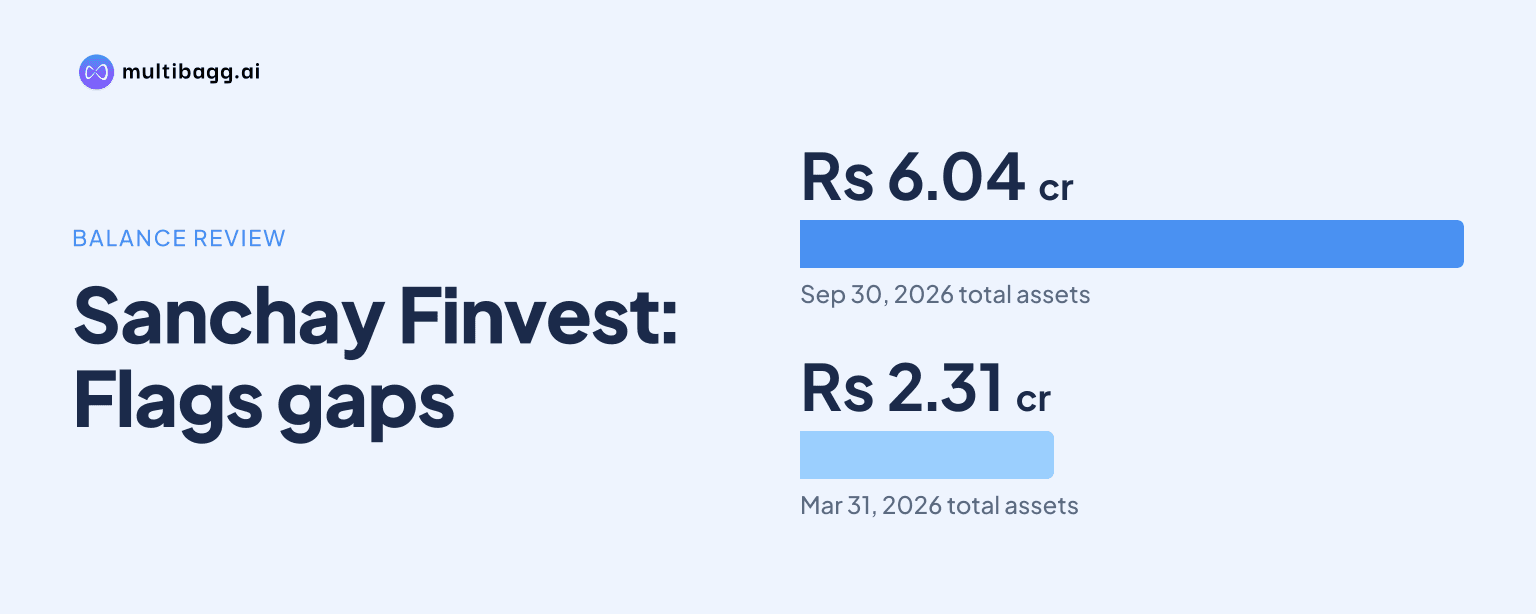
For the quarter and half year ended September 30, 2026, Sanchay Finvest Limited’s reviewer said it could not determine the possible effect on financial results because evidence for balance confirmations and reconciliations was insufficient. The reviewer also could not verify management’s classification of trade payables, while Sanchay Finvest reported total assets of Rs 6.04 crore.
Know Sanchay Finvest inside out
Results, valuation, peers and who's buying, in one view.
What did Sanchay Finvest’s reviewer find on balance confirmations?
Sanchay Finvest did not have an appropriate system to obtain confirmations and perform reconciliations for deposits, advances and other receivables and payables, according to the limited-review report dated November 14, 2026. Jain Jagawat Kamdar & Co. said that, because sufficient appropriate audit evidence was unavailable, it could not determine the possible impact, if any, on the September 30, 2026 financial results.
The finding is an evidence limitation, not a quantified adjustment to the reported accounts. The reviewer conducted the work under Standard on Review Engagement 2410, which it described as relying principally on inquiries of company personnel and analytical procedures and providing less assurance than an audit. It did not perform an audit or express an audit opinion for the quarter and half year ended September 30, 2026.
The reported balance sheet shows growth in the areas covered by the concern. Sanchay Finvest’s total assets rose to Rs 6.04 crore at September 30, 2026 from Rs 2.31 crore at March 31, 2026, while current assets increased to Rs 4.82 crore from Rs 1.04 crore. Trade receivables were Rs 8.60 lakh at September 30, compared with nil six months earlier, and other financial assets were Rs 15.00 lakh against Rs 8.60 lakh.
Why could Sanchay Finvest’s payable classifications not be verified?
Sanchay Finvest’s trade payables were divided into micro, small and medium enterprise, or MSME, and other creditors, then identified as disputed or undisputed solely on management’s assessment, the reviewer said. It said no audit evidence supported those classifications, preventing it from commenting on their accuracy, completeness, or potential effect on liabilities and related disclosures.
Sanchay Finvest said it was compiling supplier information to establish coverage under the Micro, Small and Medium Enterprises Development Act, 2006. The company said its disclosures were made only to the extent information was available in its books and that any interest potentially payable under the law was not expected to be material. The reviewer’s September 30, 2026 finding nonetheless states that evidence supporting the classifications was not provided.
Reported trade payables to micro and small enterprises were Rs 4.02 lakh at September 30, 2026, compared with Rs 5.05 lakh at March 31, 2026. Total current liabilities were Rs 5.27 lakh at September 30, down from Rs 81.97 lakh at March 31. The filing does not quantify what amount, if any, could change after confirmations, reconciliations, or supporting documentation are obtained.
The report says its opinion was not modified in respect of the matters described in the emphasis-of-matter section. That wording does not mean the classifications were verified; it means the reviewer separately identified the absence of supporting evidence while retaining its stated limited-review conclusion for the September 2026 results.
Got a follow-up? Ask IRIS
How did Sanchay Finvest’s September results compare with earlier periods?
Sanchay Finvest reported profit before tax of Rs 0.97 lakh for the quarter ended September 30, 2026, compared with losses before tax of Rs 35.92 lakh in the preceding June 2026 quarter and Rs 26.39 lakh in the September 2025 quarter. For the half year ended September 30, 2026, loss before tax narrowed to Rs 34.95 lakh from Rs 62.52 lakh a year earlier.
The quarterly result improved even as total expenses increased to Rs 35.60 lakh from Rs 22.71 lakh in June 2026 and Rs 7.21 lakh in September 2025. Total revenue was Rs 37.04 lakh in the September 2026 quarter, against negative Rs 16.91 lakh in the June quarter and Rs 4.78 lakh a year earlier. These are reported figures and do not resolve the reviewer’s stated inability to assess the possible effect of unreconciled balances.
Sanchay Finvest reported one operating segment, share broking and trading in shares and securities, for the September 2026 period. Its activities were restricted to India, so it made no separate geographical segment disclosure under Indian Accounting Standard 108. The filing therefore provides no segment-level split that could identify whether the reconciliation issue is concentrated in a particular business line.
What other September 2026 events did Sanchay Finvest disclose?
Sanchay Finvest redeemed promoter-held 12% redeemable non-cumulative preference shares during the September 2026 quarter by paying Rs 47.00 lakh for their liability component. The shares had fallen due for redemption in October 2024. The company transferred the associated Rs 4.29 lakh equity component to retained earnings within other equity.
Sanchay Finvest also disclosed that a National Stock Exchange financial status report showed Rs 28.39 lakh of dues at March 31, 2026. Following an updated report and reconciliation, Rs 3.69 lakh was reversed or adjusted. The company paid Rs 22.50 lakh on May 6, 2026, after receiving a National Stock Exchange notice dated May 4, 2026, and said the dues were adjusted in its accounts using the latest report and payment information.
In April 2026, Sanchay Finvest completed a preferential allotment of 48.50 lakh equity shares, with a face value of Rs 10 each, to non-promoter investors. It received Rs 4.85 crore, comprising Rs 1.50 crore on April 18 and Rs 3.35 crore on April 20. Paid-up equity share capital rose to Rs 8.00 crore at September 30, 2026 from Rs 3.15 crore at March 31, 2026.
On November 14, 2026, the board took note of Jain Jagawat Kamdar & Co.’s resignation as statutory auditor after it issued the September 2026 limited-review report. The board approved S K B J P & Co. as proposed statutory auditor to fill the casual vacancy, subject to shareholder approval under Section 139(8) of the Companies Act, 2013.
Conclusion
The September 2026 filing shows a reported return to quarterly profit before tax of Rs 0.97 lakh, but it also records two unresolved evidence issues. Sanchay Finvest’s reviewer could not determine the potential effect of missing balance confirmations and reconciliations, and could not substantiate management’s classifications of trade payables into MSME, other, disputed and undisputed categories.
The next disclosed matter to watch is shareholder approval for S K B J P & Co. following the November 14, 2026 auditor resignation. Sanchay Finvest is also compiling supplier information under the MSME law, while the reviewer’s finding points to the need for a system to obtain confirmations and reconcile deposits, advances, receivables and payables.