










Sarda Energy & Minerals Reports Record H1 EBITDA of ₹1,326 Crore
Key highlights
- Sarda Energy & Minerals reported record H1 FY27 EBITDA of ₹1,326 crore, up about 4% year on year.
- H1 FY27 profit after tax rose about 5% to ₹798.62 crore, while cash profit was ₹1,225 crore.
- Q2 FY27 EBITDA was ₹564 crore after a 47-day shutdown of a 300 MW thermal unit.
- SEML plans growth capital expenditure exceeding ₹10,000 crore and expects Avagudam manganese-block operations in 12 to 14 months.
powered by IRIS
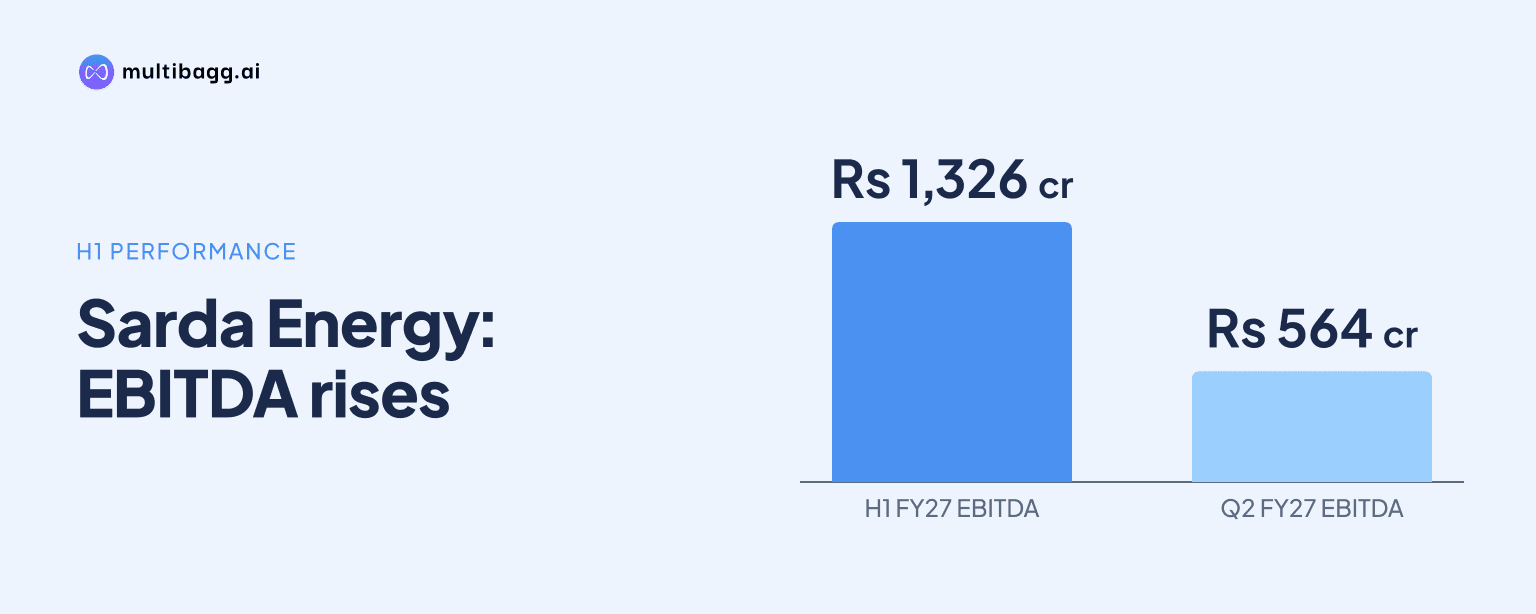
Sarda Energy & Minerals Limited reported record H1 FY27 EBITDA of ₹1,326 crore, up about 4% year on year, while profit after tax rose about 5% to ₹799 crore despite planned maintenance shutdowns, operational outages and flooding at mining facilities during the monsoon.
Know Sarda Energy & Minerals inside out
Results, valuation, peers and who's buying, in one view.
What drove Sarda Energy & Minerals' record H1 FY27 earnings?
Sarda Energy & Minerals Limited, referred to as SEML, closed the first half of FY27 with its highest-ever half-yearly EBITDA, supported by its integrated energy, mining and metals operations. Total income for H1 FY27 stood at ₹3,221 crore, while cash profit reached ₹1,225 crore. Management said the result reflected the resilience of its underlying businesses despite operating interruptions during the period.
Energy remained the principal earnings contributor. According to the earnings-call summary, the energy business accounted for more than 75% of H1 EBITDA. SEML said record pellet production also demonstrated the operating capacity of its assets, while its mining initiatives could support further integration over time.
The company reported H1 revenue from operations of ₹3,060.88 crore, compared with ₹3,160.89 crore in the corresponding period a year earlier. Even with lower revenue from operations, profit after tax increased to ₹798.62 crore from ₹764.42 crore. The figures point to the importance of business mix and operating performance in the half-year result.
How did maintenance and monsoon conditions affect Q2 FY27?
SEML reported Q2 FY27 EBITDA of ₹564 crore and profit after tax of ₹320 crore on total income of ₹1,505 crore. Q2 EBITDA was down about 3% year on year, according to the earnings-call material, as planned maintenance and operational disruptions affected output during the quarter.
A 300 MW unit at the company’s 600 MW thermal power plant was shut for planned maintenance for 47 days. SEML also replaced a 30 MW turbine at its steel plant, with that unit resuming operations in August 2026. Management said it recalibrated captive power operations in response to market conditions to optimise its portfolio mix.
Mining operations in India were also affected by heavy monsoon rainfall. Managing Director Pankaj Sarda said mining facilities were flooded during the period. These disruptions provide context for the lower quarterly EBITDA, even as the company maintained record profitability for the first half.
The company said no shutdown is expected at the SKS thermal operation in H2 FY27. SKS thermal generation reached 202 crore units in H1, and SEML expects full-year generation to exceed 420 crore units. Management also indicated that thermal generation and profitability are expected to improve in the second half, while hydropower profitability is expected to be seasonally lower.
Got a follow-up? Ask IRIS
What are SEML's mining and power expansion plans?
SEML said it has secured preferred bidder status for the Avagudam manganese block in Andhra Pradesh, marking its entry into manganese mining. Management expects operations at the block to begin in approximately 12 to 14 months, subject to the steps required before production can start.
The company has outlined plans to quadruple mining capacity and double energy-generation capacity. Management linked these investments to India’s industrial and energy requirements and said it remains focused on execution while maintaining financial discipline and a strong balance sheet.
The medium-term target is to double EBITDA from the FY26 base. Planned growth capital expenditure exceeds ₹10,000 crore and is focused on energy and mining assets that management described as high-return opportunities. The transcript does not provide a project-wise spending schedule or a firm completion date for the overall expansion programme.
SEML operates as an integrated energy, mining and metals company, with thermal and hydropower assets, coal and iron-ore mines, steel-product facilities, and ferro-alloy plants across India and Indonesia. This operating structure connects resource access, power generation and downstream production, although the earnings call did not quantify the financial contribution of each business beyond the energy segment’s share of H1 EBITDA.
How do India's power-market conditions matter for SEML?
India’s expanding electricity demand remains relevant for SEML because energy is its largest earnings contributor. During the quarter, national power generation increased 11% year on year to around 536 billion units, while peak demand rose 18% to 270 GW, a new second-quarter high, according to management’s comments on the call.
SEML said the addition of renewable capacity does not remove the need for dependable generation at different hours of the day. Its thermal generation assets therefore remain central to the company’s operating portfolio, particularly when power-market conditions support the flexibility to optimise captive and external generation decisions.
For investors, the H1 result shows that the energy business remained the key contributor while maintenance outages and weather-related mining disruptions constrained Q2. The expected absence of an SKS thermal shutdown in H2 and the company’s generation target are operational markers disclosed by management, rather than guarantees of future earnings.
The wider mining expansion is also significant because it could add resource capacity to SEML’s integrated model. However, the Avagudam project is not expected to commence operations for 12 to 14 months, and the company has not disclosed financial projections for the block in the material provided.
Conclusion
SEML delivered record H1 FY27 EBITDA of ₹1,326 crore and profit after tax of about ₹799 crore despite maintenance shutdowns, a steel-plant turbine replacement and monsoon-related flooding at Indian mining facilities. Energy contributed more than 75% of H1 EBITDA, underscoring its central role in the company’s earnings profile.
The next disclosures to watch are H2 thermal generation, including progress towards more than 420 crore units for FY27, and execution of the planned growth capital expenditure exceeding ₹10,000 crore. Investors will also track the expected 12-to-14-month timeline for the Avagudam manganese block and the company’s stated target of doubling EBITDA from the FY26 base.