










SEML says 300-MW overhaul supports higher full-year SKS output
Key highlights
- SEML said one 300-megawatt SKS unit was shut while the other 300-megawatt unit operated at full capacity.
- Management expects full-year SKS generation to exceed last year’s level after the maintenance work.
- SEML said no normal SKS shutdown is required in the current quarter or the following quarter.
- Thermal power realisation was about Rs 5.30 per unit, and 60% of saleable thermal capacity is tied up.
powered by IRIS
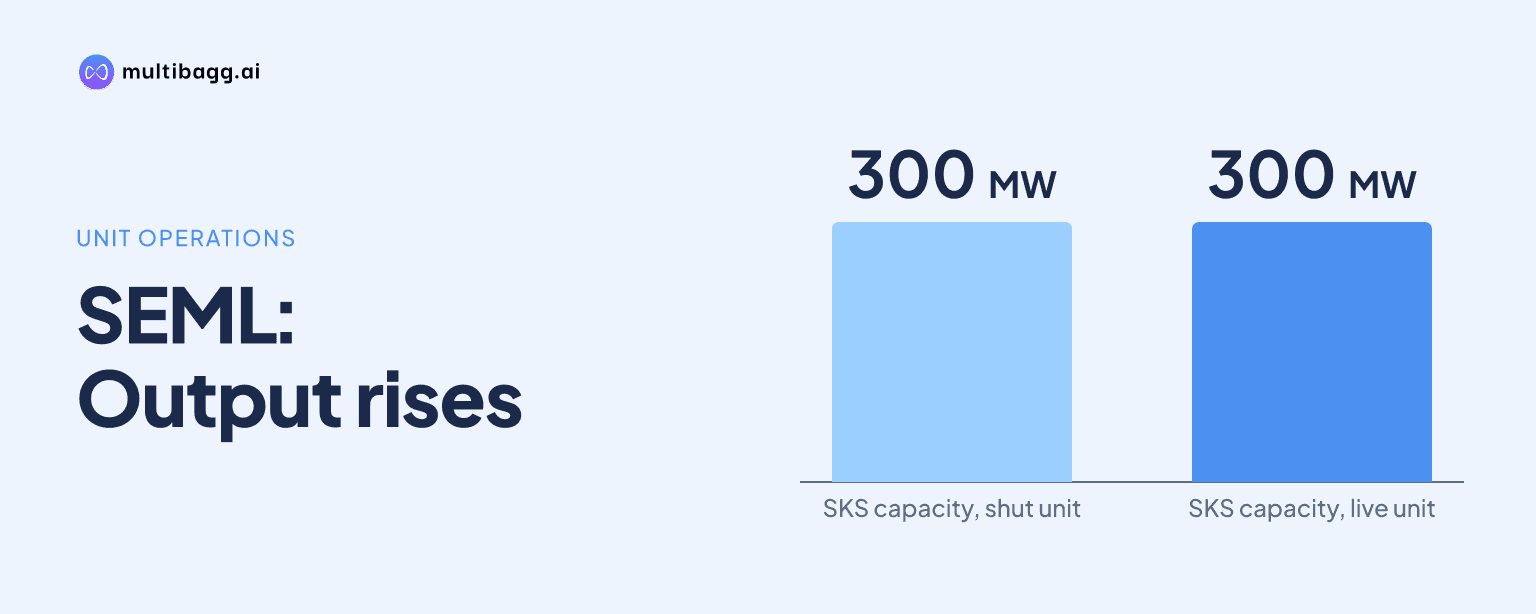
In FY27, Sarda Energy & Minerals Limited expects SKS generation to exceed last year’s level after maintenance on one 300-megawatt unit, which an investor described as a 47-day outage. Management said the other 300-megawatt unit remained at full capacity and no normal shutdown is required in the current or next quarter.
Know Sarda Energy & Minerals inside out
Results, valuation, peers and who's buying, in one view.
Why did SEML take an SKS unit offline?
SEML said SKS has two generating units of 300 megawatts each, and it normally takes one unit offline for maintenance in alternate years. Padam Jain said one unit was shut last year and the other was shut in FY27, making the work part of the plant’s regular maintenance cycle rather than an additional shutdown of the entire 600-megawatt site.
An investor described the FY27 outage as lasting 47 days and questioned why a 600-megawatt plant was shown in the company material. Pankaj Sarda clarified that only one 300-megawatt unit was closed, while the second 300-megawatt unit operated at full capacity. Jain said a standard maintenance outage generally lasts 30 to 40 days, depending on the condition of the individual unit.
The distinction means availability fell at one-half of the 600-megawatt site, rather than across its full capacity. The investor said generation was about 200 million units below an expected level despite the outage, but SEML did not independently disclose the expected-generation benchmark, a revenue loss, or an EBITDA impact from the 47-day period.
Will SEML generate more power than last year?
SEML expects full-year SKS generation to exceed last year’s level, despite the quarterly effect of the 300-megawatt maintenance outage. Jain said the shutdown affected the quarter but would not prevent annual generation from surpassing the prior year, because the completed work would improve the unit’s generation capacity.
Management did not provide the prior year’s generation, an FY27 generation target, or a target above 420 crore units in the supplied discussion. Its statement was directional rather than numerical: output for the full year is expected to be higher than last year, but the size of that increase cannot be calculated from the call transcript.
SEML also said it would not require another shutdown in the current quarter or the following quarter in the normal course of operations. That statement covers the remaining H2 FY27 period and contrasts with the lower first-half utilisation at the independent power producer, or IPP, thermal plant, where the 300-megawatt maintenance programme reduced availability.
The second-half outlook differs across energy segments. In response to an analyst question, Jain said thermal profitability should be substantially higher in H2 FY27 because of improved market conditions and higher generation, while hydropower profitability should be lower because of seasonal conditions. Energy accounted for more than 75% of SEML’s H1 EBITDA, or earnings before interest, tax, depreciation and amortisation.
Got a follow-up? Ask IRIS
What did the SKS outage do to SEML’s quarterly performance?
SEML confirmed that the maintenance of one 300-megawatt unit affected the quarter, but it did not quantify the effect on revenue, EBITDA or profit. Management instead described the outage as a temporary reduction in thermal availability that should support higher generation for the full year after the maintenance work was completed.
The call provides power-price context but not an SKS-specific margin calculation. SEML reported thermal power realisation of about Rs 5.30 per unit in the quarter, while hydropower realisation was above Rs 6 per unit. These are sales realisations, and the transcript does not disclose SKS fuel cost, operating cost or profit per unit.
The hydro and thermal figures should therefore not be treated as a comparison of segment profitability. Management expects hydro profitability to decline in H2 FY27 because of seasonal conditions, even though reported hydro realisation was above Rs 6 per unit in the quarter. Thermal earnings, in contrast, are expected by management to benefit from higher generation and better market conditions.
The FY27 maintenance schedule also differs only by unit from the previous year. SEML said one 300-megawatt unit was maintained last year and the other 300-megawatt unit was maintained this year. Management’s expectation that full-year generation will rise depends on the completed work improving the availability of the unit maintained in FY27.
What supports SEML’s thermal outlook for H2 FY27?
SEML expects H2 FY27 thermal performance to improve through higher plant utilisation and better market conditions. Jain said capacity utilisation at the IPP thermal plant was lower in the first half and should improve in the second half after the maintenance programme, while other plants, including iron ore pellet and sponge iron operations, should remain broadly in line with earlier levels.
SEML has tied up 60% of its saleable thermal power capacity, management said. The company did not disclose the counterparty names, contracted volume, duration or tariff for that 60%, so the earnings contribution of contracted capacity cannot be calculated. Management nevertheless said second-half power prices should be better than first-half levels because the demand scenario had changed.
Management cited India’s quarterly power-generation growth of 11% year on year to about 536 billion units and an 18% increase in peak demand to 270 gigawatts. It also said solar generation rose 39% year on year during the quarter. SEML presented these figures as support for dependable generation across different hours, alongside rising renewable capacity.
Fuel sourcing is a further factor in the thermal outlook. SEML said it meets part of its coal requirement from captive coal mines, providing some insulation from higher imported-coal logistics costs. Management did not quantify the captive share, but it said bulk freight for a 50,000-ton vessel had risen to about Rs 36 to Rs 38 per US dollar equivalent, from a usual range of about Rs 18 to Rs 22 per US dollar equivalent.
Conclusion
SEML’s stated position is that the 47-day outage concerned one 300-megawatt unit, not all 600 megawatts of SKS capacity. The maintenance reduced quarterly availability, but management expects the completed work, higher H2 FY27 utilisation and improved thermal market conditions to lift full-year generation above last year’s level. The supplied call does not support a specific annual target of more than 420 crore units.
The next operational test is whether SKS runs without a normal shutdown through the current and following quarter, as management expects. Investors can also watch whether higher H2 FY27 generation coincides with better power prices than the Rs 5.30-per-unit thermal realisation reported for the quarter, while 60% of saleable thermal capacity remains tied up.