










Sasken Sets $12m-$14m Revenue Threshold for 10%-12% EBITDA
Key highlights
- Sasken said product solutions needs $12 million-$14 million of quarterly revenue for 10%-12% EBITDA margin.
- Sasken currently runs product solutions at about $7 million-$8 million per quarter.
- Management is working to secure almost 90%-95% of memory required for FY2027.
- Sasken disclosed a $47 million order book, including about $33 million of software services and roughly $14 million of product solutions.
powered by IRIS
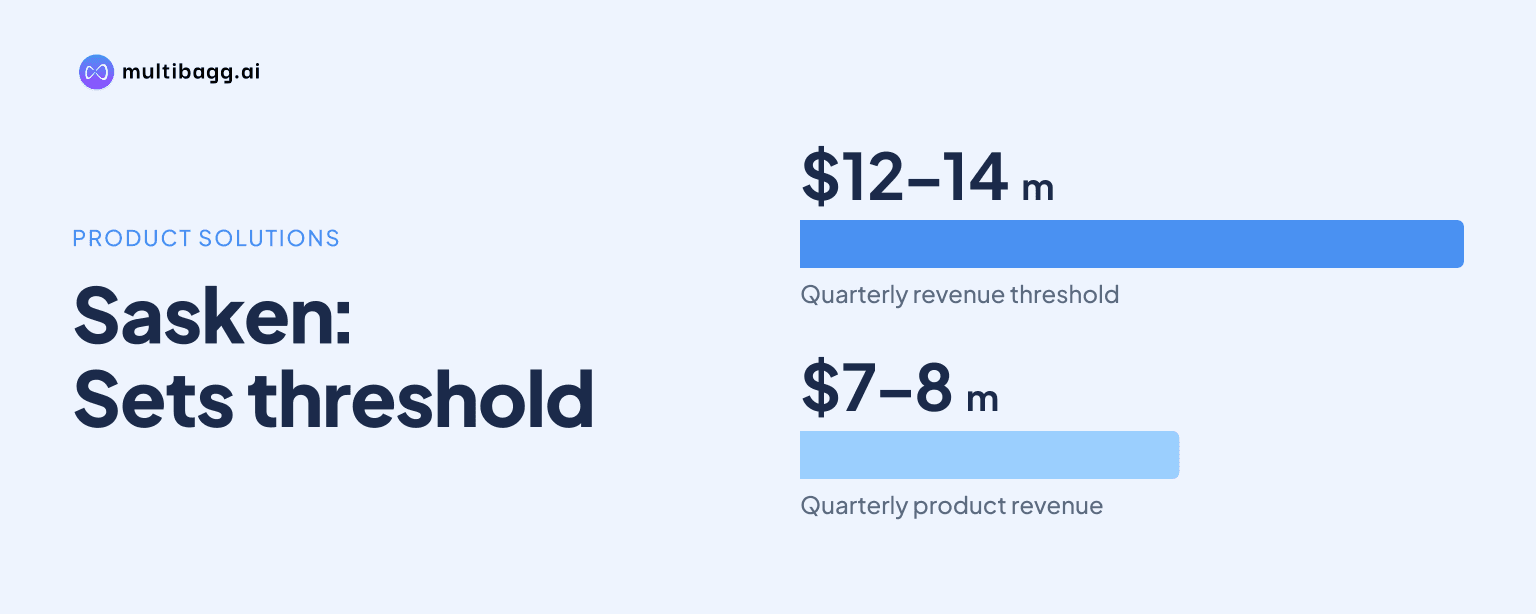
Sasken said product solutions can begin delivering EBITDA, or earnings before interest, tax, depreciation and amortisation, margins of 10%-12% when quarterly revenue reaches about $12 million-$14 million, compared with its current $7 million-$8 million quarterly run rate. Management said shipment volumes, overhead absorption and memory availability still make current product margins variable.
Know Sasken Technologies inside out
Results, valuation, peers and who's buying, in one view.
What revenue does Sasken need for 10%-12% product EBITDA margin?
Sasken needs product-solutions revenue of approximately $12 million-$14 million per quarter before it starts seeing EBITDA margins of about 10%-12%, management said. The segment is currently running at about $7 million-$8 million per quarter, leaving a gap of about $4 million-$7 million to the stated revenue range.
Rajiv Mody also referred to an annual run rate of about $60 million when discussing the scale required for product margins. Priyaranjan clarified that the measure was EBITDA margin, rather than EBIT, or earnings before interest and tax. Sasken did not disclose a timetable for reaching the quarterly revenue threshold or the segment's current EBITDA margin.
The $12 million-$14 million range is management's view of a more mature product-solutions business, not revenue guidance for FY2027, or fiscal year 2027. Management did not provide an FY2027 product-revenue forecast in response to the question on memory shortages and product-segment growth.
Why are Sasken product-solutions margins volatile each quarter?
Sasken said product-solutions margins are volatile because shipment volumes affect the absorption of overhead costs. Management said software-services margins can be assessed quarter to quarter, while product solutions require a longer view because a change in shipping volume can materially alter a quarter's margin.
The product-solutions business provides turnkey work from concept and design through manufacturing, deployment, warranty and maintenance support. Sasken said it receives purchase orders for that lifecycle but uses third-party electronics manufacturing services providers for manufacturing. Component supply, execution and shipped volumes can therefore affect reported margins.
Memory is a crucial, high-demand product component, according to management. Sasken said it was working with semiconductor manufacturers to secure almost 90%-95% of its memory requirement for FY2027 through supplier engagement, customer support, other partners and open-market purchases.
Sasken has also moved from DDR5 to DDR4 memory in most cases and reduced memory configurations in some products to manage device cost. Management said DDR4 availability helped it obtain larger orders, but said the business needs time to work through memory challenges before product margins stabilise.
What improved Sasken product margins in Q2?
Sasken said Q2 product-margin improvement primarily reflected operational efficiencies, recovery from silicon-segment execution issues in the preceding quarter and slowly improving volumes. Management said the resolved execution issues should continue to support results, while higher volumes should improve overhead absorption.
The company did not quantify the product-solutions margin increase in Q2. It differentiated the product improvement from software-services margin drivers: product solutions benefited from silicon execution and volumes, while services benefited from project staffing, ownership-led delivery, lower bench costs and operating leverage.
Exchange rates accounted for about 0.5% of quarter-on-quarter margin improvement, management said. Priyaranjan described currency movement as dependent on the overall economy, meaning it was not presented as a recurring operating-efficiency driver for product solutions.
The period comparison is therefore qualitative. The prior quarter included silicon-execution challenges, whereas Q2 benefited from their recovery and better volumes; however, Sasken still said shipping volumes can shift product margins before the business reaches $12 million-$14 million of quarterly revenue.
Got a follow-up? Ask IRIS
How does Sasken's software-services margin path differ?
Sasken said software-services margins have improved consistently over the last five to six quarters and can be measured more reliably quarter to quarter than product margins. Management attributed the trend to a shift toward ownership-driven work and efforts to build non-headcount, non-linear revenue.
Software-services revenue grew 15% quarter on quarter in Q2, according to Rajiv Mody, as multiple programmes ramped at the same time. Management said two large deal wins, bench planning and capability-engine training enabled a faster staffing ramp. Mody said growth should moderate to sustained single digits for the foreseeable future while remaining above the industry average for mid-tier or small-tier companies.
Product solutions, by contrast, can scale faster after a product win because it is non-headcount driven, management said. That characteristic can improve fixed-cost absorption when shipments rise, but it also makes a single quarter less representative when shipment patterns change.
What does Sasken's order book indicate about product scale?
Sasken disclosed a $47 million order book comprising about $33 million of software services and roughly $14 million of product solutions. Priyaranjan corrected an earlier statement that had put the software-services portion at $38 million, making $33 million the applicable services figure from the call.
The roughly $14 million product-solutions order book is not a forecast of quarterly revenue or a timetable for reaching the $12 million-$14 million quarterly scale target. Management said about 90%-95% of second-half revenue was tied up through signed orders and that it was continuing to pursue additional business in Q3 and Q4.
Sasken said the European telematics, cockpit advanced driver-assistance systems and cellular system-on-chip intellectual-property programmes began recognising revenue in Q2 and reached full ramp-up on October 1, 2026. It also said it does not yet earn royalties from intellectual property, as royalty income requires customers to complete design, manufacturing and product sales over multiple years.
Conclusion
Sasken has set a defined scale marker for product solutions: management expects 10%-12% EBITDA margins only after quarterly revenue rises from the current $7 million-$8 million run rate to about $12 million-$14 million. Q2 margin improvement reflected recovered silicon execution and improving volumes, but shipment-related overhead absorption and memory supply still make the segment less predictable than software services.
The next indicators are product shipment volumes, progress toward securing almost 90%-95% of FY2027 memory needs and conversion of the roughly $14 million product-solutions order book into revenue. Management is also pursuing its $240 million revenue objective through organic and inorganic means and said the target may be delayed by about 12 months.