










Sasken Q2 EBIT margin rose 250 bps despite revenue decline
Key highlights
- Sasken’s Q2 FY27 EBIT margin increased 250 basis points sequentially to 8.9%.
- Sasken reported Q2 FY27 consolidated revenue of Rs 321 crore, down 5.4% sequentially and up 25.6% year on year.
- Software-services revenue rose 14.6% sequentially to Rs 252 crore, while product-solutions revenue fell 42% to Rs 69 crore.
- Sasken signed US$47 million of total contract value in Q2 FY27, up 66% year on year.
powered by IRIS
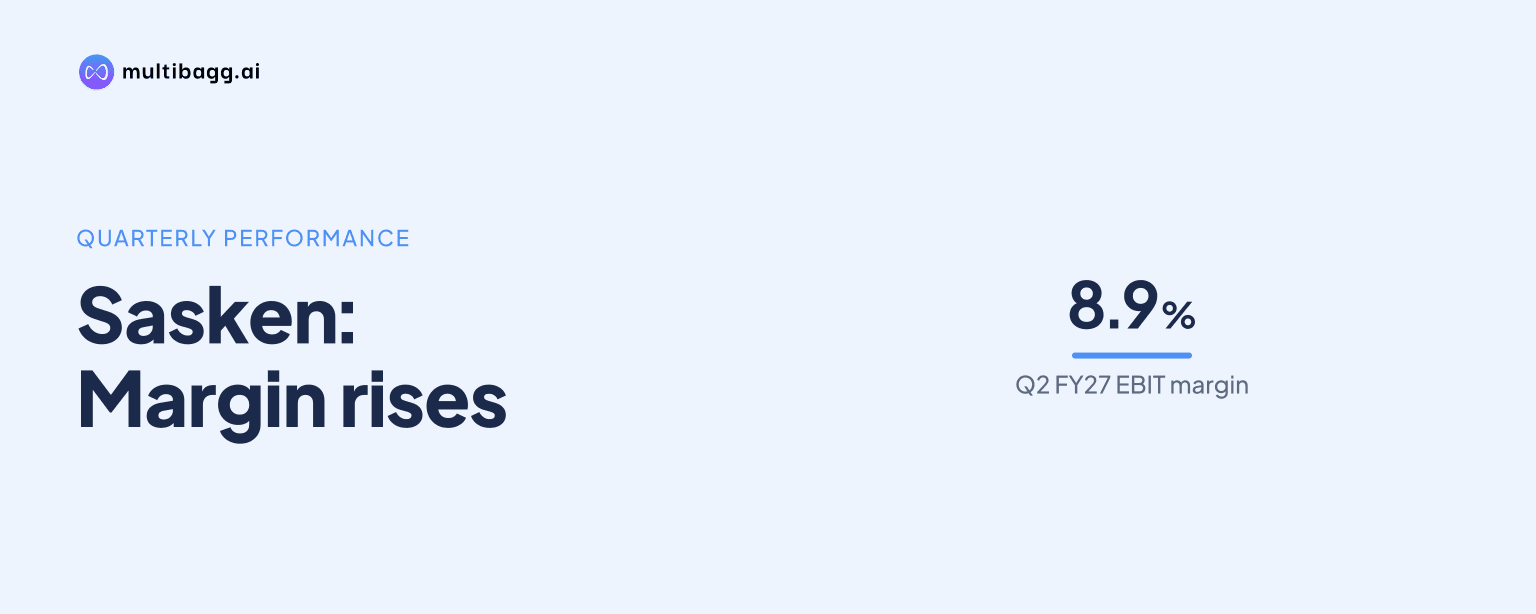
In Q2 FY27, Sasken reported an EBIT margin of 8.9%, up 250 basis points from Q1, although consolidated revenue fell 5.4% sequentially to Rs 321 crore, as favourable business mix, 86% utilisation, operating efficiencies and exchange-rate gains lifted profitability despite July salary revisions and lower product-solutions shipments.
Know Sasken Technologies inside out
Results, valuation, peers and who's buying, in one view.
Why did Sasken’s EBIT margin rise while revenue declined?
Sasken’s EBIT, or earnings before interest and tax, margin rose because delivery and cost improvements more than offset the sequential revenue decline. Q2 FY27 gross margin was 26.8%, or Rs 86 crore, about 490 basis points higher than the preceding quarter, with management attributing the change to business mix, utilisation, operating efficiencies and exchange-rate gains.
The company implemented annual salary revisions across levels in July, yet earnings before interest, tax, depreciation and amortisation, or EBITDA, reached Rs 41 crore in Q2. EBITDA margin was 12.9%, up 330 basis points sequentially and 700 basis points year on year, while profit after tax was Rs 26 crore, representing an 8% margin.
For the first half ended September 30, 2026, Sasken reported EBITDA margin of 11.2%, EBIT margin of 7.6% and profit-after-tax margin of 7.4%. The Q2 EBIT margin of 8.9% was therefore above the first-half level, while the quarter’s revenue result reflected substantially different movements in software services and product solutions.
What caused Sasken’s Q2 revenue decline?
Sasken’s consolidated revenue decline came from a 42% sequential fall in product-solutions revenue, which outweighed 14.6% sequential growth in software services. Q2 consolidated revenue was Rs 321 crore, up 25.6% year on year, while first-half revenue reached Rs 660 crore, up 24.8% from the comparable prior-year period.
Software services generated Rs 252 crore in Q2, rising 34% year on year as multiple customer programmes ramped up. Product solutions generated Rs 69 crore, up 2.4% year on year but lower sequentially because memory availability and component-pricing pressures affected shipment volumes.
Management said software services is best assessed quarterly because it depends on engineering engagements, customer spending cycles and team ramp-ups. It said product solutions should be viewed over a longer period because programme milestones, shipment schedules and product life cycles can cause quarterly variation; even so, product-solutions gross margin improved from 5.9% in Q1 to 7.0% in Q2 on higher silicon-product margins.
Got a follow-up? Ask IRIS
What do Sasken’s bookings and customer metrics show?
Sasken signed total contract value of US$47 million in Q2 FY27, up 66% year on year, giving management a disclosed base to convert bookings into revenue. Of that amount, US$25 million came from new bookings and the balance from renewals, while annual contract value for orders won during the quarter was about US$34 million.
The company added four new logos, taking its active customer base to 101. Its disclosed wins included a multiyear telematics engineering programme with a European automotive group, cockpit and advanced driver-assistance systems work for a European automotive original equipment manufacturer, and applications, human-machine interface, middleware and testing work for an Indian electric-vehicle company.
Sasken also launched Juniper Alta, a device developed end to end and brought to shipment within 18 months. Management presented the product as an example of its ability to take a programme from concept through engineering and commercialisation, alongside its effort to take on broader engineering responsibilities for customers.
Revenue concentration declined in Q2 as the customer base broadened. The top five customers accounted for 49% of revenue, compared with 56% in Q1, and the top 10 accounted for 63% in Q2; management said newer customer relationships generally require one to two years before scale effects emerge.
What could determine Sasken’s FY27 margin trajectory?
Sasken’s FY27 profitability will depend partly on product-solutions shipment volumes, memory supply and the conversion of software-services bookings into delivery revenue. Management said product-solutions margins can vary quarter to quarter because shipment volumes affect overhead absorption, even though the segment’s gross margin increased 110 basis points to 7.0% in Q2.
Management said it had secured about 90% to 95% of memory required for FY27 through direct supplier engagement, customer support and open-market purchases. It also said it had moved many products from DDR5 to DDR4 and adopted lower-memory configurations to manage device costs and support larger orders.
For software services, management said it expects sustained single-digit growth for the foreseeable future after Q2’s 14.6% sequential increase. The quarter’s programme ramp-up was supported by prior large deal wins, bench deployment and training programmes, while headcount increased 7%, last-12-month attrition declined to 9.3% and utilisation rose to 86% at the end of Q2.
Sasken ended Q2 with about Rs 399 crore of cash and investments. Management said its priorities for the remainder of FY27 are converting bookings into revenue, improving business mix, maintaining cost discipline and strengthening profitability, while retaining flexibility to invest in relevant capabilities and opportunities.
Conclusion
Sasken’s Q2 FY27 results show that the 5.4% sequential revenue decline to Rs 321 crore did not prevent a substantial profitability improvement. Software-services growth, an 86% utilisation level, improved mix, operating efficiencies and exchange-rate gains helped lift gross margin to 26.8% and EBIT margin to 8.9%, while lower product-solutions shipments constrained consolidated revenue.
The next indicators are the conversion of US$47 million of Q2 total contract value into revenue, the pace of software-services growth after its 14.6% quarterly increase, and the effect of memory availability on product-solutions shipments and margins. Management said it has secured about 90% to 95% of FY27 memory requirements and plans to focus on mix, cost discipline and programme ramp-ups through the remainder of FY27.