










Sathlokhar targets December PEB start with 1,200-tonne capacity
Key highlights
- Sathlokhar expects commercial production at its PEB plant to start in December 2026, subject to statutory approval.
- The 165,000-square-foot facility is designed for approximately 1,200 metric tonnes of monthly output at optimum utilisation.
- Management expects the plant to contribute 4,500 tonnes of production capacity during FY27.
- Sathlokhar reported an order book of approximately Rs 1,239 crore, excluding goods and services tax, as of October 1, 2026.
powered by IRIS
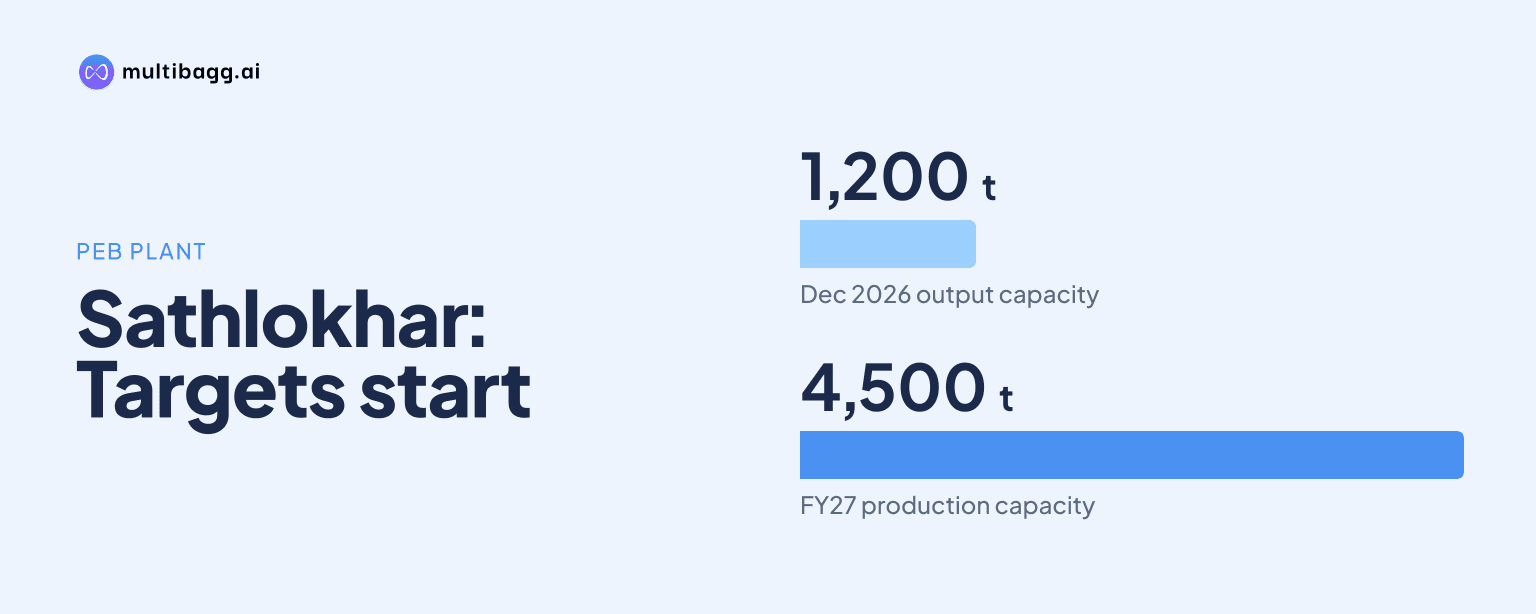
Sathlokhar Synergys E&C Global Limited expects its new pre-engineered metal building plant to start commercial production in December 2026, subject to statutory approval, with design capacity of approximately 1,200 metric tonnes a month at optimum utilisation; machinery installation and commissioning were roughly completed on August 30, 2026.
Know Sathlokhar Synergys E&C Global inside out
Results, valuation, peers and who's buying, in one view.
When will Sathlokhar’s new PEB plant start production?
Sathlokhar expects the facility to begin commercial production in December 2026, subject to receiving certain statutory approvals. Management gave this timeline on the October 30, 2026 earnings call and said the required machinery’s installation and commissioning were roughly completed on August 30, 2026, leaving the plant fully geared for a commercial start.
The December date is an expectation rather than a completed operating milestone because management did not identify the outstanding statutory approval or provide a fallback launch date. Actual revenue contribution will depend on the pace of production ramp-up, capacity utilisation and market demand after commercial production begins in FY27.
What capacity will Sathlokhar’s PEB plant provide?
Sathlokhar’s 165,000-square-foot pre-engineered building, or PEB, manufacturing facility is designed to produce approximately 1,200 metric tonnes a month at optimum utilisation. Management said the plant uses specialised machinery and forms part of its backward-integration strategy, under which Sathlokhar can manufacture a key input for its projects rather than depend entirely on external producers.
For the current financial year, management expects the facility to contribute 4,500 tonnes of production capacity as output builds following the planned December 2026 start. That FY27 contribution is below a full-year run rate based on 1,200 tonnes a month because the plant is scheduled to start partway through the financial year and utilisation is expected to improve progressively.
Management did not disclose a target utilisation rate, capital expenditure, facility revenue target or a timetable for reaching optimum capacity. The 4,500-tonne expectation is therefore a production-capacity indication for FY27, not a forecast of finished-goods sales to either internal projects or external customers.
How will Sathlokhar use output from the PEB plant?
Sathlokhar intends initially to use the plant’s output for captive project requirements while evaluating sales opportunities to external customers. This approach connects the new capacity to the company’s PEB and structural-steel project work before any expansion into third-party supply, with external demand remaining an opportunity under assessment rather than a disclosed sales plan.
Management said backward integration could provide greater control over material procurement, production planning, coordination and delivery timeliness. It also expects reduced dependence on external manufacturing vendors, although it did not quantify a reduction in procurement cost, project duration or the proportion of PEB requirements that the plant may eventually meet.
The production model is relevant to Sathlokhar’s stated project cycles. Typical steel-construction PEB projects take about 5 to 6 months to complete, while projects involving mechanical, electrical and plumbing, or MEP, work generally take 7 to 9 months, depending on their scope and complexity. Management did not say that in-house manufacturing would shorten either timeline.
Got a follow-up? Ask IRIS
What financial benefit does management expect from backward integration?
Management expects the PEB plant’s gradual ramp-up to deliver incremental operating-margin improvement of approximately 1%. It attributed that expectation to backward integration, procurement control, reduced external-vendor dependence, improved production planning and greater control over execution, while stating that operating conditions and market factors will affect the outcome.
The proposed margin benefit follows an already improved Q2 FY27 operating result that included startup costs for the new facility. Revenue from operations rose to Rs 297 crore in Q2 FY27 from Rs 138 crore in Q2 FY26, while operating earnings before interest, tax, depreciation and amortisation, or EBITDA, increased 137% year on year to Rs 44 crore and EBITDA margin rose to 14.9% from 12.6%.
For H1 FY27, revenue from operations increased 85% year on year to Rs 509 crore from Rs 271 crore. Operating EBITDA grew 131% to Rs 74 crore, with the margin improving by 296 basis points to 14.8%, while profit after tax rose 120% to Rs 51 crore and the profit-after-tax margin stood at 10.1%; these results preceded commercial production from the new plant.
Management said the facility was funded largely through internal accruals and preferential funds, with limited bank borrowing for equipment and machinery. It did not disclose the project cost, the amount raised through preferential funds, or the size of the equipment-related borrowing.
What order activity could support Sathlokhar’s plant ramp-up?
Sathlokhar reported a confirmed order book of approximately Rs 1,239 crore, excluding goods and services tax, in its October 1, 2026 business update. The order book included civil construction, PEB and MEP work, providing an internal project base that could require PEB capacity as the new facility enters production.
The company secured orders worth approximately Rs 352.68 crore in Q2 FY27, taking H1 FY27 order inflow to Rs 624.73 crore including goods and services tax. It also reported approximately Rs 117.61 crore of order intake for October 2026 excluding goods and services tax, so the October figure should not be directly added to the H1 total because the tax treatment differs.
Sathlokhar’s bid pipeline stood at approximately Rs 23,505 crore, and management said its historical bid-to-order conversion rate was around 10% to 12%. Conversion will depend on customer decisions, project approvals, commercial viability and demand, meaning the pipeline is not a confirmed order book or a committed source of plant utilisation.
What is Sathlokhar planning after its first PEB plant?
Sathlokhar plans to establish new PEB manufacturing facilities across India over the next 5 years, according to management. The stated aim is to locate capacity progressively closer to key industrial markets and support both captive projects and potential external demand, but management did not disclose sites, plant numbers, commissioning dates or investment amounts.
The manufacturing plan sits alongside management’s FY27 revenue guidance of approximately 70% growth over FY26 revenue. Management said it remains confident in that outlook because of its order book, continued order inflow, repeat business and expanding execution capacity, while also saying execution quality, working-capital management and capacity matching remain priorities.
In the October 30 call’s question-and-answer session, management said it had working capital for ongoing projects to fulfil its FY27 guidance. For FY28, it said it was working with bankers for debt and could consider non-convertible debentures, or NCDs, if needed, while stating that it had no equity-raising plan at that point.
Conclusion
Sathlokhar’s planned December 2026 launch would shift part of its PEB supply chain from external manufacturers to its own 165,000-square-foot facility. The plant’s approximately 1,200-tonne monthly design capacity and expected 4,500-tonne FY27 contribution create a captive-supply capability, while management’s approximately 1% margin-improvement expectation remains dependent on utilisation, operations and market demand.
The next disclosed milestones are receipt of the statutory approval required for the December 2026 start and progress toward the expected 4,500 tonnes of FY27 production capacity. Investors can also watch the ramp-up between captive use and any external sales, the proposed five-year expansion of PEB plants, and management’s execution of its approximately 70% FY27 revenue-growth guidance.