










Sakar expects oncology to exceed 60% revenue in two years
Key highlights
- Sakar said oncology contributed roughly Rs 50 crore, or about 50%, of Q2 FY27 revenue.
- Q2 FY27 revenue from operations rose 52% year on year to Rs 87.42 crore, while EBITDA margin increased to 28% from 20%.
- Sakar reported 22 oncology marketing authorizations, with around six molecules under those approvals already commercialized.
- H1 FY27 external oncology API sales were about Rs 36 crore to Rs 37 crore within roughly Rs 85 crore of oncology revenue.
powered by IRIS
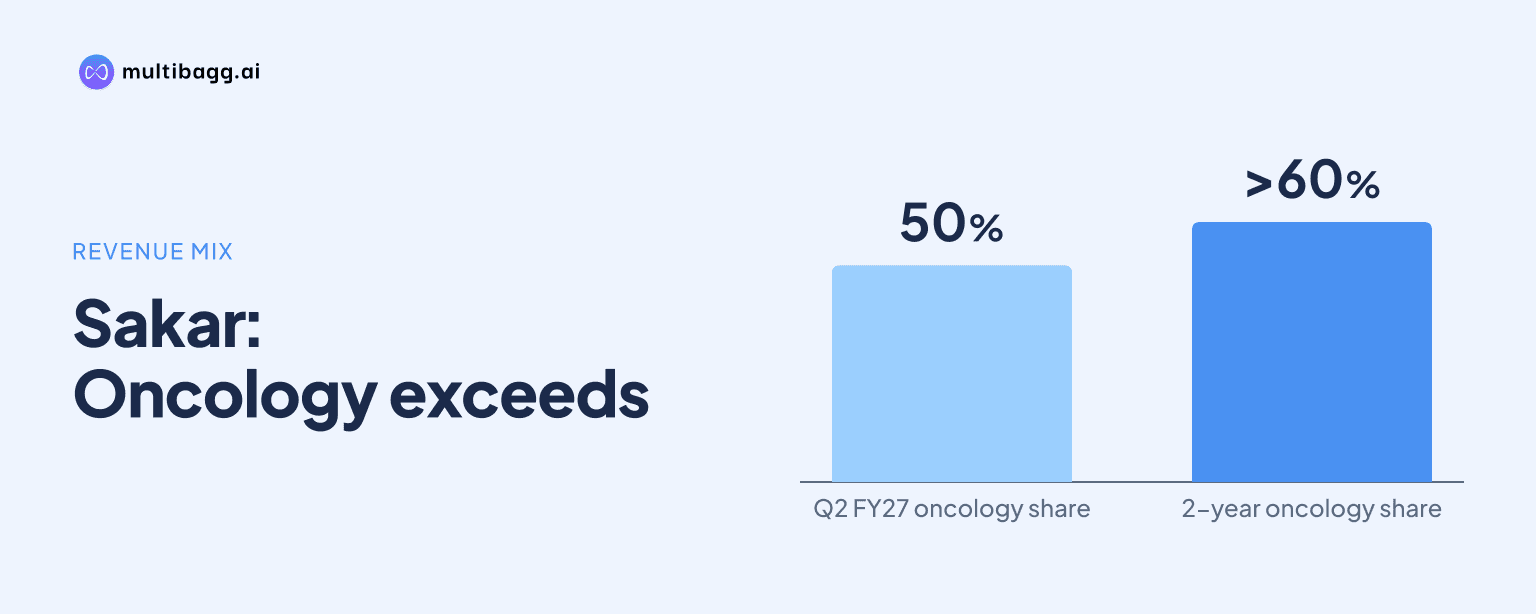
Sakar Healthcare Limited expects oncology to exceed 60% of revenue within a couple of years after the segment contributed roughly Rs 50 crore, or about half of Q2 FY27 revenue. Management tied the expected mix change to 22 marketing authorizations, 69 oncology contracts, commercialization activity and in-house active pharmaceutical ingredient integration.
Know Sakar Healthcare inside out
Results, valuation, peers and who's buying, in one view.
How close is Sakar to a 60% oncology revenue mix?
Sakar is currently near an even oncology and non-oncology revenue split and expects oncology to cross 50% from next year before exceeding 60% within a couple of years. Management said non-oncology had been the predominant business until the previous financial year, so the projected shift would make oncology the larger revenue contributor.
In Q2 FY27, Sakar reported roughly Rs 50 crore of oncology sales against revenue from operations of Rs 87.42 crore. Management described more than Rs 43 crore of quarterly oncology sales as domestic and around Rs 8.20 crore as direct exports, while also noting that sales to domestic principals can subsequently be exported as deemed exports.
The H1 FY27 composition also shows the role of oncology active pharmaceutical ingredients, or APIs. Sakar said total oncology revenue was around Rs 85 crore in the first half, including about Rs 36 crore to Rs 37 crore of external oncology API sales. The company said it makes only oncology cytotoxic APIs, and that captive API consumption is excluded from external-sales figures.
What drove Sakar's oncology sales in Q2 FY27?
Sakar's Q2 FY27 oncology sales came from domestic supplies, direct exports and contract development and manufacturing organisation, or CDMO, work. Management estimated that roughly Rs 3.50 crore of the Rs 8.20 crore oncology export revenue was direct export business, with the balance coming from CDMO activity.
The direct oncology export figure increased from around Rs 6.30 crore in the preceding quarter cited during the call to Rs 8.20 crore in Q2 FY27. However, the domestic oncology number includes supplies to principals that may export finished products themselves, so it does not represent only sales consumed in India.
Sakar reported 52% year-on-year growth in Q2 FY27 revenue from operations to Rs 87.42 crore, while EBITDA rose 114% to Rs 24.35 crore and margin increased to 28% from 20%. In H1 FY27, revenue increased 45% to Rs 160.39 crore and EBITDA grew 90% to Rs 45.59 crore, with margin rising to 28% from 22%.
Management attributed the change in profitability to business mix, operating leverage and oncology's increasing contribution. It estimated EBITDA margins at around 30% for oncology and 26% for non-oncology at the current more-or-less equal revenue mix, while clarifying these were estimates rather than separately reported segment margins.
Which approvals can become Sakar commercial sales?
Sakar has received 22 oncology marketing authorizations, and management said around six molecules under those approvals had already been commercialized as of the October 27, 2026 earnings call. It also said eight products had been commercialized across its oncology activities, while approved products were at stages including manufacturing, artwork finalisation, dispatch or dispatch planning.
Management said commercialization after a marketing authorization can take between one and six months, although tender cycles can be quarterly or half-yearly. Of the 22 marketing authorizations, it said 16 products in the licensing-out business were yet to be commercialized, making approval conversion a key part of the planned export expansion.
The regulatory pipeline includes 351 oncology dossiers shared globally, 191 submissions to regulatory agencies and 22 marketing authorizations. The authorizations comprise 11 in Europe and the United Kingdom, six in Latin America, four in Myanmar and one in Canada, according to management.
Site variations provide another route to commercial supply because they allow partners to manufacture from Sakar's site. The company reported 33 site-variation submissions covering 18 cytotoxic molecules and approvals for 11 products across the European Union and the United Kingdom; management also said more than six products through this route had been commercialized.
Got a follow-up? Ask IRIS
How will API integration change Sakar's oncology business?
Sakar plans to increase captive API use in finished formulations rather than focus solely on expanding external API sales in the following year. Management said external oncology API sales of Rs 36 crore to Rs 37 crore in H1 FY27 could be doubled or more by the end of FY27 if the first-half pace continued, but said backward integration would be the primary objective thereafter.
The intended mechanism is to combine internally made APIs with finished-dose formulations, which management said could lift blended profitability and reduce exposure to API price fluctuations. Sakar has developed 21 oncology APIs in-house, including 16 APIs with written confirmation, and two of its seven Certificate of Suitability, or CEP, applications have been approved.
Management said the remaining five CEP applications are in process and that another 15 to 20 key APIs would need to be integrated before its earlier discussion of EBITDA margin above 35% could be reached. It said this process would take another couple of years, rather than setting a nearer-term margin target.
Sakar also manufactures the platinum-based APIs Oxaliplatin, Carboplatin and Cisplatin in-house. Management estimated the three products account for roughly 8% to 10% of its 32 molecules from a product perspective, and said in-house production gives it flexibility as platinum prices increase the cost of APIs and finished products.
What supports Sakar's oncology commercialization plan?
Sakar has 33 technology-transfer projects underway across four partners, adding a route to supply alongside its own registrations and licensing-out arrangements. The company also executed 69 oncology product contracts and was discussing a further 45 international opportunities during H1 FY27.
Management expects the number of partnerships to exceed 70 within FY27, but said the immediate focus is product registrations and commercialization rather than simply adding partners. It has completed 36 European marketing-authorization filings, including 16 proprietary filings, which management identified as part of the route to future commercial supplies.
Through Accord, Sakar received six additional European Medicines Agency, or EMA, site-variation approvals at its oncology facility, taking the total to eight approvals out of 11 molecules. Management said these approvals, together with its API-integrated European Union good manufacturing practice-approved oncology formulations facility, support commercial supplies to domestic and international markets.
Conclusion
Sakar's anticipated move to more than 60% oncology revenue is based on a segment already contributing roughly Rs 50 crore in Q2 FY27 and around Rs 85 crore in H1 FY27. The company is relying on a combination of marketing authorizations, site variations, CDMO projects, contracts and API integration rather than a single sales channel to change its business mix.
The next measures to watch are commercialization of the 16 approved licensing-out products that management said remained pending, progress on the five unapproved CEP applications and additional marketing authorizations from the 191 regulatory submissions. Management also expects some pending authorizations to come through in the first half of the next financial year, while the planned move toward captive API use will determine the mix between external API sales and finished formulations.