










Sakar targets 34%-35% EBITDA margin with API integration
Key highlights
- Sakar reported about Rs 36 crore to Rs 37 crore of external oncology API sales in the first half of FY27.
- Sakar recorded about Rs 85 crore of total oncology revenue in the first half of FY27.
- Management said EBITDA could move from around 30% to 34%-35% or more over a couple of years through API integration.
- Sakar said 11 products are under site variation, with potential revenue of Rs 50 crore to Rs 150 crore.
powered by IRIS
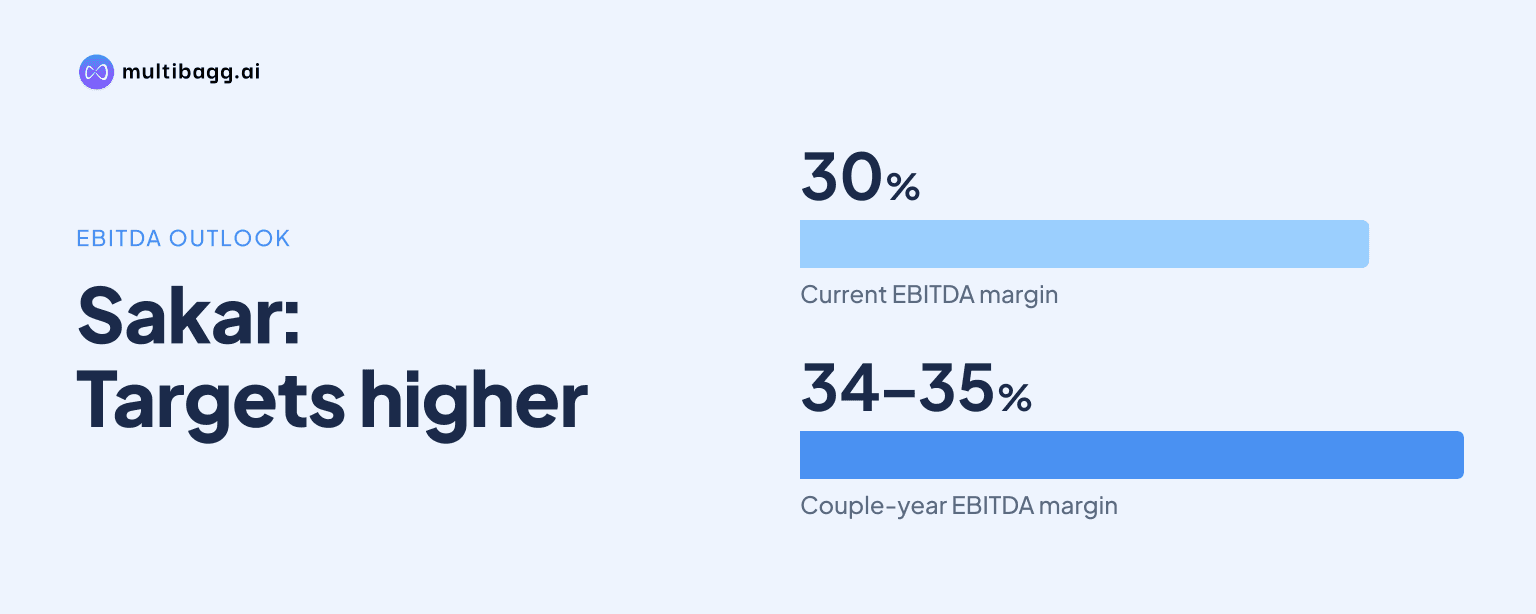
In the first half of FY27, Sakar Health Limited reported about Rs 36 crore to Rs 37 crore of external oncology active pharmaceutical ingredient, or API, sales and said greater captive use could raise EBITDA from around 30% to 34%-35% or more over a couple of years. Sakar reported about Rs 85 crore of oncology revenue in the same half-year.
Know Sakar Healthcare inside out
Results, valuation, peers and who's buying, in one view.
Why is Sakar moving oncology APIs to captive use?
Sakar is moving toward captive API consumption because management expects in-house APIs to earn more when combined with finished oncology formulations than when sold separately to third parties. The company said its Rs 36 crore to Rs 37 crore of first-half FY27 API sales represented external sales only, while captive consumption was excluded. It produces only oncology cytotoxic APIs, making the reported API line entirely oncology-related.
Management said its primary objective for the coming year is to use more APIs internally rather than increase external API sales. Sakar said the approach should improve blended profit across APIs and finished formulations, make the company more self-reliant and limit exposure to fluctuations in API market prices. Management added that large Indian pharmaceutical companies are seeking oncology APIs from Sakar, but said the company remains more focused on finished-dose products.
The accounting mix may therefore change even if underlying API production rises. An API sold outside the company is recorded as third-party API revenue, whereas an API used by Sakar is incorporated into a finished formulation before sale. Management's stated margin objective depends on this shift in value capture, rather than on a disclosed programme of cost reduction or a plan to expand external API volumes.
How large is Sakar's oncology API business?
Sakar reported about Rs 36 crore to Rs 37 crore of external oncology API sales in the first half of FY27, against about Rs 85 crore of total oncology revenue. The API sales therefore represented a substantial part of the oncology revenue base, although management did not provide a separate value for finished-formulation oncology sales in the half-year. It said the Rs 36 crore to Rs 37 crore of API sales had equalled the prior year's sales.
Management said that achieving Rs 36 crore to Rs 37 crore of external API sales in six months implied that FY27 API sales could be double that figure or more. However, it also said the next year's priority would be backward integration of some APIs, which means a higher API production run rate would not necessarily translate into higher reported external API revenue.
For the quarter discussed on the call, Sakar put oncology domestic revenue at about Rs 43 crore-plus and oncology export revenue at about Rs 8.2 crore, compared with Rs 6.3 crore of oncology exports previously. Management said about Rs 3.5 crore of the Rs 8.2 crore export amount was direct export business, with the remainder from contract development and manufacturing organisation, or CDMO, business. It also noted that some domestic sales include deemed exports through customers that export Sakar products.
Got a follow-up? Ask IRIS
What EBITDA margin does Sakar expect from API integration?
Sakar said its current oncology business model supports EBITDA of around 30%, while deeper API integration could take EBITDA to about 34%-35% or more. EBITDA is earnings before interest, tax, depreciation and amortisation. Management said this outcome would take a couple of years because it must integrate in-house APIs into the finished-formulation business, rather than treat the higher range as an immediate result.
Management described the change as a gradual journey from around 30% as integration expands. It said EBITDA should remain at about 30% while the current business mix continues, then improve as more oncology APIs are consumed internally. The company did not set out annual margin milestones, capital expenditure requirements or a specified proportion of API output that will move from third-party customers to captive use.
Sakar also supplied a historical comparison between business mixes. Management said EBITDA was around 25% two years earlier, when non-oncology had a larger presence, and was moving around 28% at the time of the call as oncology contributed a greater share. The around 28% observation is different from the around 30% level management associates with the current oncology business model, while the 34%-35% range depends on further API integration.
What could support Sakar's formulation-led oncology growth?
Sakar said marketing authorisations, or MAs, and site variations could support a larger finished-formulation business alongside API integration. An MA allows a product to be marketed in a particular territory. Management said it had received 22 MAs, with related products either dispatched or in the dispatch-planning phase, including manufacturing and artwork finalisation.
Management said 16 of the 22 products in the licensing-out stream still needed commercialisation. It also cited seven or eight molecules under site variations that needed to be commercialised, while more than six site-variation products had already been commercialised. A site variation allows a partner to obtain approval for manufacturing at Sakar's site, and management said the commercialisation process can take one to six months, with tender-linked supplies also subject to quarterly or half-yearly tender timing.
The company said products that have yet to receive or earn MAs could begin contributing to exports, with some expected in the first half of the next financial year. Management also said its own MAs would not have a full-year contribution if approvals arrived in the first half. In response to an analyst's Rs 30 crore to Rs 40 crore discussion for own-MA oncology revenue, management said 50%-60% of that value could be reached next year.
Site-transfer opportunities may provide another source of formulation volume. Management said 11 products were under technology transfer, or site variation, and almost all were approved at Sakar's site. It described potential revenue from this portfolio at Rs 50 crore to Rs 150 crore and said Rs 100 crore was an average figure to consider, while cautioning that multinational customers have multiple procurement sites.
Conclusion
Sakar's stated margin plan is based on redirecting an established external API revenue stream into finished oncology formulations. The company generated about Rs 36 crore to Rs 37 crore of third-party oncology API sales within about Rs 85 crore of oncology revenue in the first half of FY27. Management expects the mix change to move EBITDA from around 30% toward 34%-35% or more, following an earlier shift from around 25% to around 28% as oncology gained share.
The next points to watch are the rate at which Sakar integrates APIs into its formulation production, commercialises the 16 licensing-out products and advances the seven or eight site-variation molecules still awaiting commercialisation. Management said some additional MAs could come in the first half of the next financial year, while full-year contribution from MAs currently in process is expected only by the end of FY28.