










Optimystix sets Hindi films’ 90%-100% pre-sales rule
Key highlights
- Optimystix requires three Hindi-film pre-sales to cover 90% to 100% of production costs before production starts.
- Optimystix reported H1 FY27 EBITDA of Rs 19.50 crore, versus Rs 14.90 crore in H1 FY26.
- Optimystix reported H1 FY27 profit after tax of Rs 14.60 crore, up from Rs 11.60 crore a year earlier.
- Optimystix may retain 100% of IP on selected regional films budgeted at Rs 5 crore to Rs 7 crore.
powered by IRIS
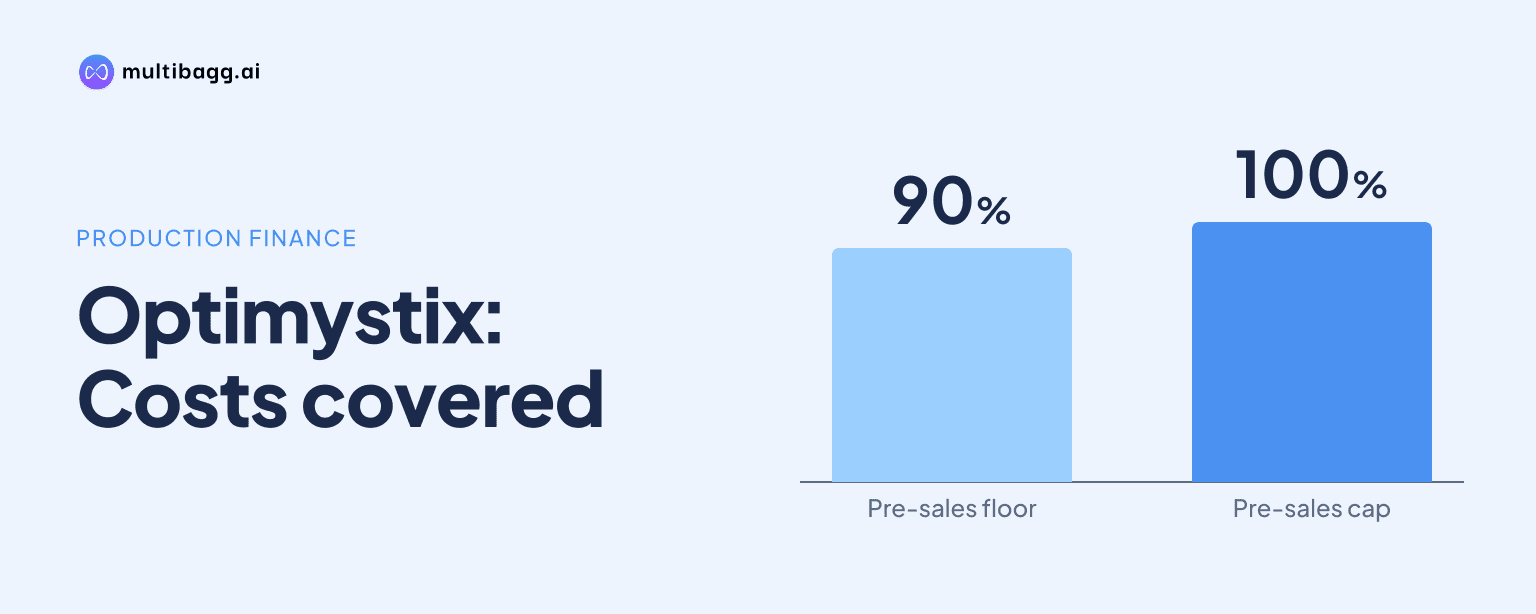
In H1 FY27, Optimystix Entertainment India Limited said it would begin Hindi film production only after digital, broadcast and music pre-sales cover 90% to 100% of production costs. The model is intended to secure a fixed producer fee before release while leaving Optimystix with a negotiated share of intellectual property, or IP, and theatrical upside.
Know Optimystix Entertainment India inside out
Results, valuation, peers and who's buying, in one view.
How does Optimystix’s Hindi film pre-sales rule work?
Optimystix said it initially funds a Hindi film’s script development and actor sign-up, then seeks a studio deal before production starts. Under the structure described on the H1 FY27 call, the studio project-finances production in return for 30%, 40% or 50% of the IP, while Optimystix remains the producing company.
The company’s stated rule is that three rights must be sold before filming: digital rights, broadcast rights and music rights. Management said those pre-sales must together cover 90% to 100% of the production cost, with possible buyers including Netflix or Amazon for digital rights and Sony, Star or Colors for broadcast rights.
This approach means box-office receipts are not the basis for approving a Hindi production, according to management. Optimystix said it will not produce a film until the required pre-sales are in place, although a film that performs well theatrically can generate additional income from the company’s IP share.
What does Optimystix earn from a Hindi film?
Optimystix said it receives a fixed producer fee of 10% of a Hindi film’s budget under the studio-backed model. Management also cited a further 3% to 4% relating to salary allocation and the project team, which it described separately from the possible profit share linked to IP ownership.
Management said its film IP position generally falls in a 40% to 50% range, while noting that individual film terms are confidential and may vary. This differs from television and conventional over-the-top, or OTT, commissions, where Optimystix said it works on a cost-plus-margin basis and does not own the IP.
The company used a hypothetical Rs 100 crore net box-office collection to explain the potential waterfall. In that illustration, about 50%, or Rs 50 crore, would go to exhibitors, while the remaining Rs 50 crore would reach the studio; with a 50% IP share, Optimystix would receive Rs 25 crore alongside its Rs 10 crore producer fee on a hypothetical Rs 100 crore-budget film. Management presented this as an example rather than guidance or an outcome from a released film.
How is Optimystix’s regional-film strategy different?
Optimystix said regional films have a separate capital-allocation rule: its target project ticket size is no more than Rs 5 crore to Rs 7 crore. For a project within that range that meets its script criteria, management said the company may fund production itself and retain 100% of the IP instead of sharing it with a studio.
The company identified Tamil, Telugu, Malayalam, Gujarati, Marathi and Punjabi as languages for its regional slate. Management said it had partnerships covering Tamil, Telugu and Malayalam, and that one Gujarati film was already on the floor at the time of the H1 FY27 call.
Hindi projects are therefore intended to use studio financing and the three-rights pre-sale threshold, while selected regional projects can be owned outright within the Rs 5 crore to Rs 7 crore budget discipline. Management said it would still use partnerships and pre-sales where needed rather than assume all regional projects would be self-funded.
Got a follow-up? Ask IRIS
What did H1 FY27 results show about Optimystix’s earnings mix?
Optimystix reported H1 FY27 revenue of Rs 71.75 crore, compared with Rs 72.20 crore in H1 FY26 and Rs 62.80 crore in H2 FY26. Despite revenue being slightly lower year on year, earnings before interest, tax, depreciation and amortisation, or EBITDA, rose to Rs 19.50 crore from Rs 14.90 crore in H1 FY26.
Profit after tax reached Rs 14.60 crore in H1 FY27, up from Rs 11.60 crore a year earlier and Rs 12.40 crore in H2 FY26. Management attributed the higher operating margin to revenue mix and broadly flat salary and other operating costs, and said profit-after-tax margin was 20.3%, compared with 16.1% in H1 FY26.
Management did not provide an absolute H2 FY27 revenue forecast. It said, however, that it had confirmed visibility or signed understanding for about 60% to 62% of its internally targeted revenue for the balance six months, and maintained an expected 30% to 35% compound annual growth rate from the FY26 base over the next three years.
How does Optimystix plan to increase wholly owned IP?
Optimystix described television and commissioned OTT work as a cash engine, film co-productions as a value engine, and animation, YouTube and regional films as a future compounding engine. In FY26, management said television supplied about 45% of revenue, film and OTT together supplied about 48% to 49%, and digital accounted for about 6.5% to 7%.
The company said it owns the animation rights to Baalveer in perpetuity and has developed 30 to 35 original characters for an animated superhero universe. Management said its technology platform, developed in collaboration with Google and Seed Dance, can produce a 20- to 24-minute episode in six to seven hours, compared with two to three weeks for an episode under its described traditional process after character and world creation.
Management’s internal target was to launch its animation YouTube business by mid- to end-January. It said the production cycle and key hiring were under way, and that the technology-led process was expected to cost about one-tenth of the earlier traditional method for comparable animation output.
Conclusion
Optimystix’s Hindi-film model seeks to make most production costs recoverable through three pre-sales before a shoot begins, while preserving a fixed 10% producer fee and a potential 40% to 50% IP position. That structure contrasts with its regional strategy, which allows 100% IP ownership for selected films costing no more than Rs 5 crore to Rs 7 crore.
The next disclosed milestones are the planned mid- to end-January animation YouTube launch and the proposed move of The Diplomat Part Two into production next year, after management said its story had been approved and writing was under way. Management also said the larger effect of capital deployment and newer initiatives would be more visible in FY28.