










Tata Capital Ltd. targets a Q4 NIM-plus-fee improvement
Key highlights
- Tata Capital said Q2 NIM fell about 10 basis points from Q1, split equally between funding costs and prime-home-loan competition.
- Tata Capital expects NIM-plus-fee to remain stable to marginally better in Q3 and improve in Q4.
- Tata Capital reported 66% floating-rate assets versus 48% floating-rate liabilities.
- Tata Capital's higher-margin businesses recorded 40% disbursement growth and 14% AUM growth.
powered by IRIS
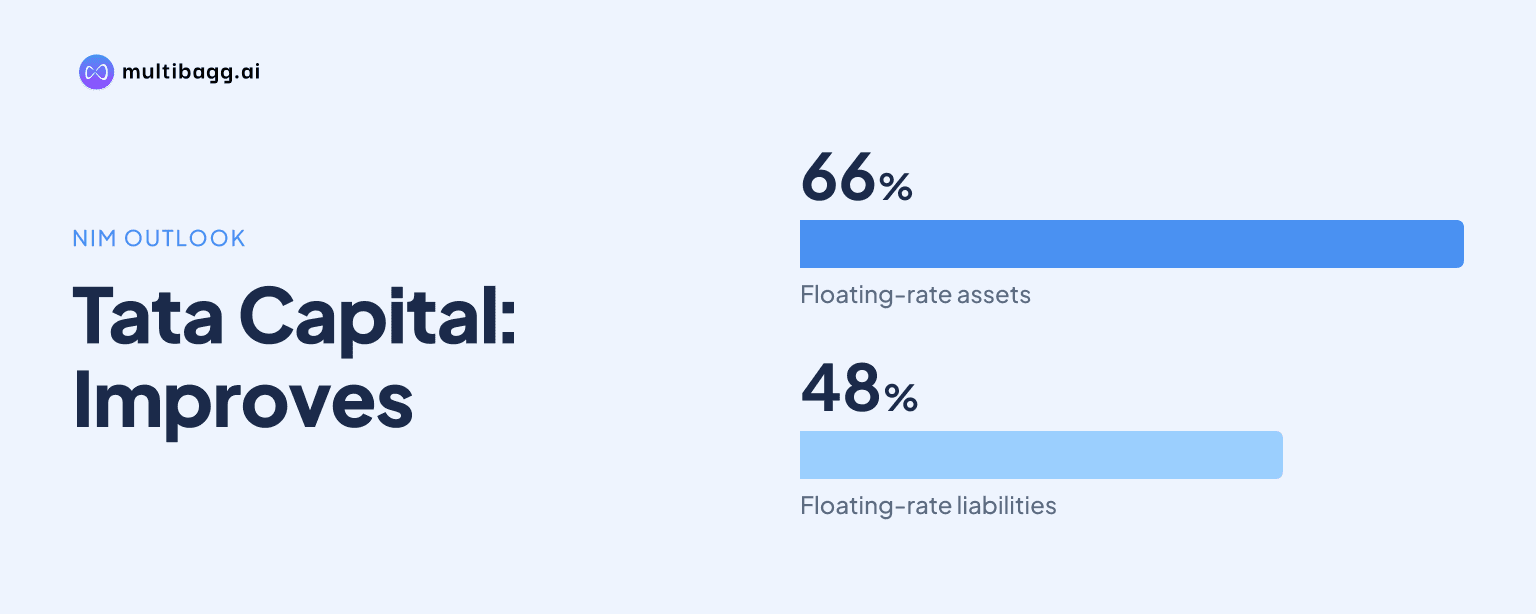
Tata Capital expects NIM-plus-fee to improve in Q4 after net interest margin fell 10 basis points in Q2 from Q1, as management relies on 20-25-basis-point repricing from November 1, a 66% floating-rate asset mix and higher-margin business disbursements that rose 40%.
Know Tata Capital inside out
Results, valuation, peers and who's buying, in one view.
Why did Tata Capital's NIM fall in Q2?
Tata Capital's net interest margin, or NIM, fell by about 10 basis points in Q2 compared with Q1, with about 5 basis points caused by a higher cost of funds and another 5 basis points caused by competition in prime home loans. Management had previously indicated that Q2 would bring moderation, rather than attributing the full change to a single interest-rate factor.
Management said the pressure was most visible in price-sensitive products because falling interest rates increased the pressure from balance transfers and customer repricing. In housing, it said competitive conditions had pushed lending rates lower, and it is seeking to increase the share of affordable housing, micro housing and loan against property, or LAP, to reduce the negative margin effect from prime mortgages.
Tata Capital distinguished its NIM-plus-fee outlook from NIM alone. Management expects no further drag in NIM-plus-fee in Q3, with stability more likely than a material improvement, before the measures already implemented produce a clearer improvement in Q4. This sequence is management's outlook, rather than a reported Q4 result.
How will Tata Capital's 20-25-basis-point repricing affect margins?
Tata Capital said its pricing changes are intended to support margins from November 1, when management said they would apply to almost all of the relevant portfolio. The measures include a 25-basis-point reset linked to the 25-basis-point repo-rate increase effective from October and a 20-basis-point increase in housing pricing.
The 20-basis-point housing increase is intended to apply to both existing and incremental customers, according to management. Tata Capital said 95% of its housing assets are floating rate, while roughly 40% of housing liabilities will reprice following the rate increase. Management said that difference should provide a lift to the housing portfolio.
The wider balance-sheet mix is also central to management's assessment. Floating-rate assets represent 66% of Tata Capital's assets, against 48% of liabilities, a gap of 18 percentage points. Management said this structure is supportive in a rising-rate environment, although it will assess any future rate pass-through against the mix of assets and liabilities rather than apply it automatically.
Management said its 20-basis-point housing change reflected its view that leading home-loan providers need higher lending rates to cover funding costs. That is management's reading of market behaviour, not a reported industry-wide outcome. Tata Capital also plans faster assets under management, or AUM, growth in near-prime and affordable housing during Q3 and Q4.
Got a follow-up? Ask IRIS
What other measures could lift Tata Capital's NIM-plus-fee in Q4?
Tata Capital expects its higher-margin business mix to become more supportive by Q4 because disbursements in those businesses rose 40%, while their AUM rose 14%. The gap means fresh lending grew faster than the outstanding book, so the effect of that mix shift on the total portfolio yield had not fully emerged in Q2.
Management expects the 14% AUM growth in higher-margin businesses to almost match overall portfolio growth by Q4 and to exceed it from the next financial year. It also said business leaders had put yield-improvement plans in place from Q2 across products outside the disclosed higher-margin retail and corporate categories, with more visible output expected from the end of Q3 or in Q4.
Fee income was another contributor, although Tata Capital separated assignment-related income from other fee streams. Total fee income rose 30% year on year and sequentially, while assignment income increased 58% year on year. Management said non-assignment income, as a percentage, remained at a similar level to Q1, indicating that assignment income drove the reported increase.
Operating costs could provide a further earnings offset, according to management. Tata Capital expects income to grow by about 25% for the year and costs by about 15%, a difference it said should help profitability. The transcript does not quantify the resulting effect on NIM or NIM-plus-fee.
What could limit Tata Capital's margin recovery?
Mortgage competition and the timing of funding-cost transmission remain relevant risks to Tata Capital's recovery plan because prime home loans accounted for about 5 basis points of the 10-basis-point Q2 NIM decline. Management said it aims to improve the timing between an interest-rate change and customer-rate pass-through, while noting that draft regulatory guidelines also seek faster transmission in both directions.
Regulatory developments could affect fee income, but Tata Capital did not provide a quantified impact from proposed insurance-commission rules because the final guidelines and effective date were unknown. Management said it is assessing alternative insurance products and NIM-plus-fee improvements in businesses without insurance, while noting that not selling insurance could reduce operating costs.
Flexi-loan regulation is a separate uncertainty. Tata Capital said retail flexi loans form about 2% to 2.5% of its book, and management believes more than half of the portfolio assessed could be converted to modified products without a revolver feature. Some alternatives were already being tested, with the remaining products scheduled for testing at the beginning of November.
Growth discipline will also affect the margin outcome. Tata Capital reported about 26% AUM growth in the quarter, above its stated 23%-25% guidance range, but management said it had passed on certain deals that did not meet margin requirements. It said it wants to operate within the 23%-25% range rather than pursue volume at the expense of margins.
Conclusion
Tata Capital's planned Q4 improvement depends on the combined effect of repricing, its larger floating-rate asset base, a higher-margin lending mix and costs that management expects to rise more slowly than income. The reported Q2 decline was split between higher funding costs and prime-home-loan competition, while fee growth was led by assignment income rather than non-assignment fees.
The next test is whether Q3 NIM-plus-fee remains stable as management expects and whether November 1 repricing reaches almost the entire relevant portfolio. Investors will also watch whether higher-margin AUM growth approaches overall portfolio growth by Q4, alongside final insurance-commission and flexi-loan regulations and Tata Capital's planned testing of remaining alternative flexi products from early November.