










Tata Capital expects Motor Finance growth in Q4 of FY27
Key highlights
- Tata Capital expects Motor Finance to stabilise in Q3 FY27 and grow in Q4 FY27.
- Motor Finance represented about 7.7% of Tata Capital’s total book, down from 14.5% in March 2025.
- Tata Capital said overall NPAs were stable at 1.9%, while Motor Finance absolute slippages were lower year-on-year.
- Tata Capital created a macro provision of about Rs 30 crore in CV finance during Q2 FY27.
powered by IRIS
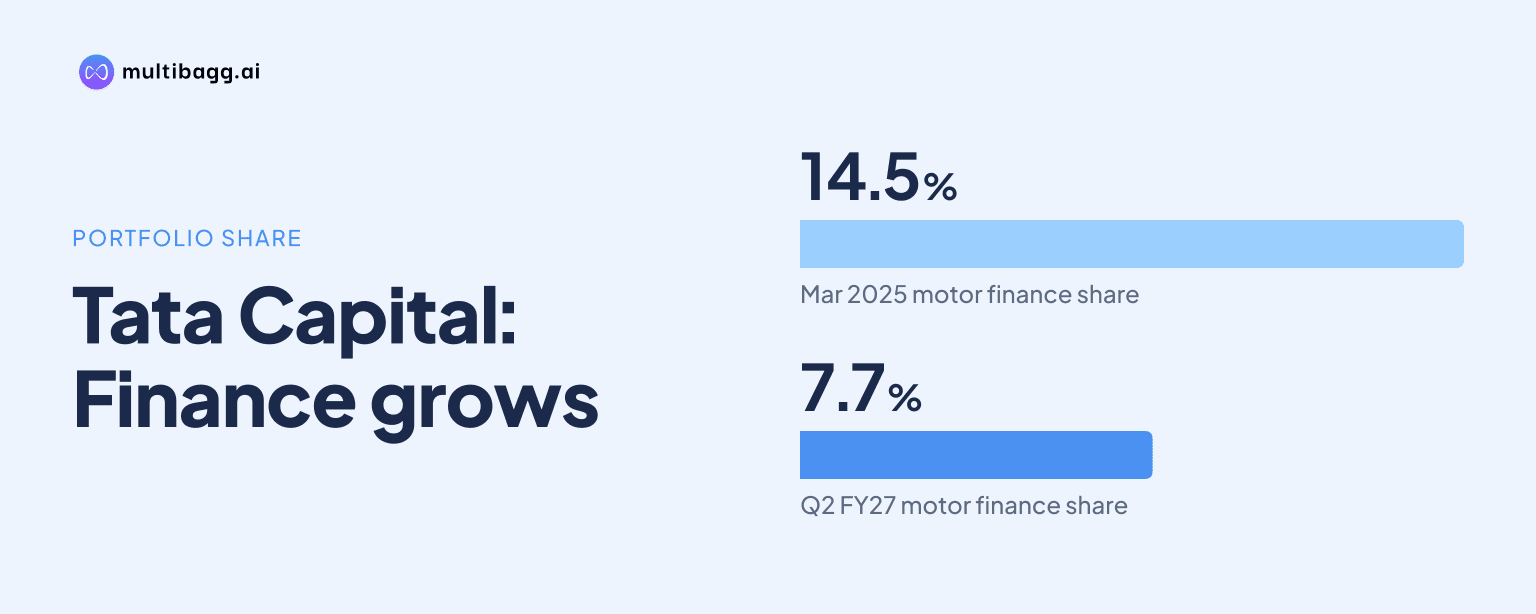
Tata Capital expects its Motor Finance portfolio to stabilise in Q3 FY27 and return to growth in Q4 FY27, after the business’s share of its total book declined from 14.5% in March 2025 to about 7.7%. Management said the portfolio rundown reduced in each of the past two quarters.
Know Tata Capital inside out
Results, valuation, peers and who's buying, in one view.
Why does Tata Capital expect Motor Finance growth in Q4 FY27?
Tata Capital expects Motor Finance to be flat in Q3 FY27 and grow in Q4 FY27 because the quarterly rundown has reduced successively. Management said the Q2 FY27 rundown was lower than Q1 FY27, while Q1 FY27 was lower than Q4 of the previous year. Its month-on-month reading now supports a stabilisation before a return to expansion.
The expected recovery is later than Tata Capital had planned. Management said portfolio growth was lagging its earlier expectation by two to three quarters, although credit costs, slippages, portfolio diversification and cost-to-income were progressing as intended. Tata Capital is increasing lending beyond Tata vehicles, but said its priority is profitability rather than restoring volumes quickly.
Tata Capital said it became more conservative during Q2 FY27 after the war began, amid concern that fuel-price effects could be passed on. After management concluded that this was not occurring, it increased disbursement efforts and invested in additional markets and dealerships. Those steps underpin the stated expectation of a flat Q3 FY27 followed by Q4 FY27 growth.
Why did Tata Capital's Motor Finance GNPA ratio rise in Q2 FY27?
Tata Capital said the increase in its Motor Finance gross non-performing asset, or GNPA, ratio reflected a shrinking loan-book denominator and seasonal movement, rather than higher absolute slippages. Management said absolute slippages in Q2 FY27 were significantly lower than in Q2 of the previous year, while overall non-performing assets remained stable at 1.9% from the prior quarter.
A declining Motor Finance book can lift the GNPA percentage even when the flow of new problem loans falls, because the denominator becomes smaller. Management said Q2 has historically been the quarter with the highest increase in Motor Finance NPAs, with the trend moderating in Q3 and declining further in Q4. It said the same seasonal pattern is visible in FY27.
Tata Capital has paired the planned restart with a cautious commercial vehicle, or CV, risk approach. It created a macro provision of about Rs 30 crore in the CV business during Q2 FY27 and said it would monitor future conditions. Management described the CV industry as cyclical and said fuel-price effects require continuing observation.
An analyst suggested that a Motor Finance GNPA portion of about Rs 2,000 crore to Rs 2,100 crore could be sold to an asset reconstruction company. Tata Capital said it had not considered such a transaction, arguing that its in-house team understands both the business and collections. Management confirmed that the majority of the relevant GNPA exposure came from loans written before March 2025.
Got a follow-up? Ask IRIS
How is Tata Capital changing Motor Finance before expanding it?
Tata Capital is seeking a profitability-led Motor Finance restart through selective dealer expansion, in-house collections, efficiency measures and a broader vehicle mix. Management said it is working to improve return on assets through yield, cost efficiency and credit costs, while keeping CV portfolio growth moderated during the recovery phase.
The reduced scale of the business shapes that approach: Motor Finance represented about 7.7% of Tata Capital’s total book at the time of the call, down from 14.5% in March 2025. Management said its move toward non-Tata vehicles is proceeding well, but did not provide a separate Motor Finance disbursement figure. The smaller segment share provides the context for its emphasis on economics and collections over rapid growth.
Tata Capital said all CV collections are managed in-house, allowing it to act more proactively. It is also expanding dealer access so it can be more selective about proposals, while investments in an integrated technology model are intended to improve turnaround times and efficiency. These mechanisms support management’s plan to reduce the rundown in Q3 FY27 before growing the portfolio.
The wider retail platform is also expected to add momentum. Tata Capital said retail growth should pick up in Q3 FY27 and increase further in Q4 FY27 through geographic expansion, faster turnaround times and product structuring. Its housing business plans a larger expansion in the number of locations in Q3 and Q4 FY27 than it completed in Q2 FY27, focused on affordable and micro housing.
What could affect Tata Capital's Motor Finance recovery?
Tata Capital’s Q4 FY27 growth plan depends on fuel-price effects, CV utilisation and portfolio performance, which management said it will monitor as the CV industry is cyclical. The company said it will remain calibrated in its growth approach, strengthen collections and avoid a volume-led expansion that could conflict with its profitability objective.
Tata Capital has also tightened underwriting screens in certain small and medium enterprise, or SME, segments covering secured and unsecured business loans. Management linked the move to its monitoring of the war and higher costs in products supported by crude prices. It did not describe these screens as a Motor Finance-specific policy, but the measures show a wider risk response across lending operations.
Interest rates are another factor in the operating backdrop. Tata Capital said 66% of assets and 48% of liabilities were floating rate. Its asset-liability committee approved a 25-basis-point increase in floating portfolio lending rates for Tata Capital, effective 1 November, after a 25-basis-point repo-rate increase became effective in October.
Management said net interest margin, or NIM, plus fee income should be stable or marginally better in Q3 FY27 and improve in Q4 FY27. NIM declined by about 10 basis points in Q2 FY27 from Q1 FY27, with about 5 basis points attributed to higher funding costs and about 5 basis points to competition in prime home loans. This is group-level margin commentary, rather than Motor Finance-only guidance.
Conclusion
Tata Capital’s stated sequence is to reduce the Motor Finance rundown in Q2 FY27, stabilise the portfolio in Q3 FY27 and restore growth in Q4 FY27. Management bases that plan on lower absolute slippages than a year earlier, expected seasonal moderation in the GNPA ratio, dealer expansion, in-house collections and a focus on profitability over volumes.
The next disclosed test is the Q3 FY27 portfolio trend, particularly whether the book is flat as management expects and whether the Motor Finance GNPA movement moderates after Q2. Investors will also watch the Rs 30 crore CV macro provision, fuel-price and utilisation conditions, and whether Q4 FY27 growth can emerge within Tata Capital’s calibrated underwriting and collection approach.