










Tata Capital AI processes 70% of retail applications
Key highlights
- Tata Capital said AI-led workflows processed approximately 70% of retail applications in Q2 FY27.
- Tata Capital's underwriting engines processed more than 7.8 crore documents and achieved over 95% adoption in personal and business loans.
- Tata Capital reported 99% digital customer onboarding and 99% digital collections in Q2 FY27.
- Tata Capital's cost-to-income ratio improved 438 basis points year on year to 35.3% in Q2 FY27.
powered by IRIS
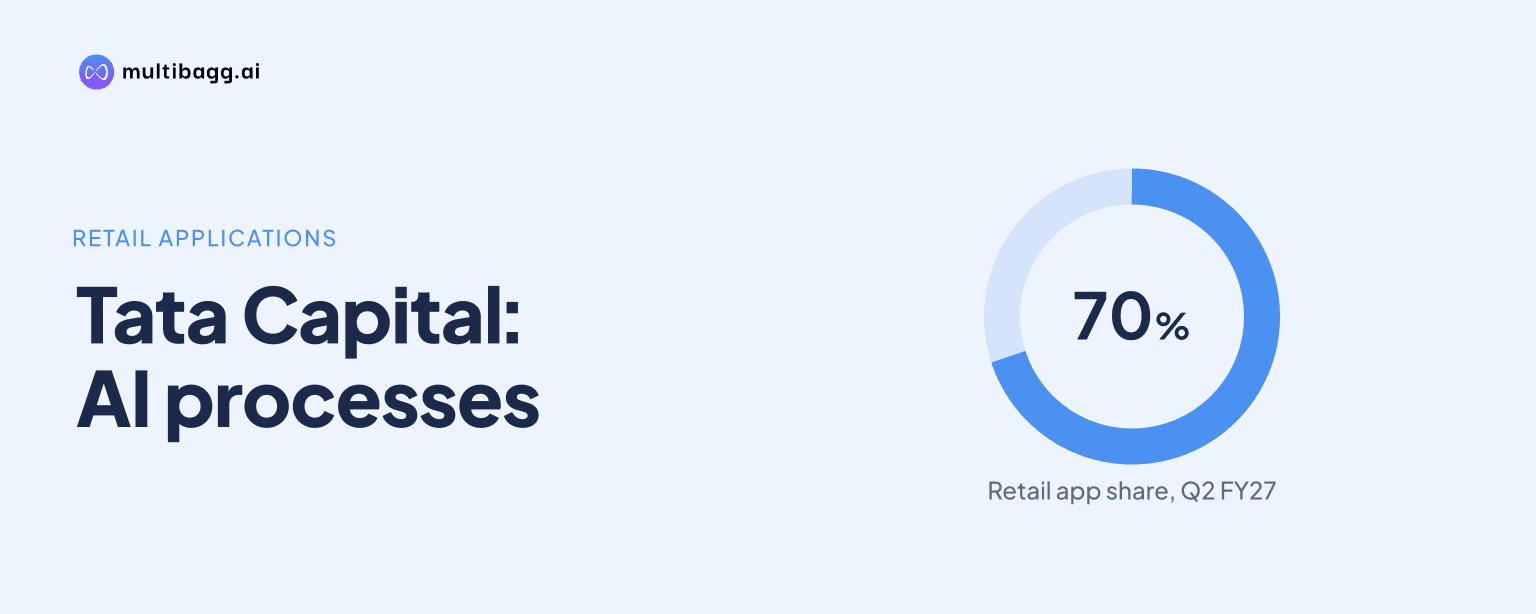
Tata Capital said artificial intelligence, or AI, workflows processed approximately 70% of retail applications in the second quarter of FY27, while its credit-intelligence and decisioning engines had processed more than 7.8 crore underwriting documents. Management linked the deployment to faster turnaround times, higher productivity and lower operating costs, without quantifying an AI-specific saving.
Know Tata Capital inside out
Results, valuation, peers and who's buying, in one view.
What share of Tata Capital retail applications does AI process?
Tata Capital said AI-led workflows process approximately 70% of retail applications in Q2 FY27. The company described this as an operations measure and said the workflows are driving productivity gains, faster turnaround times and lower operating costs, though it did not provide a comparable earlier-period processing percentage or a rupee value for savings.
The 70% application measure sits within a wider digital model. Tata Capital said 99% of customers are onboarded through digital channels, 98% of retail disbursements use scorecard- and business-rule-engine decisioning, 99% of collections occur digitally, and 98% of customer queries are digitally addressable. These measures indicate that AI workflows operate within a largely digitised lending and servicing process.
Tata Capital had more than 180 digital partnerships in Q2 FY27, which management said expanded customer reach and accessibility. Its digital distribution model supported a customer base of 92 lakh, alongside approximately 1,515 branches across 1,094 locations in 26 states and union territories after a net addition of 24 branches during the quarter.
How extensively has Tata Capital deployed AI in underwriting?
Tata Capital said its AI-powered credit-intelligence and decisioning engines have processed more than 7.8 crore documents for underwriting. The systems achieved more than 95% adoption in personal-loan and business-loan underwriting, and management said they produced meaningful productivity and turnaround-time improvements without disclosing a time-based benchmark.
The underwriting systems form part of an enterprise-wide AI programme rather than a disclosed pilot. Tata Capital said AI is embedded across customer acquisition, underwriting, operations, servicing and collections, with the stated aim of building an AI-first non-banking financial company, or NBFC. Management said its focus has shifted from isolated use cases to AI-led transformation across the lending value chain.
AI also supports activity before formal underwriting. Tata Capital said AI-led onboarding initiatives enabled more than 30 lakh customer interactions, while AI-generated content powers the majority of marketing creatives and campaign communications. The company did not disclose how many of those 30 lakh interactions became applications, disbursements or loans.
How is Tata Capital using AI in servicing and collections?
Tata Capital said AI-powered voice and email platforms automate customer interactions and enable same-day query resolution in servicing. Management said these tools lower the cost to serve, but did not disclose the proportion of service contacts handled by AI, the same-day resolution rate or the reduction in servicing expenditure in Q2 FY27.
In collections and portfolio monitoring, Tata Capital said AI supports automated risk surveillance, stock-audit monitoring and AI-assisted customer engagement. The company said the tools contribute to collection effectiveness and operating leverage. Since 99% of collections were already digital in Q2 FY27, the AI tools are being applied within an already digitised collections channel.
Tata Capital reported consolidated gross Stage 3 assets, the most serious loan-impairment classification, of 1.9% as of September 2026. Annualised consolidated credit cost declined to 0.9% in Q2 FY27 from 1.0% in Q1 FY27, while the provision coverage ratio improved to 59%. Management attributed the credit-cost decline to improvement in the retail portfolio, but did not isolate AI monitoring's contribution.
Got a follow-up? Ask IRIS
What operating-leverage evidence accompanies Tata Capital's AI rollout?
Tata Capital said investments in technology, data infrastructure, AI and distribution are increasingly improving productivity, operating efficiency and scalability. Its cost-to-income ratio improved by 438 basis points year on year to 35.3% in Q2 FY27, while cost to average assets was 2.3%. A basis point equals one-hundredth of a percentage point.
The staffing and asset trends provide a separate comparison. Consolidated assets under management, or AUM, grew 26% year on year and 6% sequentially to Rs 3.0803 lakh crore as of September 2026, while on-roll headcount increased 6% to 31,655. More than 80% of employees were deployed in frontline sales and collections, according to Tata Capital.
These data show that headcount and the cost-to-income ratio moved more slowly than AUM in the reported period, but they do not quantify an AI-only efficiency gain. Tata Capital cited technology, data, distribution and product capabilities together, while its 98% automated-decisioning coverage for retail disbursements and 70% AI workflow coverage for retail applications are its clearest automation-scale disclosures.
What financial context supports Tata Capital's AI investment?
Tata Capital reported consolidated profit after tax of Rs 1,660 crore in Q2 FY27, up 51% year on year and 7% sequentially. Consolidated disbursements rose 29% year on year to Rs 51,665 crore, while AUM increased 26% year on year. Management presented AI and digital investment as part of its strategy for growth, risk management and operating leverage.
Retail and small and medium enterprise portfolios accounted for 85.4% of AUM in Q2 FY27. High-margin businesses recorded 40% year-on-year disbursement growth and 14% AUM growth, compared with 10% AUM growth in Q1 FY27. Tata Capital also expanded affordable and micro-housing into 23 new locations during the quarter, using its branch and digital distribution model.
Funding conditions also shaped management's near-term margin plans. Tata Capital's cost of funds increased to 7.33% in Q2 FY27 from 7.28% in Q1 FY27, while management said net interest margin, or NIM, declined by about 10 basis points, including about 5 basis points from funding costs and 5 basis points from competitive intensity in prime home loans.
Conclusion
Tata Capital's disclosures establish substantial AI deployment across lending operations: approximately 70% of retail applications move through AI-led workflows, underwriting engines have processed more than 7.8 crore documents, and personal-loan and business-loan underwriting adoption exceeds 95%. The company paired those measures with 99% digital onboarding and collections, and a 438-basis-point year-on-year reduction in its cost-to-income ratio to 35.3%.
The next disclosed milestones are management's margin expectations after pricing changes effective 1 November. Tata Capital's asset-liability committee approved a 25-basis-point increase in its floating-rate product lending rates, while Tata Capital Housing Finance approved a 20-basis-point increase; management expects NIM plus fee to remain stable or improve marginally in Q3 FY27 and show a clearer improvement in Q4 FY27.