










Tata Capital says 3% to 4% AUM could face draft-rule effects
Key highlights
- Tata Capital estimated that 3% to 4% of AUM could be affected if revolving-credit draft rules are finalised as evaluated.
- Tata Capital's Q2 FY27 consolidated AUM was Rs 3.08 lakh crore, up 26% year on year and 6% sequentially.
- Tata Capital said it has not reduced lending and has already piloted some alternative products.
- Tata Capital's cost of funds increased to 7.33% in Q2 FY27 from 7.28% in the previous quarter.
powered by IRIS
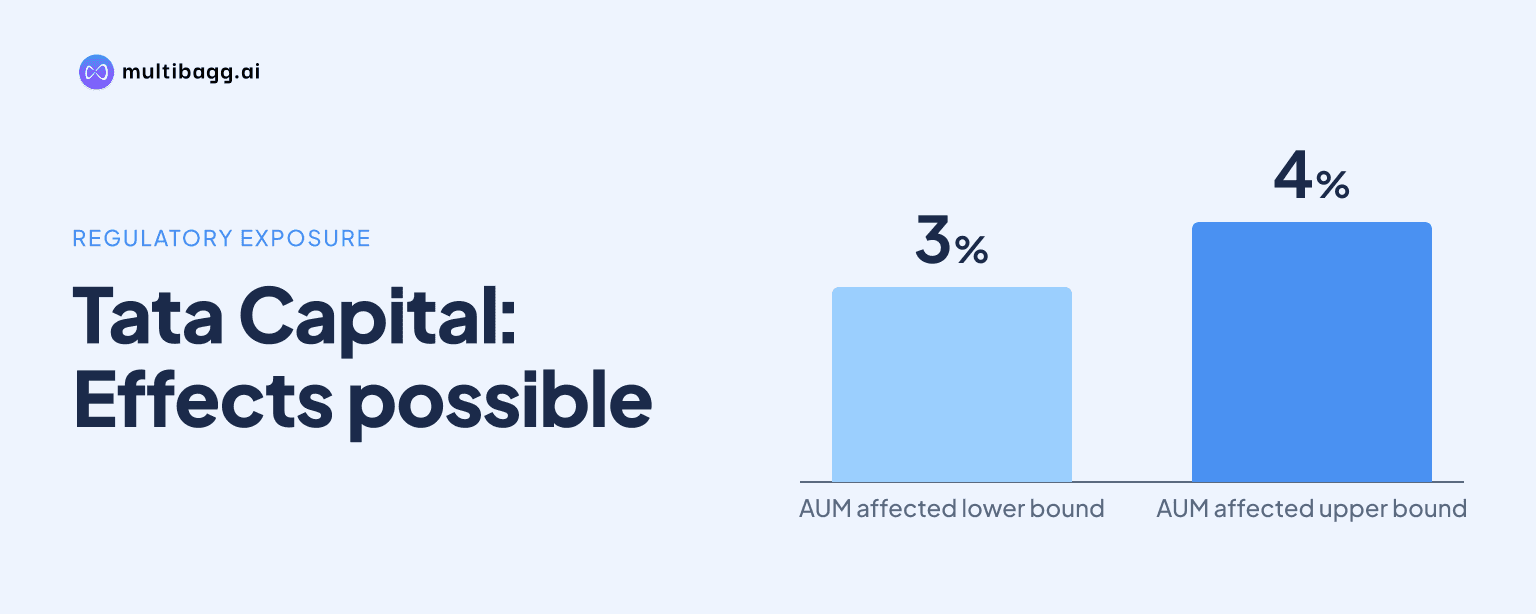
Tata Capital Limited said on October 27, 2026 that 3% to 4% of its Rs 3.08 lakh crore assets under management could be affected if draft revolving-credit guidelines are issued as evaluated and certain balances cannot be converted into standard term loans. Tata Capital has not reduced lending and is piloting alternative products.
Know Tata Capital inside out
Results, valuation, peers and who's buying, in one view.
How much of Tata Capital's loan book could draft revolving-credit rules affect?
Tata Capital's assessed exposure is 3% to 4% of assets under management, or AUM, under the scenario management evaluated. Managing Director and Chief Executive Officer Rajiv Sabharwal said the estimate covers products that may fall under the interpretation of revolving credit and cannot be converted into a standard term loan if the guidelines are issued as drafted. Tata Capital did not provide a rupee value for the affected portfolio or disclose product-level balances.
The potential exposure sits within a loan book that reached Rs 3.08 lakh crore at the end of Q2 FY27, up 26% year on year and 6% sequentially. Retail and small and medium enterprise businesses represented about 85.4% of consolidated AUM, while AUM excluding motor finance grew 32% year on year. The exposure estimate is therefore a defined share of a book that expanded across housing, retail, small and medium enterprise, and corporate segments.
Management presented the 3% to 4% figure as a contingent assessment, not as a confirmed reduction in lending. The result depends on the final Reserve Bank of India (RBI) guidelines, the interpretation of products covered, and the extent to which balances can move into term-loan structures. Tata Capital said it will comply with the final regulations.
Has Tata Capital cut revolving-credit lending before the final rules?
No, Tata Capital said it has not cut lending before final guidelines are issued because the potentially affected portfolio is not a large proportion of its book. Sabharwal said personal loans and business loans relevant to the issue are not dominant portions of disbursements. Tata Capital is continuing existing lending while preparing alternatives for a possible regulatory change.
Tata Capital has already piloted some alternative products and expects to pilot others in the coming month, according to management. It did not name the replacement products or give expected disbursement volumes. Management said the purpose is to meet customers' requirements if final rules restrict existing revolving-credit structures, rather than to withdraw products before the RBI's decision.
Management also said overdraft products can benefit customers because borrowers pay only on the amount they use. Sabharwal cited supply-chain finance and loans against securities as products that have existed in the industry for more than 30 years. Tata Capital said the regulator has sought feedback on product types, customer markets and customer benefits as part of the consultation.
Got a follow-up? Ask IRIS
What is Tata Capital doing while the RBI consultation continues?
Tata Capital is engaging with the regulator and industry bodies while testing alternative structures, rather than assuming the draft rules will be finalised unchanged. Management said a self-regulatory organisation had submitted recommendations to the RBI. Tata Capital said its own engagement includes product characteristics, the markets served and customer implications of revolving-credit products.
The unresolved conversion treatment is central to the 3% to 4% estimate because Tata Capital has not disclosed which balances it considers convertible into regular term loans. Management specifically based its assessment on the portion that would not be convertible. Until final guidelines clarify permitted structures and conversion treatment, the affected AUM and operating response cannot be calculated more precisely from the call.
Tata Capital's Q2 FY27 operating metrics provide context for its product testing without a disclosed lending pullback. Profit after tax was Rs 1,660 crore, up 51% year on year and 7% sequentially, while gross Stage 3 assets were stable at 1.9%. Annualised credit cost declined to 0.9% in Q2 from 1.0% in Q1, and provision coverage improved to 59%.
Could other draft regulations affect Tata Capital's income mix?
Management said it is too early to quantify the effect of draft insurance-distribution proposals because consultations are continuing and final regulations have not been issued. Tata Capital considers insurance an important risk cover in loan underwriting, but did not estimate an effect on fee income, distribution costs or profitability. This policy issue is separate from the 3% to 4% revolving-credit AUM assessment.
If insurance rules affect income, management said it is considering retail insurance lines and could seek to mitigate an impact through net interest margin, fee income and lower costs. Net interest margin is the spread between lending income and funding costs. Sabharwal described these as possibilities rather than targets and said final policy should balance distribution costs with customer benefits.
Tata Capital is also adjusting lending rates in response to funding conditions. Its asset-liability committee approved a 20 to 25 basis point increase in prime lending rates on the floating-rate portfolio after cost of funds rose to 7.33% in Q2 from 7.28% in the preceding quarter. Management expects the repricing to support an improving net-interest-margin-plus-fee trajectory in Q4, subject to interest-rate movements and regulatory outcomes.
Conclusion
Tata Capital has placed a quantified boundary around the revolving-credit issue: 3% to 4% of Q2 FY27 AUM could be affected if draft guidelines are implemented as evaluated and certain balances cannot become term loans. It has not curtailed lending in advance, citing the portfolio's limited size, and is using product pilots and regulatory engagement to prepare for possible final-rule scenarios.
The next items to watch are the RBI's final revolving-credit policy and Tata Capital's planned additional product pilots in the coming month. Management's Q4 expectation for the 20 to 25 basis point floating-rate repricing, and its stated FY27 AUM-growth range of 23% to 25%, will also indicate how the lender is balancing regulatory preparation with loan growth.