










Neochem H1 revenue climbs 50% as FY2027 growth tops 40%
Key highlights
- Neochem reported H1 FY2027 revenue of Rs 68.9 crore, up 50.4% from Rs 45.8 crore.
- H1 FY2027 operating EBITDA rose 39.5% to Rs 12 crore, while profit after tax increased 41.8% to Rs 7.8 crore.
- Neochem's H1 FY2027 volumes grew 20% and Moraiya plant utilisation reached a 62% annualised rate.
- Trade receivable days fell to 127 at September 30, 2026, from 161 days at March 2026.
powered by IRIS
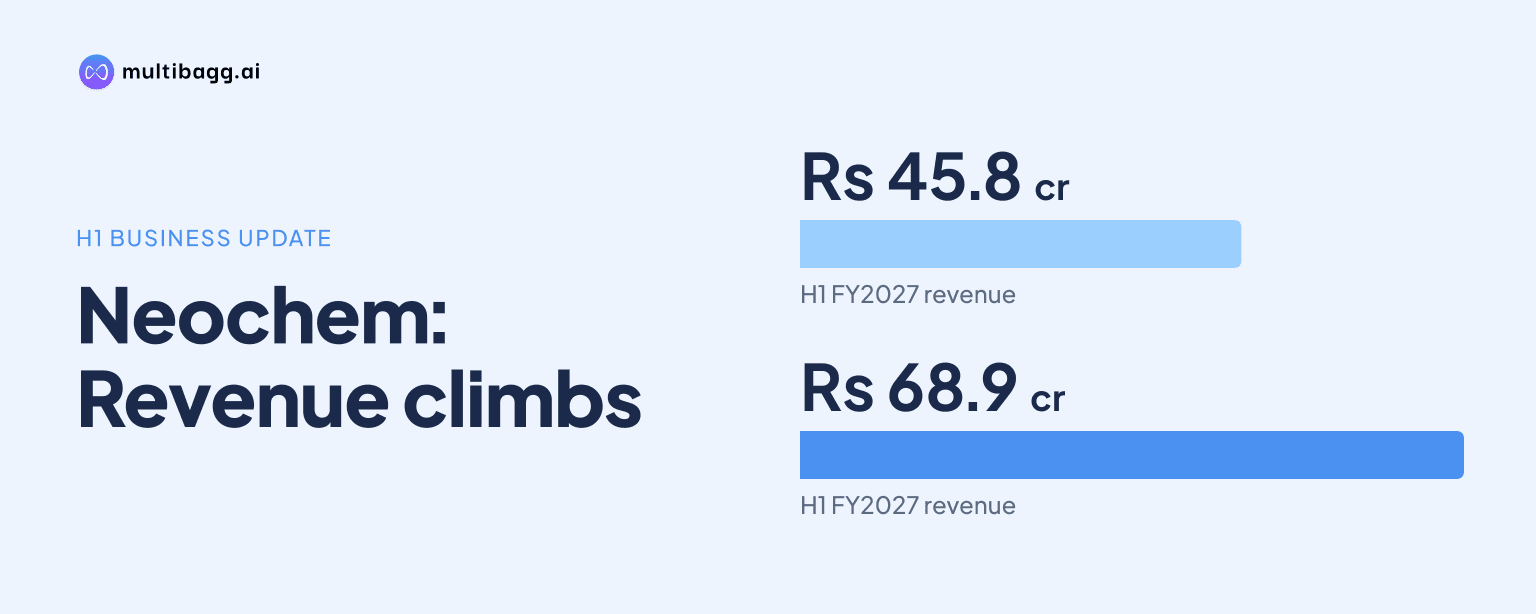
NEOCHEM BIO SOLUTIONS LIMITED reported revenue from operations of Rs 68.9 crore in H1 FY2027, up 50.4% year on year, and management said it expects growth above 40% for FY2027. The result reflected 20% volume growth and a better product and customer mix, although a lag in recovering crude-linked input costs moderated gross-margin progress.
Know Neochem Bio Solutions inside out
Results, valuation, peers and who's buying, in one view.
How did Neochem perform in H1 FY2027?
Neochem increased H1 FY2027 revenue from operations to Rs 68.9 crore from Rs 45.8 crore a year earlier, while operating earnings before interest, tax, depreciation and amortisation, or EBITDA, rose 39.5% to Rs 12 crore from Rs 8.6 crore. Profit after tax increased 41.8% to Rs 7.8 crore from Rs 5.5 crore, according to the chief financial officer's October 29, 2026 presentation.
Revenue grew faster than gross profit and operating EBITDA during the half year. Gross profit increased 29.9% to Rs 20.4 crore from Rs 15.7 crore, reflecting higher raw-material costs and the time taken to recover those costs through customer pricing.
Neochem's profit-after-tax margin was 11.4% in H1 FY2027, compared with 12% in H1 FY2026. Management said the company remained within its stated 10% to 12% profit-after-tax margin range, while EBITDA margin was 18%, within the 18% to 20% range it had set out.
What drove Neochem's 50% revenue growth?
Neochem said the 50.4% revenue increase was not solely price-led because volumes grew 20% year on year in H1 FY2027. The balance of revenue growth came from a richer product and customer mix, higher plant utilisation and pass-through of some input-cost increases.
The Moraiya facility has installed capacity of 22,000 metric tonnes a year, and H1 FY2027 utilisation ran at an annualised rate, or ARR, of 62%. That was above approximately 53% on an annualised basis in FY2026, providing more production throughput alongside the 20% volume increase.
Textiles accounted for 75.06% of H1 FY2027 revenue and non-textile applications accounted for 24.94%. By chemistry, esters contributed 29.40%, surfactants 25.06%, polymers 24.34% and silicon 21.20%, while management identified a broader non-textile contribution as a strategic objective.
The first half represented approximately 62% of Neochem's full-year FY2026 revenue. Management said its historical revenue pattern has been a 45:55 split between the first and second halves and expects that pattern to remain broadly applicable in FY2027, making second-half execution material to the full-year outlook.
How did crude-linked costs affect Neochem's margins?
Neochem said the escalation of the West Asia conflict lifted crude-linked raw-material costs across the industry, and about 30% of its raw materials are directly linked to crude. Management chose a measured price pass-through to preserve customer relationships, supply continuity and volume momentum rather than immediately recover all cost increases.
That approach created a timing gap between cost inflation and price recovery, which management said weighed modestly on gross margin. H1 FY2027 gross profit rose 29.9% to Rs 20.4 crore, below revenue growth of 50.4%, while operating EBITDA margin was maintained at 18%.
Management said gross margin should remain in a 30% to 35% range and EBITDA margin in an 18% to 20% range. It added that larger contributions from esters, silicones, home and personal care, coatings and PFAS-free, chlorine-free technology are intended to support a 33% to 35% steady-state gross-margin level.
The gross-margin trajectory remains dependent on input-cost movements, customer demand and the pace of product commercialisation, management said. Management also said it was hopeful that full-year gross margin would be near 33% by the end of H2 FY2027 after the H1 dip caused by crude-linked costs.
Got a follow-up? Ask IRIS
Is Neochem improving its working capital and cash flow?
Neochem reduced trade receivable days to 127 days as of September 30, 2026, from 161 days as of March 2026. Trade receivables remained flat at Rs 48.1 crore even as half-year revenue increased 50%, according to management.
Management's FY2027 target is to reduce receivable days below 120 days, and it said it expects to reach that level in H2. The reduction from 161 days at March 2026 to 127 days at September 2026 is part of its effort to convert a higher revenue base into improved cash generation.
Operating cash flow improved to approximately negative Rs 1 crore in H1 FY2027 from approximately negative Rs 17 crore at the previous financial year's close. Management expects operating cash flow to turn positive in H2, subject to its working-capital actions and the operating environment.
The company also disclosed a July 2026 cyber-fraud incident involving Rs 1.47 crore. It had recovered Rs 80.58 lakh to date and was pursuing recovery of the remaining Rs 67.13 lakh with authorities, while saying it had added measures intended to prevent similar incidents.
What is Neochem's outlook for FY2027?
Neochem's management said current visibility and business seasonality support growth of more than 40% in FY2027. This is above the approximately 30% revenue-growth commitment management described from May 2026, following H1 revenue growth of 50.4% to Rs 68.9 crore.
The company reaffirmed a target of approximately 65% capacity utilisation by the end of FY2027, compared with the H1 annualised rate of 62%. Its export business was described as on track, and management expects improved business sentiment from Bangladesh to support a turnaround in the second half.
Neochem said it is commercialising new products through customer qualification, application development and regional commercialisation. Its research and development work focuses on sustainability, bio-based products and import substitution, with applied development based on customer requirements.
Management appointed Vikram Nair as chief commercial officer, Siddharth Raj as textiles business head and Harshit Shah as chief financial officer on October 27, 2026. The appointments form part of its plan to add commercial scale, financial controls and business leadership as it pursues growth across the portfolio.
Conclusion
Neochem's H1 FY2027 result combined a 50.4% increase in revenue, 20% volume growth and a 39.5% rise in operating EBITDA with a margin effect from crude-linked input costs. Product mix, customer mix and higher utilisation supported the expansion, while gross profit grew more slowly than revenue because price recovery lagged cost inflation.
The next measures to watch are management's targets for more than 40% FY2027 growth, approximately 65% capacity utilisation and receivables below 120 days by year-end. Management also expects positive operating cash flow in H2, gross margin near 33% for the full year and a Bangladesh-led export improvement, while identifying input costs, customer demand and commercialisation pace as variables.