










Sati Poly Plast H1 FY27 Profit Rises 162.5% to ₹2.1 Crore
Key highlights
- Sati Poly Plast reported H1 FY27 revenue from operations of ₹122.5 crore, down 26.4% year on year.
- H1 FY27 net profit was about ₹2.1 crore, up 162.5% year on year.
- Operating margin improved to 2.2% in H1 FY27 from 0.7% in H1 FY26.
- Borrowings were ₹9.9 crore and net worth was ₹21.7 crore after the H1 FY27 period.
powered by IRIS
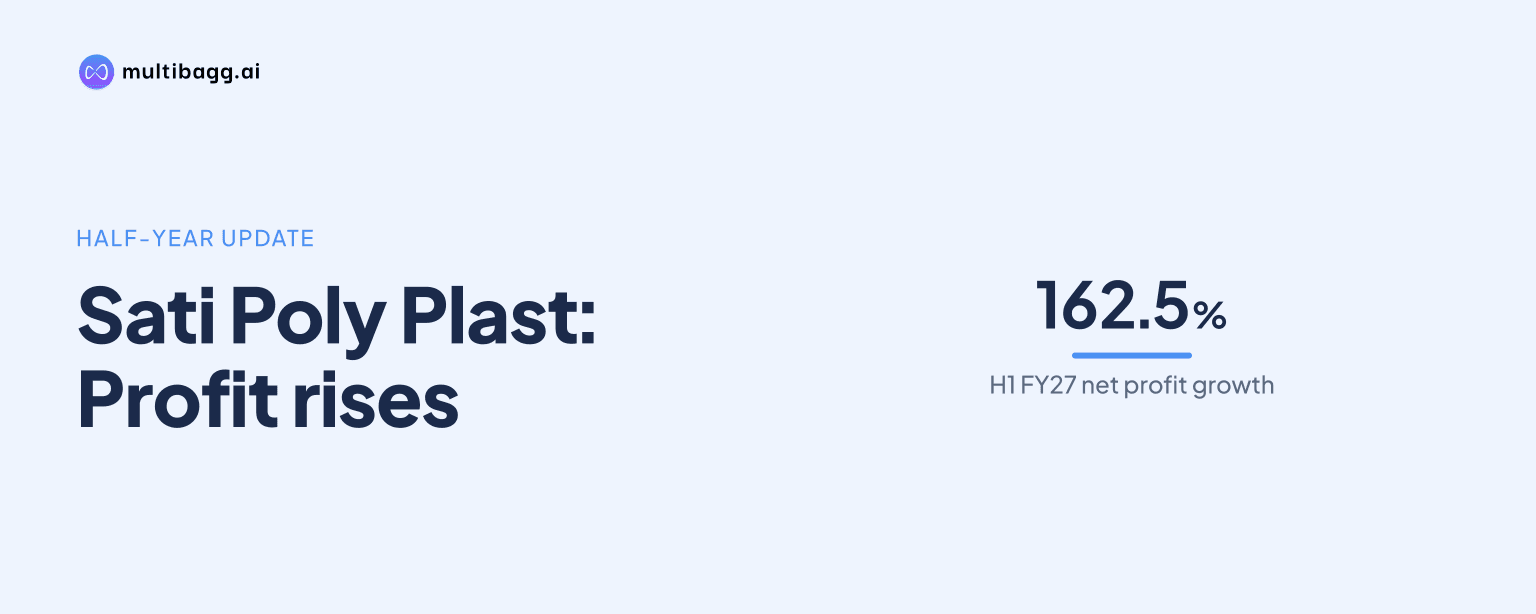
Sati Poly Plast Limited reported net profit of ₹2.1 crore for H1 FY27, a 162.5% year-on-year increase, while revenue from operations declined 26.4% to ₹122.5 crore for the half year ended September 2026. The results show improved profitability despite lower sales, while the company’s insurance claim related to a February 2025 fire remains under process.
Know Sati Poly Plast inside out
Results, valuation, peers and who's buying, in one view.
What did Sati Poly Plast report for H1 FY27?
Sati Poly Plast reported unaudited standalone revenue from operations of ₹122.5 crore for the half year ended September 2026, compared with ₹166.4 crore in H1 FY26. Total income was ₹122.6 crore, including a small amount of other income. The company’s revenue therefore declined sharply from the corresponding period last year.
Net profit rose to about ₹2.1 crore from ₹0.8 crore in H1 FY26, according to the result summary filed with the NSE. The filing calculated year-on-year net-profit growth at 162.5%. Profit before exceptional items and tax was ₹2.7 crore, against ₹1.1 crore a year earlier, indicating that the improvement occurred before tax as well.
The board approved the unaudited results at its meeting on November 14, 2026. The company had earlier informed the exchange that the meeting would consider financial results for the period ended September 30, 2026.
Why did profit increase despite lower revenue?
Sati Poly Plast recorded a substantial improvement in profit even as its revenue base reduced. The company’s operating margin, calculated before other income, rose to 2.2% in H1 FY27 from 0.7% in H1 FY26. This indicates that costs declined more than revenue during the reporting period.
The company’s result summary attributed the profit improvement to lower costs. The available financial data show that the half-year operating profit was higher year on year, even though revenue declined. Operating profit increased 237.5% year on year, according to the NSE results summary.
The comparison with the immediately preceding half year presents a different picture. Revenue from operations was ₹106.9 crore in H2 FY26, while net profit was ₹2.6 crore. On that basis, H1 FY27 revenue improved, but net profit was 19.2% lower and operating profit was 25% lower than the preceding half year.
What is the status of the fire insurance claim?
Sati Poly Plast said its fire insurance claim remains under process. The claim is connected to an accident reported in February 2025, and the company stated that the required documents have been submitted to the insurer.
The board noted the pending claim along with the H1 FY27 results. No claim amount, settlement date, or final outcome was disclosed in the information provided. As a result, the reported H1 FY27 profit reflects the results available at the time of the filing rather than any confirmed insurance recovery.
The unresolved claim remains relevant because it relates to an earlier operational incident. Investors will need to rely on future company disclosures for any update on the assessment, approval, or receipt of insurance proceeds.
Got a follow-up? Ask IRIS
How did the half-year results affect Sati Poly Plast’s financial position?
Sati Poly Plast reported borrowings of ₹9.9 crore and net worth of ₹21.7 crore following the H1 FY27 period. The company’s borrowings were lower by ₹2.2 crore, while net worth increased, based on the result-related information provided.
The company also reported capital expenditure of ₹2.1 crore. These figures indicate that the business continued to make capital investments during a period in which sales were lower than the previous year. The disclosed debt reduction and increase in net worth are important balance-sheet developments alongside the improvement in profitability.
For shareholders, the results present two contrasting operating signals. Revenue was lower by more than one-fourth from H1 FY26, but profit improved from a relatively low base and margins strengthened. The financial position data add context by showing lower borrowings, although the pending insurance claim remains an unresolved item.
How does H1 FY27 compare with Sati Poly Plast’s recent results?
Sati Poly Plast’s H1 FY27 revenue of ₹122.5 crore was below the ₹166.4 crore reported in H1 FY26, but above the ₹106.9 crore reported in H2 FY26. The company’s performance has therefore varied across recent half-year periods, with sales declining year on year but recovering relative to the immediately previous half year.
Profitability has also moved unevenly. H1 FY26 net profit was ₹0.8 crore, H2 FY26 net profit was ₹2.6 crore, and H1 FY27 net profit was ₹2.1 crore. The latest result is stronger than the year-earlier period but below the preceding half year, showing that the year-on-year comparison benefits from a low profit base in H1 FY26.
The main market relevance of the filing is the combination of weaker revenue and better margins. For the plastics sector, revenue movements, raw-material costs, operating expenses, and utilisation levels can all influence profitability. The company’s disclosure supports an improvement in cost performance, but it does not provide a detailed break-up of the factors behind the decline in revenue.
Conclusion
Sati Poly Plast delivered higher H1 FY27 profit despite a 26.4% decline in revenue, with net profit rising 162.5% to ₹2.1 crore and operating margin improving to 2.2%. Lower costs, reduced borrowings, and higher net worth were positive elements of the disclosure, while lower sales remained the principal operating concern.
The next item to watch is any update on the fire insurance claim from the February 2025 accident, which remains under process after document submission. Investors will also assess whether the company can sustain improved margins and convert the sequential recovery in revenue from H2 FY26 into stronger sales growth in subsequent results.