










SEIL can file scheme as public stake falls to 10.03% in GEPL
Key highlights
- BSE issued SEIL a no-adverse-observation letter on November 19, 2026.
- Public shareholders’ interest must be disclosed as falling from 50.11% in SEIL to 10.03% in GEPL.
- The stated 100:212 share-exchange ratio cannot change because of GEPL partly paid-share forfeiture.
- BSE’s observation letter remains valid for six months from November 19, 2026.
powered by IRIS
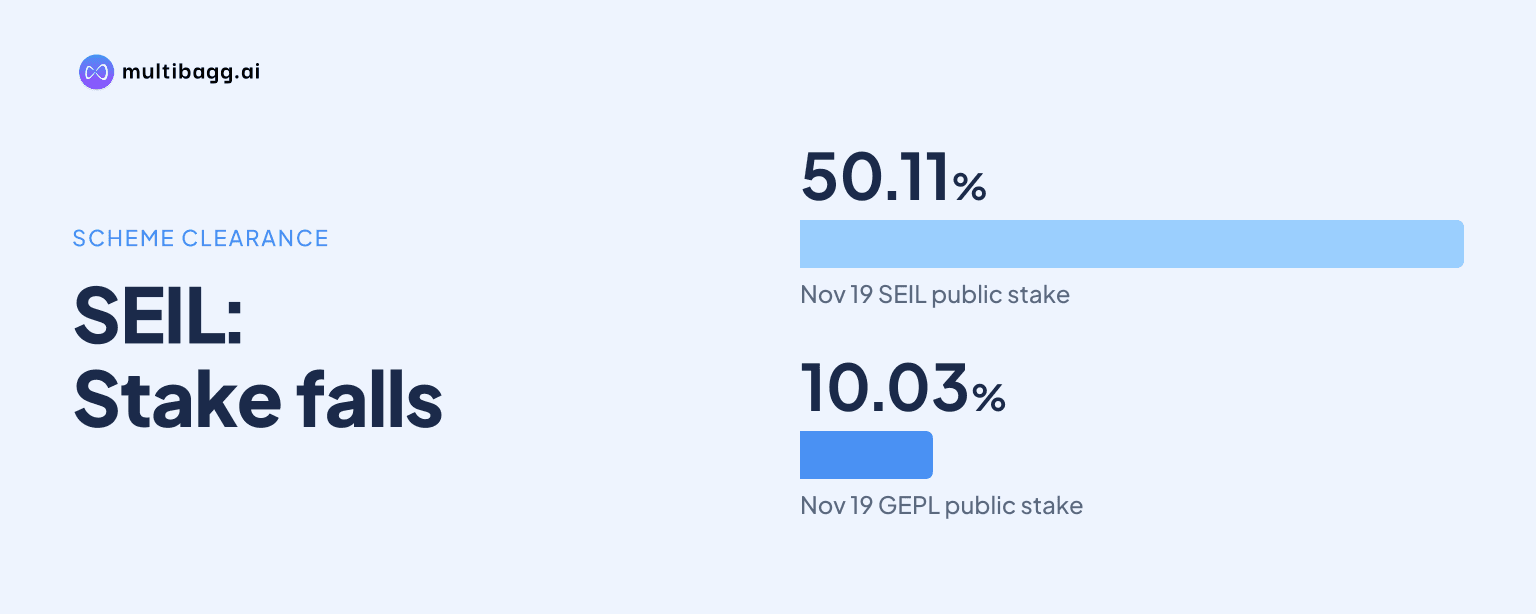
Shanti Educational Initiatives Limited received BSE’s no-adverse-observation letter on November 19, 2026, allowing an application to the National Company Law Tribunal while requiring disclosure that public shareholders’ interest would fall from 50.11% in SEIL to 10.03% in GEPL after the composite scheme.
Know Shanti Educational Initiatives inside out
Results, valuation, peers and who's buying, in one view.
What did BSE allow SEIL to do?
BSE allowed SEIL to file its composite scheme with the National Company Law Tribunal, or NCLT, after issuing its no-adverse-observation letter on November 19, 2026. The exchange said its observations were limited to matters affecting listing, delisting and continuous-listing requirements, rather than constituting final approval of the transaction.
The scheme involves SEIL as the transferor or amalgamating company, Shanti Learning Initiatives Private Limited, or SLIPL, as the transferee company, and Grew Energy Private Limited, or GEPL, as the amalgamated company. It is proposed under Sections 230 to 232 of the Companies Act, 2013, and was modified on November 4, 2026.
SEIL said the scheme remains subject to statutory and regulatory approvals and approvals from the shareholders and creditors of the entities involved. BSE required the companies to incorporate observations from the Securities and Exchange Board of India, or SEBI, and BSE in the NCLT petition, and said changes after the SEBI filing are permitted only when required by regulators, authorities or the tribunal.
The observation letter is valid for six months from November 19, 2026 under Regulation 37(3) of the SEBI Listing Obligations and Disclosure Requirements Regulations, 2015. The scheme therefore must be submitted to the NCLT within that period, while Competition Commission of India approval must be obtained before filing where that approval applies.
How would public ownership change under the SEIL scheme?
Public shareholders’ interest is stated to decline from 50.11% in SEIL before the scheme to 10.03% in GEPL after implementation, a decrease of 40.08 percentage points. BSE required this comparison to be prominently disclosed in the explanatory statement or notice sent to shareholders for approval under Sections 230 to 232.
BSE directed SEIL to put a before-and-after table of promoter, promoter-group and public shareholding on the first page of the shareholder-meeting notice. The disclosure must be bold and highlighted, state that approving the merger also means agreeing to the resulting increase in promoter ownership, and ask investors to read the scheme documents before voting.
The required shareholder materials must also explain the reason for the increase in promoter and promoter-group ownership and its impact on public shareholders’ rights and the value of their holdings. SEIL must disclose promoter-wise and aggregate promoter-group ownership in both SEIL and GEPL before and after the scheme, including the effects of warrant conversion and calls on GEPL’s partly paid shares.
Got a follow-up? Ask IRIS
What must SEIL disclose before shareholders vote?
SEIL must provide financial, valuation, asset-transfer and enforcement disclosures before seeking shareholder approval, including the SEBI order dated June 30, 2026 and Appeal No. 281 of 2026 before the Securities Appellate Tribunal. The disclosure requirement covers the companies, their promoters, directors and key managerial personnel, as well as the possible impact of those proceedings on GEPL.
The shareholder notice must include assets, liabilities, net worth and revenue for SEIL, SLIPL and GEPL before and after the scheme. It must also provide revenue, profit after tax, or PAT, and earnings before interest, tax, depreciation and amortisation, or EBITDA, for each entity for the last three financial years, along with financial statements not more than six months old from the date of the stock exchange no-objection certificate.
BSE also required disclosure of the registered valuers’ and merchant banker’s reports, the methods used for the 100:212 share-exchange ratio and slump-sale consideration, and the rationale and assumptions supporting those methods. The notice must cover sensitivity of GEPL’s value and the ratio to discount and growth rates, along with subsidy, call money and warrant money included in GEPL’s equity value and clarificatory notes dated November 3 and 4, 2026.
The materials must explain the value of SEIL assets and liabilities transferred to SLIPL and GEPL, assets retained by SEIL, and GEPL’s post-scheme balance sheet. They must also cover intellectual property retained by SEIL and vesting in GEPL, the terms under which SLIPL can use it, whether this is a related-party transaction, and whether any consideration is payable.
What conditions apply to GEPL shares and listing?
GEPL’s listing remains subject to separate SEBI relaxation under Rule 19(2)(b) of the Securities Contracts (Regulation) Rules, 1957, compliance with SEBI’s June 20, 2023 circular, BSE listing criteria and BSE’s discretion. BSE’s November 19, 2026 letter therefore permits an NCLT filing but does not assure that GEPL shares will list or receive trading permission.
GEPL must submit an information memorandum to BSE containing disclosures applicable to public issues and make it available through its own website. It must also publish a newspaper advertisement containing prescribed GEPL details and referring readers to the information memorandum available on the websites of both GEPL and BSE.
The scheme must provide that shares allotted under it remain frozen in the depository system until the designated stock exchange grants listing and trading permission. It must also provide that GEPL’s shareholding pattern will not change between the record date and listing where a change could affect the approval, while all scheme shares must be issued in dematerialised form.
The June 30, 2026 SEBI order sets a specific allotment mechanism for Vedprakash Devkinandan Chiripal and Savitridevi V. Chiripal. If the Securities Appellate Tribunal stay is vacated and a restraint is in force at allotment, GEPL must place the shares in a GEPL-controlled suspense account; if the stay is in force, shares go to demat accounts and must be frozen or locked if the restraint later revives. GEPL must also classify Vineeta Chiripal as part of its promoter group.
Conclusion
SEIL has passed a procedural stage because BSE’s November 19, 2026 letter permits an NCLT filing, but the letter attaches detailed transparency requirements rather than providing an unconditional endorsement. The central ownership change is public shareholders’ interest moving from 50.11% in SEIL to 10.03% in GEPL, alongside required disclosures on the 100:212 exchange ratio, valuation assumptions, partly paid shares and enforcement proceedings.
The next issue is whether SEIL submits the scheme to the NCLT within the six-month validity of BSE’s letter and obtains Competition Commission of India approval before filing where applicable. GEPL’s unresolved listing steps include SEBI relaxation under Rule 19(2)(b), its information memorandum, compliance with the June 20, 2023 SEBI circular, and BSE’s eventual listing and trading permissions.