










Sensex surges 2.68% as Nifty jumps 2.43% on cheaper crude
Key highlights
- Sensex gained 2,071.78 points, or 2.68%, to 79,373.18 in the latest reported trade.
- Nifty 50 rose 581.61 points, or 2.43%, to 24,542.20.
- Brent crude traded near $94.76 a barrel after a sharp sell-off.
- Bharti Airtel’s Q2 FY27 revenue rose 16.7% year on year to ₹60,878 crore.
powered by IRIS
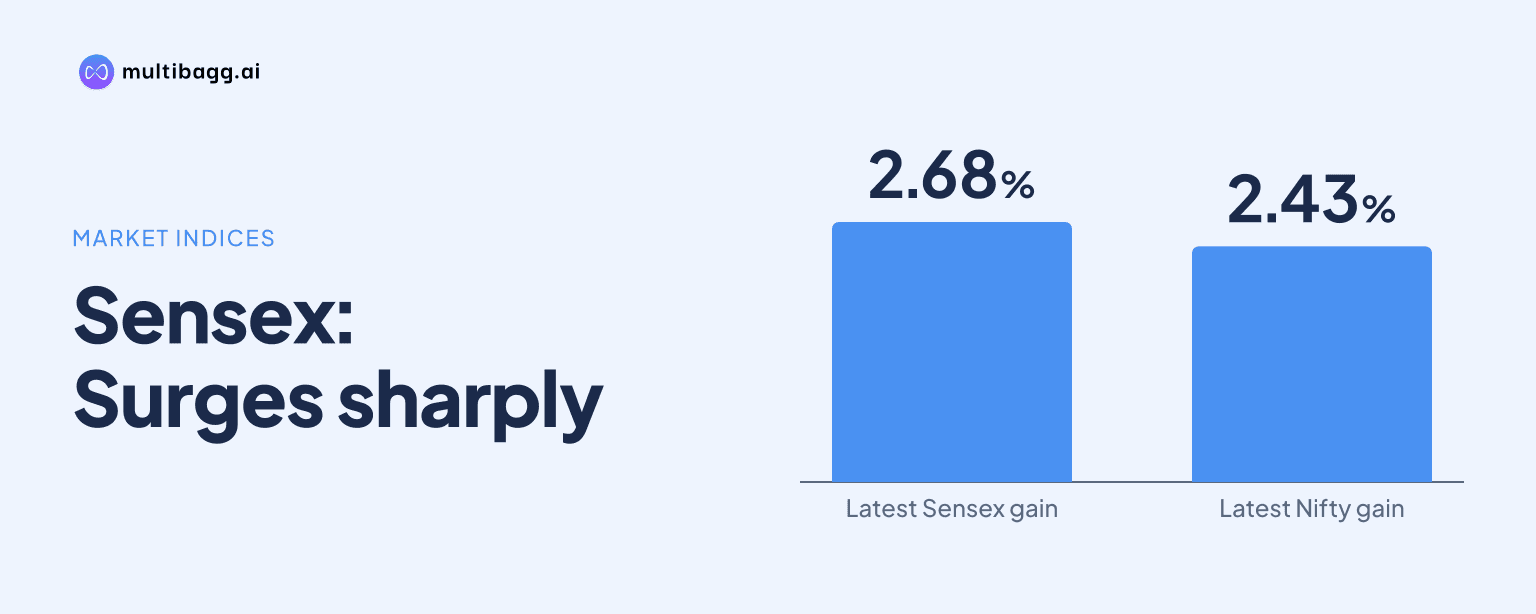
Sensex today surged 2,071.78 points, or 2.68%, to 79,373.18, while Nifty today rose 581.61 points, or 2.43%, to 24,542.20 as Brent crude fell below $95 a barrel and global risk appetite improved after the US midterm election outcome.
Why did the Indian stock market rally today?
The stock market today rallied because lower crude prices materially improved the near-term outlook for an oil-importing economy such as India. Cheaper oil can reduce pressure on the current account, temper fuel-led inflation risks and lower input costs for sectors ranging from transport to consumer companies. That gave investors a clear reason to add risk after a period dominated by concerns over energy prices and geopolitical uncertainty.
The move was not confined to a narrow set of large-cap shares. Market reports pointed to broad-based buying, with advances across cyclical and rate-sensitive pockets. The benchmark move also extended a six-session winning streak, underlining how quickly sentiment has improved as oil prices and global yields retreated.
Foreign investor participation added to the constructive backdrop. Reports indicated that overseas investors had returned as buyers in recent sessions, while one report cited more than ₹7,280 crore of secondary-market purchases on Wednesday. Flows can shift quickly, but their return has supported the sharp recovery in Indian equities.
How did Nifty and Sensex perform?
Nifty 50 rose 581.61 points to 24,542.20, up 2.43%, while the BSE Sensex gained 2,071.78 points to 79,373.18, up 2.68%, in the latest reported trade. Earlier in the session, the indices had already opened sharply higher, with the Sensex up 1,435.46 points and Nifty 50 up 395.20 points at 9:19 am.
The scale of the advance shows that the market was responding to a macro reset rather than a single domestic corporate trigger. Nifty had closed at 23,960.60 on November 4 after a 0.63% gain. Thursday’s sharp follow-through took it decisively above 24,500 during the session, while the Sensex moved past 79,000.
For investors, the important point is that the rally was driven by a tangible easing in a key macro headwind: energy costs. That is more consequential for the broader market than a short-lived rally in any one sector. Still, valuations, earnings delivery and overseas flows will determine whether the move can sustain.
Which sectors led and lagged the rally?
Autos, metals and banks were among the main leaders, reflecting the market’s preference for domestic cyclicals and beneficiaries of lower crude. The BSE Auto Index was reported up 3.5% in morning trade, while reports through the day also highlighted buying in realty shares.
Lower fuel costs are particularly relevant for autos, logistics and consumption-linked businesses, even though the extent of any earnings benefit varies by company. Banks can also attract buying when risk appetite improves and concerns about inflation or higher interest rates ease. Metal stocks participated in the broad risk-on move alongside stronger global sentiment.
The market was not uniformly positive. Telecom and power shares faced selling pressure in early trade, and energy stocks lagged as oil weakened. Bharti Airtel, NTPC and ITC were among stocks cited as early losers, while reports later named Apollo Hospitals, ONGC and NTPC among Nifty laggards. This divergence matters because a lower oil price benefits the Indian economy overall but can weigh on upstream energy companies.
Got a follow-up? Ask IRIS
What global cues shaped the move?
Global cues turned favourable after US markets rallied following the Democratic sweep in the midterm elections, which investors interpreted as reducing political uncertainty and constraining the scope for fiscal expansion. The S&P 500 rose 1.6% and the Nasdaq 100 added 0.9% in the cited market reports, while Asian markets were mixed rather than uniformly strong.
Oil was the critical transmission channel for India. Brent traded around $94.76 a barrel in early European dealings, while West Texas Intermediate was near $86.53. The decline followed a sharp previous-session sell-off as traders assessed US-Iran diplomacy and signs of recovering Middle East supply.
Treasury yields also eased to eight-week lows, supporting global equity valuations and weakening the US dollar. The rupee was reported at a two-week high, up 0.3% to 94.35 against the dollar. For Indian assets, softer yields and a less demanding dollar environment can improve the setting for foreign portfolio allocations.
What did corporate announcements signal?
Bharti Airtel reported Q2 FY27 consolidated revenue of ₹60,878 crore, a 16.7% year-on-year increase. Its net income before exceptional items rose 32.7% to ₹9,015 crore, providing a strong operational update even as telecom shares saw selling pressure in the broader session.
Adani Ports & Special Economic Zone said it has agreed to acquire 100% of Evos B.V. and its subsidiaries through a cash transaction, subject to regulatory approvals. The announcement puts focus on the company’s expansion strategy and the eventual financial and operational terms once approvals and transaction details progress.
Happy Forgings approved unaudited Q2 and first-half FY27 financial results and committed ₹500 crore for expansion in forging and machining capacity. The capex decision signals confidence in future demand, but investors will watch the project timeline, funding mix, capacity utilisation and return profile.
What should investors watch after this rally?
The immediate watchpoints are crude oil, foreign flows and whether the global relief trade holds after the first reaction to the US election outcome. Brent remaining below $100 would be supportive for India’s inflation, current-account and corporate-cost outlook, but oil remains sensitive to diplomatic developments and supply news.
Investors will also track US jobless claims and the Bank of England decision. The Bank of England was widely expected to raise its policy rate by 25 basis points to 4.00%, while US initial jobless claims were forecast at 196,000 against 194,000 previously. These events can influence global yields, currencies and risk appetite.
Corporate earnings remain the domestic test. Strong results and credible investment plans can broaden support beneath the indices, while misses could expose stocks that have risen quickly. A six-session advance is constructive, but it also raises the importance of disciplined position sizing rather than assuming every sector will benefit equally.
Conclusion
The November 5 advance in the Indian stock market was anchored in a 2.68% Sensex gain and a 2.43% rise in Nifty, with cheaper crude, softer global yields and renewed foreign buying creating a powerful tailwind. Autos, metals and banks captured the improved risk mood, while energy and selected defensive or telecom names did not participate to the same extent.
Next, investors should watch whether Brent holds below $100, the Bank of England policy signal, US labour-market data and the pace of foreign flows. Company-specific attention will remain on Bharti Airtel’s earnings momentum, regulatory progress on Adani Ports & Special Economic Zone’s Evos acquisition, and execution of Happy Forgings’ ₹500 crore capacity-expansion plan.