








Shalimar merger would create Rs 19,839 crore materials group
MAX Plan at ₹4,999/yr

Find your next multibaggerBe a Pro Investor
Research stocks and track your picks on the go. Download the app.
Key highlights
- Shalimar’s pro forma FY26 revenue would be Rs 19,839 crore, compared with standalone FY26 revenue of Rs 569 crore.
- Pro forma FY26 EBITDA would be Rs 1,709 crore at an 8.6% margin, compared with Shalimar’s Rs 18.50 crore standalone EBITDA loss.
- The proposed combined platform would have 283 plants across 22 states, compared with Shalimar’s three paint plants.
- Existing Shalimar public shareholders are shown with 0.7% ownership after the merger under the scheme’s non-diluted illustration.
powered by IRIS
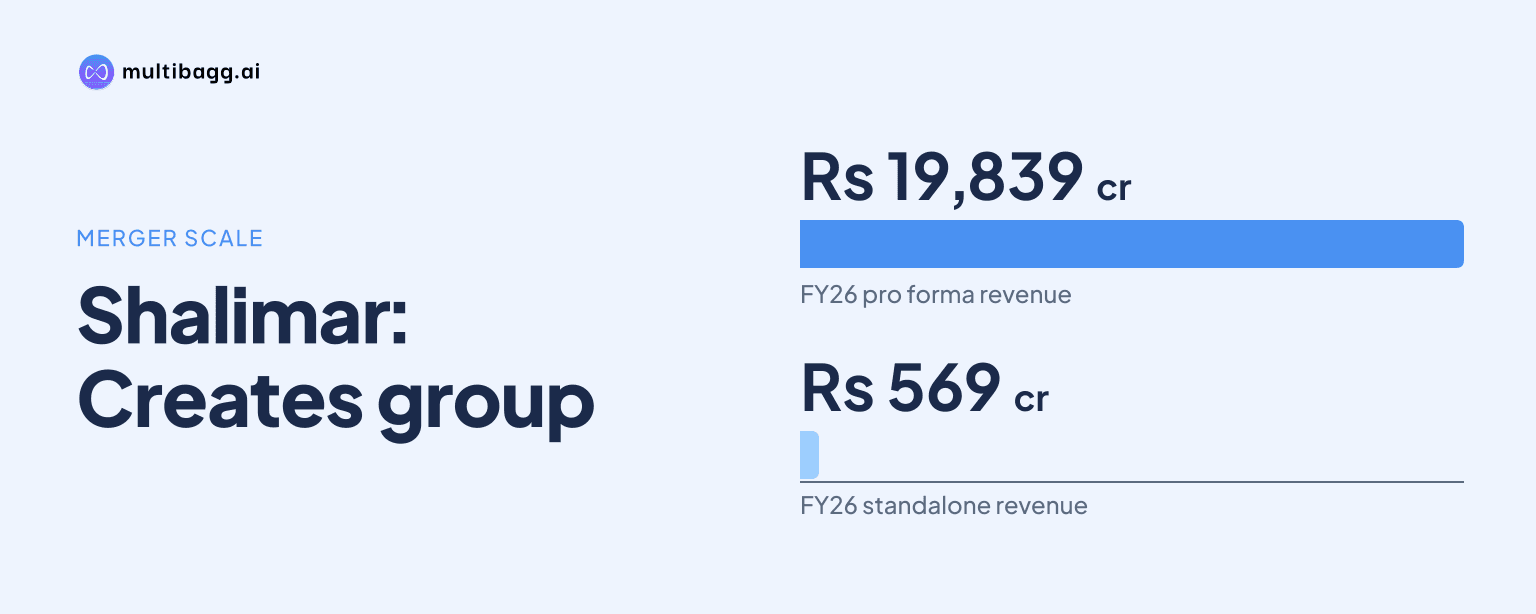
Shalimar Paints Limited’s proposed merger with Infra.Market would create a pro forma FY26 construction-materials platform with Rs 19,839 crore of revenue and Rs 1,709 crore of EBITDA, compared with Shalimar’s standalone Rs 569 crore revenue and Rs 18.50 crore EBITDA loss in FY26. The Board-approved transaction remains subject to required approvals.
Know Shalimar Paints inside out
Results, valuation, peers and who's buying, in one view.
What would the Shalimar merger change?
The Shalimar merger would turn the listed company from a paints-only business into the proposed listed parent of an integrated construction-materials platform spanning 11 in-house brands and 15 categories. The combined portfolio is presented as covering 90% to 95% of materials in a typical construction project, from ready-mix concrete, aggregates and AAC blocks to tiles, wood panels, electricals and paints.
The financial and manufacturing scale would change substantially under the pro forma comparison. Shalimar reported standalone FY26 revenue of Rs 569 crore and negative EBITDA of Rs 18.50 crore, whereas the proposed combined platform reported pro forma FY26 revenue of Rs 19,839 crore and EBITDA of Rs 1,709 crore at an 8.6% margin. Its manufacturing network would comprise 283 plants, including 163 owned and 120 exclusive facilities, across 22 states, against Shalimar’s three paint plants.
The proposed structure starts with a share swap in which Infra.Market shareholders would receive 3.14 Shalimar shares for each Infra.Market share, followed by the merger of Infra.Market into Shalimar. Shalimar would remain listed on the National Stock Exchange and BSE, while the presentation says cross-holdings would be cancelled to create one listed parent for the group.
How has the proposed Shalimar platform performed?
The proposed Shalimar platform reported a 19% revenue compound annual growth rate and a 31% EBITDA compound annual growth rate between FY23 and FY26. Revenue increased from Rs 11,847 crore in FY23 to Rs 19,839 crore in FY26, while EBITDA margin expanded from 6.4% to 8.6% over the same period.
H1 FY27 showed further growth in the pro forma business, based on limited-reviewed figures. Revenue rose 10.1% year on year to Rs 10,302 crore from Rs 9,355 crore in H1 FY26, while EBITDA rose 19.2% to Rs 868 crore and the EBITDA margin increased to 8.4% from 7.8%. Profit after tax was Rs 116 crore in H1 FY27, described in the presentation as 3.2 times the previous-year level.
Management attributes the margin progression to a higher contribution from own brands and manufacturing. Own-brand revenue increased from 33% in FY22 to 69% in FY26, while manufactured finished goods increased from about 4% to 51% of revenue. Contribution margin rose from 10.3% to 15.3%, although these business-mix and contribution-margin figures are management information and unaudited.
The two sales channels also have different economics. Business-to-business direct-to-site revenue represented 75.3%, or Rs 14,848 crore, of FY26 revenue and had an approximately 13.5% contribution margin. Business-to-retail revenue represented 24.7%, or Rs 4,870 crore, with an approximately 17.9% contribution margin; retail touchpoints reached 21,304 in FY26 after a 3.4 times increase from 6,303 over three years.
Got a follow-up? Ask IRIS
How would the Shalimar merger reshape ownership?
The Shalimar merger would reduce the indicated holding of existing public shareholders to 0.7% under the scheme’s non-diluted post-merger illustration. That compares with a reported public holding of 25.04% on 30 September 2026, before the qualified institutions placement, while Infra.Market shareholders would receive new Shalimar shares under the 3.14-to-one swap ratio.
Founders and the promoter group would hold 30.0% of post-merger Shalimar, including a 0.7% holding for the Jindal Group. Among the named institutional investors, Tiger Global would hold 20.4%, Accel 14.9%, Nexus Venture Partners 7.4% and Evolvence 5.9%; NKSquared, Ashish Kacholia and other Infra.Market investors would collectively hold 15.2%.
The ownership illustration includes 5,19,48,051 equity shares issued through Shalimar’s Rs 400 crore qualified institutions placement at Rs 77 per share, which closed on 20 November 2026. It excludes employee stock options and any equity issuance or dilution after the presentation date, meaning final ownership may differ when the transaction closes.
The presentation also identifies a wider route to market for Shalimar’s paints. The combined business reported more than 1,500 corporate customers and more than 20,000 business-to-retail touchpoints, compared with Shalimar’s 7,300-plus retail touchpoints and 48 sales depots. Management’s stated plan is to take Shalimar paints into project channels and cross-sell other group categories through the broader network.
What must happen before the Shalimar merger closes?
The Shalimar merger requires approvals from shareholders, creditors, stock exchanges, the Securities and Exchange Board of India, the National Company Law Tribunal, lenders and other regulators. The scheme gives 1 April 2027 as the proposed appointed date for the merger, while December 2026 is identified separately as the tentative point when Shalimar would consolidate Infra.Market after completion of the share swap.
The combined financial position includes Rs 5,873 crore of total debt for the 12 months ended 30 September 2026. Debt to EBITDA declined to 3.2 times for that period from 4.1 times in FY25 and 3.4 times in FY26. Management says future equity raised is intended primarily to reduce debt, but the presentation does not specify a post-merger debt target.
Cash flow improved in H1 FY27, when free cash flow before capital expenditure was Rs 275 crore, compared with negative Rs 187 crore in H1 FY26. EBITDA-to-cash conversion was 88%, while capital expenditure fell 47% in FY26. Management says existing plants have two to three times volume headroom and therefore no major new capital expenditure is required under its current plan.
Management’s priorities include completing integration, increasing private-label revenue, expanding the business-to-retail network and cross-selling to corporate customers. The presentation also identifies ready-mix concrete utilisation of 27.0% and medium-density fibreboard utilisation of 16.7%, supporting management’s intention to increase volumes from plants commissioned over the last three years.
Conclusion
The proposed transaction would materially alter Shalimar’s scale, profitability profile, manufacturing footprint and shareholder register. A standalone paints company with Rs 569 crore of FY26 revenue and negative Rs 18.50 crore EBITDA would become the listed vehicle for a pro forma Rs 19,839 crore, 15-category platform with Rs 1,709 crore of EBITDA and 283 plants.
The next disclosed milestones are completion of the share swap, tentative consolidation from December 2026 and the proposed 1 April 2027 appointed date for the merger. Investors will need to watch the required approvals, any additional dilution, the management-stated deleveraging plan for Rs 5,873 crore of debt, and progress on integration, capacity utilisation and cross-selling.

