








Shalimar merger would create ₹19,839 crore materials platform
MAX Plan at ₹4,999/yr

Find your next multibaggerBe a Pro Investor
Research stocks and track your picks on the go. Download the app.
Key highlights
- The proposed platform had ₹19,839 crore of pro forma FY26 revenue and ₹1,709 crore of EBITDA.
- Shalimar reported ₹569 crore of FY26 standalone revenue and negative EBITDA of ₹18.5 crore.
- The proposed company would have 283 plants in 22 states and more than 20,000 B2R touchpoints.
- Infra.Market shareholders would receive 3.14 Shalimar shares for every Infra.Market share, subject to approvals.
powered by IRIS
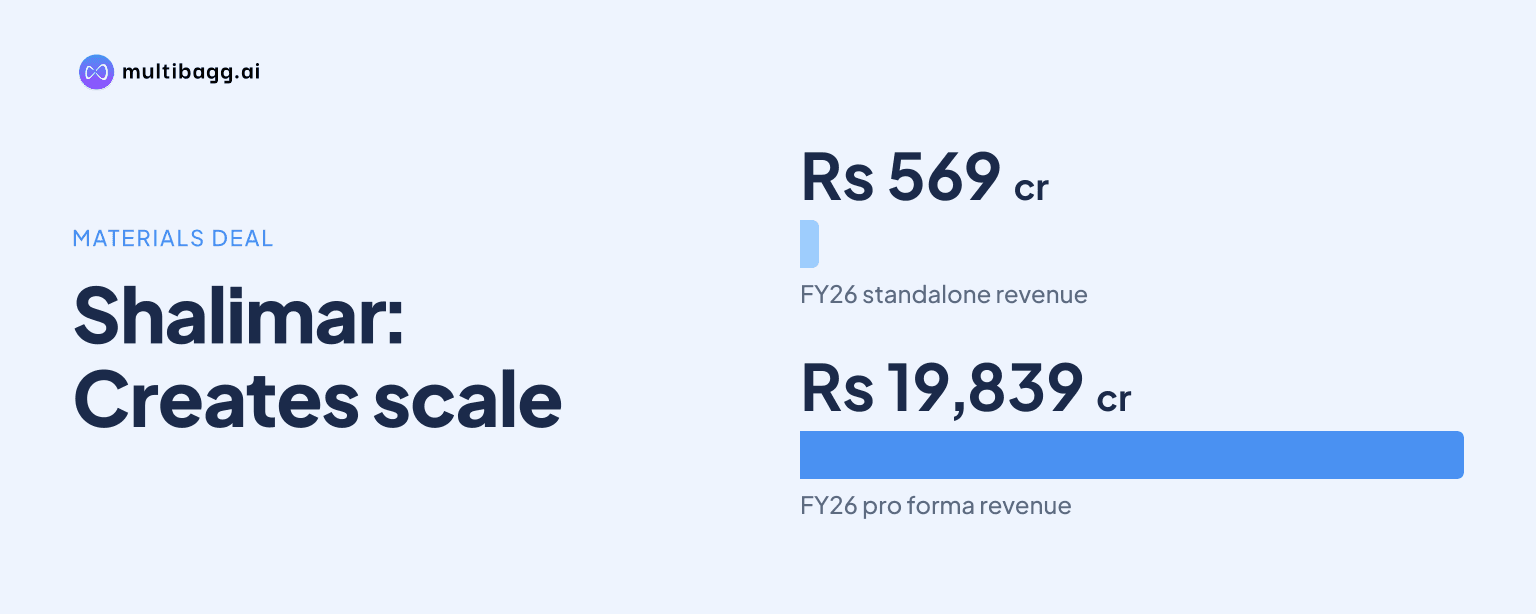
In FY26 pro forma terms, Shalimar Paints Limited’s proposed merger with Hella Infra Market Limited would create a ₹19,839 crore construction-materials platform with ₹1,709 crore of EBITDA, subject to required approvals. Shalimar’s standalone FY26 revenue was ₹569 crore and its EBITDA was negative ₹18.5 crore, compared with the proposed platform’s 8.6% EBITDA margin.
Know Shalimar Paints inside out
Results, valuation, peers and who's buying, in one view.
What would the proposed Shalimar merger do?
The proposed transaction would combine Shalimar and Infra.Market in one company that remains listed on the National Stock Exchange and BSE. Shalimar currently sells decorative and industrial paints, while the proposed platform would include 11 in-house brands across 15 categories, covering 90% to 95% of materials used in a typical construction project.
The process has two stages. Infra.Market shareholders would first swap their holdings for newly issued Shalimar shares, followed by Infra.Market’s merger into Shalimar at 3.14 Shalimar shares for each Infra.Market share. The Shalimar Board approved the share swap and merger in November 2026, but the scheme still requires approvals from shareholders, creditors, stock exchanges, the Securities and Exchange Board of India, the National Company Law Tribunal, other regulators and lenders.
Shalimar’s paints would become the final-coat category within a portfolio that also includes ready-mix concrete, aggregates, cement, steel, autoclaved aerated concrete blocks, tiles, sanitaryware, plywood, medium-density fibreboard, kitchens, electrical products and equipment services. Management lists pooled manufacturing, procurement, logistics and technology as expected benefits, alongside lower compliance and administrative costs; these are scheme objectives rather than reported results.
How much larger would Shalimar become after the merger?
Shalimar would move from ₹569 crore of audited standalone FY26 revenue to ₹19,839 crore of pro forma FY26 revenue, while its EBITDA would shift from negative ₹18.5 crore to ₹1,709 crore. EBITDA means earnings before interest, tax, depreciation and amortisation, and the proposed platform’s FY26 EBITDA margin was 8.6%.
The proposed platform would have 283 plants, comprising 163 owned and 120 exclusive facilities, across 22 states. Shalimar’s existing network includes three plants, 7,300-plus retail touchpoints and 48 sales depots, whereas Infra.Market reports more than 20,000 business-to-retail, or B2R, touchpoints and more than 1,500 corporate customers.
Infra.Market generated ₹14,848 crore, or 75.3% of FY26 revenue, from business-to-business direct-to-site sales. Its B2R channel accounted for ₹4,870 crore, or 24.7%, and served homeowners, contractors and small builders. For the 12 months to September 2026, the presentation gives illustrative, unaudited pro forma revenue of ₹20,786 crore, calculated using FY26 revenue, H1 FY26 revenue of ₹9,355 crore and H1 FY27 revenue of ₹10,302 crore.
Got a follow-up? Ask IRIS
How would Shalimar’s shareholder base change?
Shalimar’s ownership would change substantially because Infra.Market investors would receive shares through the swap. The scheme’s non-diluted illustration gives founders and the promoter group a 30.0% holding after the merger, including a 0.7% Jindal Group interest, compared with a 74.96% promoter-group holding reported on 30 September 2026 before the qualified institutions placement, or QIP.
Before the QIP, Infra.Market held 52.85% of Shalimar and the Jindal Group held 22.11%, while public shareholders held 25.04%. The QIP raised ₹400 crore at ₹77 per share and closed on 20 November 2026. The post-merger illustration includes 5,19,48,051 shares allocated in that issue and is based on shareholding as of 6 November 2026.
Tiger Global (Internet Fund V) is indicated to hold 20.4%, Accel 14.9%, Nexus Venture Partners 7.4% and Evolvence 5.9% after the merger. The scheme groups institutional and other Infra.Market investors at 67.5%, QIP investors at 1.8% and existing Shalimar public shareholders at 0.7%; these estimates exclude employee stock options and any equity issuance after the presentation date.
Infra.Market co-founders Souvik Sengupta and Aaditya Sharda are identified as continuing leaders, with Sengupta as chief executive officer and Sharda as chief operating officer. Their business was founded in 2016 and is also backed by Sistema Asia Fund, Foundamental, NKSquared, Ashish Kacholia and other investors named in the presentation.
What operating evidence supports the proposed platform?
Infra.Market’s audited FY26 results show a greater role for manufacturing and own brands than in FY22. Revenue from own manufacturing rose from about 4% in FY22 to 51% in FY26, while own-brand revenue increased from 33% to 69%; the remaining FY26 mix was 18% third-party distribution and 13% services and other activities.
Its contribution margin, a management-provided unaudited measure, rose by 500 basis points from 10.3% in FY22 to 15.3% in FY26. One basis point equals one-hundredth of a percentage point. EBITDA margin increased from 6.4% in FY23 to 8.6% in FY26, alongside a 31% EBITDA compound annual growth rate and a 19% revenue compound annual growth rate over FY23 to FY26.
B2R was the faster-growing channel over FY22 to FY26, with a 63.6% revenue compound annual growth rate against 41.4% for business-to-business sales. Management reports contribution margins of about 17.9% in B2R and about 13.5% in business-to-business, while retail touchpoints rose 3.4 times from 6,303 to 21,304 over three years.
Shalimar’s standalone EBITDA loss narrowed from ₹46.8 crore in FY25 to ₹18.5 crore in FY26. In H1 FY26 versus H1 FY25, manpower cost fell from 15.4% to 12.9% of sales, operating expenses declined from 20.6% to 17.9%, and production cost per litre reduced from ₹7.3 to ₹6.6. The proposed platform reported total debt of ₹5,873 crore and debt to EBITDA of 3.2 times for the 12 months to September 2026, down from 4.1 times in FY25.
Conclusion
The proposed scheme would replace Shalimar’s FY26 standalone paints profile of ₹569 crore revenue and negative ₹18.5 crore EBITDA with an illustrative ₹19,839 crore construction-materials platform generating ₹1,709 crore of EBITDA. It would also combine Shalimar’s three plants and 7,300-plus touchpoints with Infra.Market’s 283 plants, 20,000-plus B2R touchpoints and more than 1,500 corporate customers.
The next disclosed milestone is the tentative completion of the share swap in December 2026, when Shalimar expects to begin consolidating Infra.Market if the swap completes. The proposed appointed date for Infra.Market’s merger is 1 April 2027, but that timing remains conditional on shareholder, creditor, lender, stock-exchange, regulatory and tribunal approvals.

