










Shalimar Paints: Tiger Global and Accel set for 36% stake
Key highlights
- Tiger Global and Accel would own 20.8% and 15.2%, respectively, for a combined 36.0%.
- The founders and promoter group would hold 30.6%, including the Jindal Group’s 0.7%.
- Existing Shalimar Paints public shareholders would retain 0.7%, versus 25.04% before the proposed transaction.
- The proposed share swap gives 314 Shalimar Paints shares for every 100 Infra.Market shares.
powered by IRIS
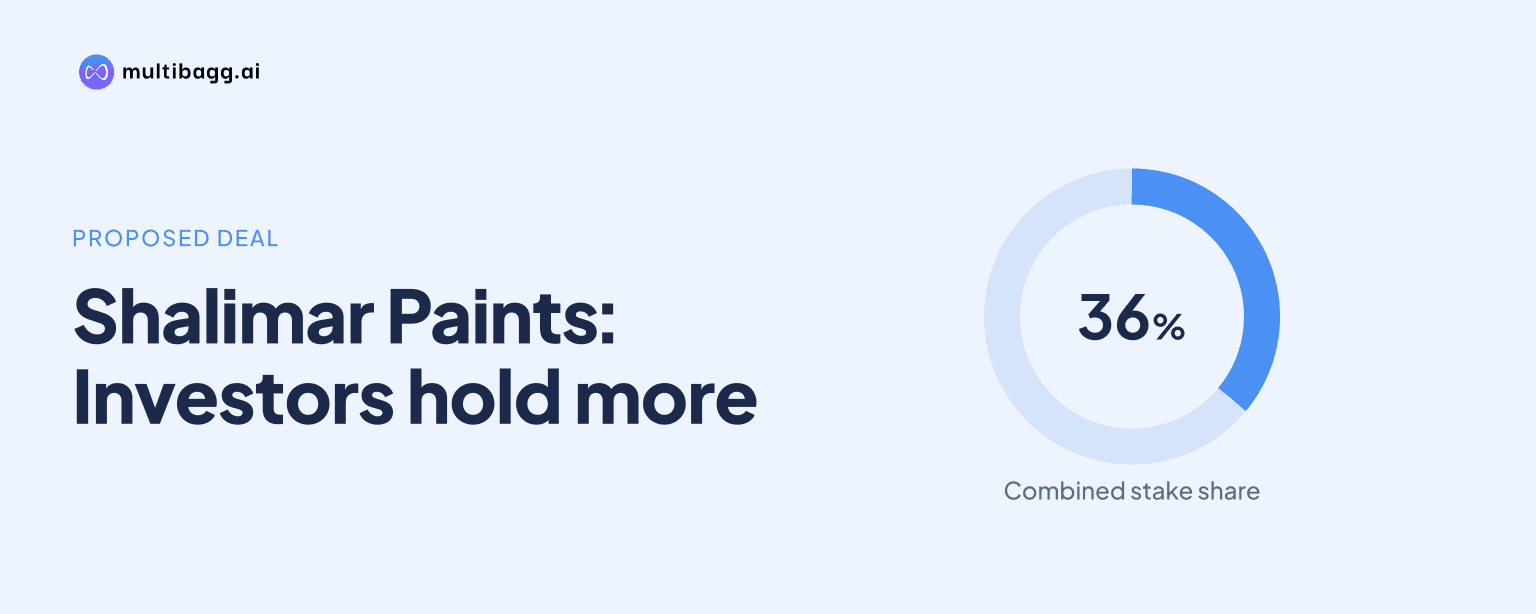
Shalimar Paints Limited’s proposed Infra.Market merger would give Tiger Global and Accel a combined 36.0% stake in Shalimar Paints, based on non-diluted holdings as of 6 November 2026. The scheme allocates 20.8% to Tiger Global and 15.2% to Accel, while existing public shareholders would retain 0.7%, subject to approvals.
Know Shalimar Paints inside out
Results, valuation, peers and who's buying, in one view.
Who will own Shalimar Paints after the Infra.Market merger?
Tiger Global would own 20.8% of Shalimar Paints after completion and Accel would own 15.2%, resulting in a combined 36.0% holding. The disclosed structure is based on the Scheme of Amalgamation and the shareholder register as of 6 November 2026, on a non-diluted basis that excludes employee stock option plans, or ESOPs.
The founders and promoter group would hold 30.6%, including a 0.7% stake attributed to the Jindal Group. Nexus Venture Partners would own 7.5%, Evolvence 6.0%, Sistema Asia Fund 1.9% and Foundamental 1.8%, while Nikhil and Nithin Kamath through NKSquared, Ashish Kacholia and other Infra.Market investors would collectively hold 15.5%.
The proposed register would differ substantially from Shalimar Paints’ standalone ownership, where the promoter group holds 74.96% and public shareholders hold 25.04%. Under the scheme, Infra.Market founders and institutional and other investors would hold 68.7%, while legacy public shareholders’ interest would decline by 24.34 percentage points to 0.7%.
How will the Shalimar Paints and Infra.Market share swap work?
Infra.Market shareholders would receive 314 Shalimar Paints equity shares for every 100 Infra.Market equity shares held on a fully diluted basis. The ratio equals 3.14 Shalimar Paints shares for each Infra.Market share, with face values of Rs 2 per Shalimar Paints share and Rs 10 per Infra.Market share.
Shalimar Paints’ board approved the proposed transaction on 16 November 2026. The transaction would first bring Infra.Market shareholders into Shalimar Paints through the share swap, followed by Infra.Market’s merger into Shalimar Paints as the listed parent of the combined group.
Infra.Market’s existing shareholding in Shalimar Paints would be cancelled under the scheme, eliminating the cross-holding. Existing Shalimar Paints public shareholders would keep their existing shares, but their collective ownership would become 0.7% after shares are issued to Infra.Market shareholders.
The share-swap ratio is supported by an independent registered valuer’s report, and a Securities and Exchange Board of India, or SEBI, registered merchant banker has issued a fairness opinion. Completion remains subject to shareholder, regulatory and other approvals, so the disclosed 36.0% holding is an expected outcome rather than a completed ownership change.
What business would Shalimar Paints shareholders own after completion?
Shalimar Paints would become the listed vehicle for a pro forma FY26 business reporting revenue from operations of Rs 19,839 crore and earnings before interest, tax, depreciation and amortisation, or EBITDA, of Rs 1,709 crore. That compares with Shalimar Paints’ standalone FY26 revenue of Rs 569 crore and negative EBITDA of Rs 18.5 crore.
The pro forma business reported an FY26 EBITDA margin of 8.6%, using financial information derived from Infra.Market’s consolidated results, which already consolidate Shalimar Paints. Its product range would span structural materials, finishing products, lifestyle categories and other activities rather than decorative and industrial paints alone.
Structural materials, including ready-mix concrete, steel, aggregates, construction chemicals and cementitious products, would account for 64.0% of FY26 pro forma revenue. Lifestyle products, including tiles, sanitaryware, paints, electrical appliances, modular kitchens and hardware, would account for 14.3%, while finishing categories would contribute 12.2%.
The source attributes the change in profitability to a shift toward own brands, owned manufacturing and retail. Own brands rose from 33% of revenue in FY22 to 69% in FY26, third-party distribution represented 18% in FY26, and the EBITDA margin increased from 5.6% in FY22 to 8.6% in FY26.
Got a follow-up? Ask IRIS
How would the merger change Shalimar Paints’ operating footprint?
The combined Shalimar Paints would have more than 250 plants in 22 states, including more than 150 owned facilities and remaining capacity operated through exclusive tie-ups. This compares with 3 plants for Shalimar Paints before the proposed transaction and would add construction materials from structural work through finishing products.
The combined route to market would include more than 20,000 retail touchpoints and more than 1,500 corporate customers, compared with Shalimar Paints’ more than 7,300 retail touchpoints. Management says the wider network would create opportunities to cross-sell concrete, blocks, steel, tiles, wood panels and paints into a shared project pipeline.
Management says the existing manufacturing base can support two to three times current volumes across manufactured categories, including ready-mix concrete, AAC blocks, steel, tiles, wood panels and paints, without substantial further capital expenditure. This is management’s capacity assessment following a three-year manufacturing build-out, after which capital expenditure nearly halved in FY26.
Retail touchpoints grew 23% in FY26, according to the announcement, while the combined portfolio would cover 90% to 95% of a project’s needs. The source describes expected benefits from pooled manufacturing, procurement, logistics and technology, alongside lower compliance and administrative costs from operating as one listed company.
What could alter the disclosed Shalimar Paints ownership percentages?
The disclosed post-merger percentages exclude a qualified institutions placement, or QIP, of up to Rs 1,000 crore approved by Shalimar Paints’ board and shareholders. If Shalimar Paints undertakes that fundraising, additional equity issuance would change the 20.8% Tiger Global, 15.2% Accel and 0.7% existing-public-shareholder figures.
The shareholding schedule also excludes ESOPs and aggregates affiliated investor entities, while individual percentages are rounded and may not add precisely to 100.0%. Tiger Global’s stated 20.8% and Accel’s 15.2% nevertheless total 36.0% on the disclosed figures.
Shalimar Paints would remain listed on NSE and BSE if the transaction completes. The announcement identifies approval timing, economic and industry conditions, raw-material prices and competition among risks that could affect forward-looking statements concerning the combined company.
Conclusion
The proposed transaction would reshape Shalimar Paints from a paint company with a 74.96% promoter holding into a listed construction-materials platform where Infra.Market founders and investors would own 68.7%. Tiger Global and Accel would be the two largest named institutional holders, with 36.0% combined, compared with 30.6% for the founders and promoter group.
The next disclosed item to watch is whether Shalimar Paints proceeds with the approved QIP of up to Rs 1,000 crore, because it would alter the non-diluted ownership percentages based on 6 November 2026. Shareholder, regulatory and other approvals are also required before the 3.14-for-one share swap and subsequent merger can be completed.