










Shera Zambia Limited sells 8.6 MT before Q4FY27 operations
Key highlights
- Shera Zambia produced and fully sold an 8.6-MT batch of 99.99%-purity copper cathode during pilot testing.
- Shera Zambia targets Q4FY27 commercial operations with Phase 1 capacity planned at 1,200 MT a year.
- The presentation identifies a proposed expansion from 1,200 MT to 5,000 MT of annual cathode capacity.
- Shera's wider capacity utilisation increased to 78% in FY26 from 74% in FY25.
powered by IRIS
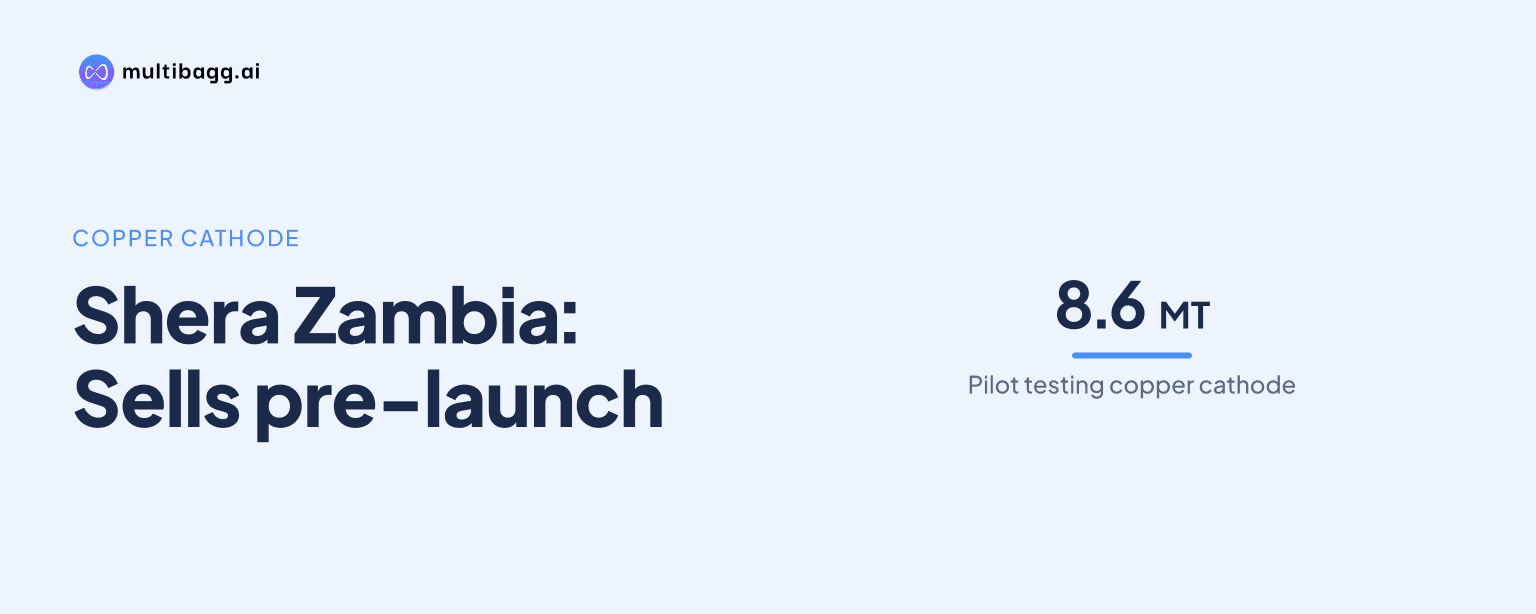
Shera Zambia Limited produced and fully sold an 8.6-MT batch of 99.99%-purity copper cathode in pilot testing, providing its first disclosed sales validation before targeted Q4FY27 commercial operations. The pre-commercial Copperbelt facility has Phase 1 capacity planned at 1,200 MT a year and a proposed scale-up to 5,000 MT a year.
Know Shera Energy inside out
Results, valuation, peers and who's buying, in one view.
What did Shera Zambia's first cathode sale demonstrate?
Shera Zambia's first cathode sale demonstrated that the pilot plant produced a saleable 8.6-MT batch and sold the entire output. The presentation says the trial material was 99.99%-purity copper cathode, and describes the completed sale as validation of both the production process and demand. This is a pilot-stage transaction, rather than evidence of sustained output at the planned 1,200-MT annual Phase 1 capacity.
The facility was pre-commercial and at the pilot stage when the presentation was issued. In June 2025, Shera Zambia entered a profit-sharing arrangement with existing owners of a previously non-functional, second-hand plant in Zambia's Copperbelt Province. The disclosed 8.6-MT sale therefore follows work to restore and test an existing plant rather than production from a newly built commercial operation.
The presentation does not disclose the batch's selling price, production cost, recovery rate, ore throughput or frequency of future pilot production. It also gives no monthly production figure against the 1,200-MT annual Phase 1 capacity. The first sale establishes a completed production and demand test, but it does not quantify the economics or consistency of cathode production.
How does Shera Zambia change the copper supply chain?
Shera Zambia is designed to move Shera upstream from buying copper cathode to producing cathode internally. Before the Zambia project, Shera entered the chain at copper rod and wire, purchasing cathode externally at prices linked to the London Metal Exchange, or LME. The presentation identifies cathode as the group's largest input cost and says margins in the existing model depend on scale, efficiency and downstream specialisation.
After the Zambia project, Shera plans to enter at the cathode stage through access to Zambian ore. Shera Zambia is in Copperbelt Province, adjacent to the Democratic Republic of Congo, which the presentation describes as one of the world's premier copper-bearing regions. The stated location advantage is access to locally sourced copper ore, although the material does not provide ore volumes, grades, supplier contracts or purchase terms.
This is backward integration alongside Shera's downstream product programme. The presentation lists continuously transposed conductor, or CTC, super-fine enamel wire, bunched strips, solar photovoltaic ribbons, busbars and copper and nickel alloys. CTC trials were complete, with full-scale production expected by year-end, while super-fine enamel wire, photovoltaic ribbons, busbars and nickel-iron alloys were already in commercial production.
Got a follow-up? Ask IRIS
What capacity, ownership and timing has Shera Zambia disclosed?
Shera Zambia has disclosed a 1,200-MT-a-year Phase 1 capacity plan, a Q4FY27 commercial-operations target and a proposed expansion to 5,000 MT a year. Its intended product is 99.99%-purity copper cathode, the same purity stated for the first 8.6-MT pilot batch. The presentation does not state the capital expenditure, commissioning budget, expected utilisation or conditions required for the proposed 5,000-MT expansion.
The detailed plant slide gives Shera Energy a 99.50% stake in Shera Zambia. A later positioning slide states that the Zambia operation is 99.8% owned, leaving a 0.30-percentage-point difference that the supplied presentation does not explain. Both disclosures indicate Shera Energy holds a controlling interest, but the precise ownership figure requires clarification.
The distinction between pilot output and nameplate capacity remains important. The only actual cathode output disclosed is the 8.6-MT batch, while 1,200 MT is the annual Phase 1 capacity plan. No plant availability, yield, commissioning progress or run-rate output has been reported, so the presentation does not allow a calculation of progress toward commercial-scale production.
How could the Zambia project affect Shera's costs and supply?
Shera Zambia could replace a portion of externally purchased cathode with captive output, but the presentation provides no quantified cost saving or margin effect. Management describes self-produced cathode as margin-accretive because it adds an upstream layer to a conversion business and turns the largest raw-material cost into an owned asset. That is management's strategic rationale, not a financial outcome established by the 8.6-MT pilot sale.
The project is also positioned against India's reliance on imported copper inputs. The presentation says India imports 90% to 95% of its copper ore requirement, while domestic mining meets only 3% to 5%. Shera's stated plan is to combine upstream cathode production in Zambia with its domestic copper, aluminium and brass manufacturing lines.
Shera's broader operating platform reported 78% capacity utilisation in FY26, up from 74% in FY25. It also has an in-house recycling operation through Rajputana Industries with capacity of 18,100 MT a year. That recycling capacity is distinct from the Zambia project: Rajputana Industries supports a scrap-to-metal loop, while Shera Zambia is intended to provide primary copper cathode production.
Conclusion
Shera Zambia's fully sold 8.6-MT batch is the first disclosed operating proof that its Copperbelt pilot facility can produce and market 99.99%-purity copper cathode. The result supports Shera's plan to move upstream from LME-linked cathode purchases while its domestic platform expands products including CTC, super-fine enamel wire, photovoltaic ribbons and busbars.
The next disclosed milestone is the Q4FY27 target for commercial operations at the 1,200-MT-a-year Phase 1 facility. Investors will need to watch for repeated production data, plant utilisation, the economics of captive cathode versus purchased material, clarification of the 99.50% and 99.8% ownership disclosures, and any decision to pursue the proposed 5,000-MT expansion.