










Shree Rajasthan Syntex Ltd. Fully Utilises ₹10.77 Crore Issue Funds
Key highlights
- Shree Rajasthan Syntex's Board approved unaudited standalone Q2 and H1 FY27 results on November 5, 2026.
- Shree Rajasthan Syntex fully utilised ₹10.77 crore of preferential-issue funds by September 30, 2026.
- Shree Rajasthan Syntex used ₹10.09 crore by June 30, 2026 and a further ₹0.27 crore during the September-quarter period.
- Shree Rajasthan Syntex reported a standalone net loss of ₹8.08 crore for FY26, compared with ₹14.38 crore in FY25.
powered by IRIS
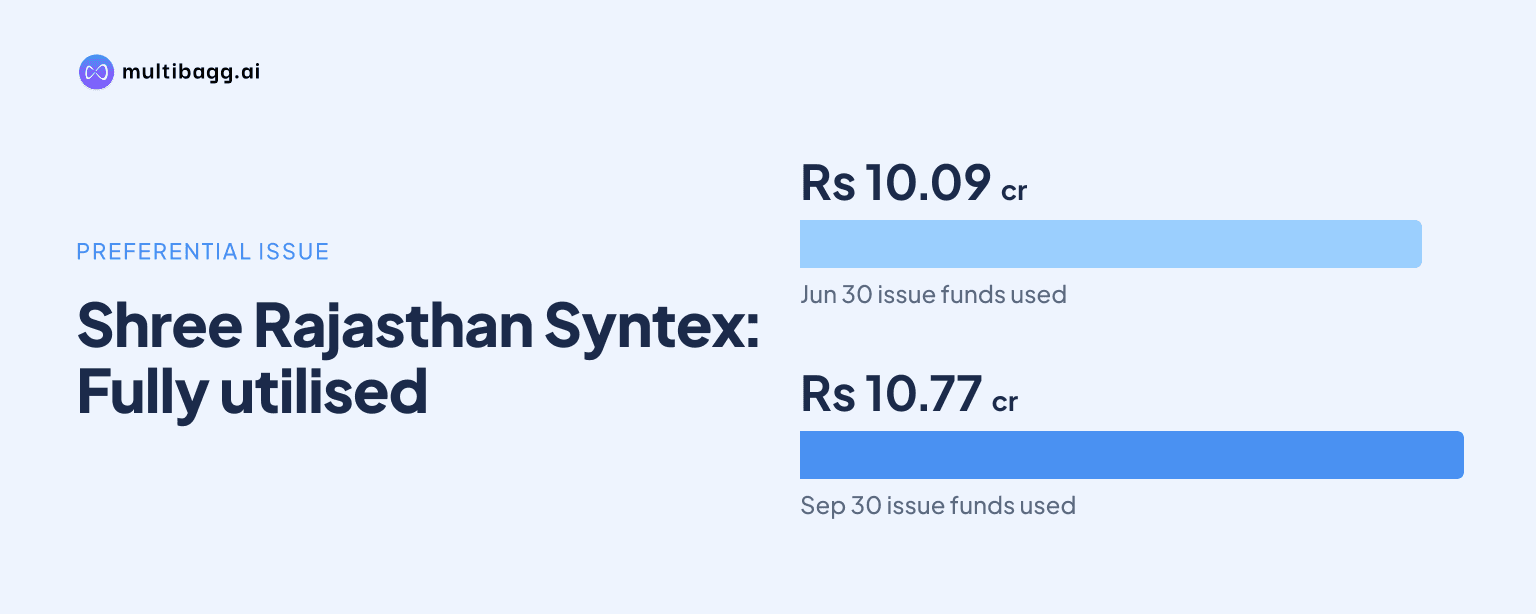
On November 5, 2026, Shree Rajasthan Syntex Ltd. announced its unaudited standalone Q2 and H1 FY27 results and confirmed that ₹10.77 crore raised through a preferential issue had been fully used by September 30, 2026, with no deviation from stated objects.
Know Shree Rajasthan Syntex inside out
Results, valuation, peers and who's buying, in one view.
What did Shree Rajasthan Syntex approve at its November 5 board meeting?
Shree Rajasthan Syntex approved its unaudited standalone financial results for the quarter and half-year ended September 30, 2026. The approval was granted by the Board of Directors at its meeting on November 5, 2026, under Regulation 33 of the SEBI (Listing Obligations and Disclosure Requirements) Regulations, 2015.
The available disclosure confirms the approval of the Q2 FY27 and first-half FY27 statements, but does not provide the detailed revenue, profit or loss figures for the September quarter. As a result, a period-on-period assessment of the company’s latest operating and financial performance cannot be made from the information provided.
The board meeting followed an earlier intimation to BSE that the company would consider its standalone results for the period. Shree Rajasthan Syntex had also closed its trading window from October 1, 2026 until 48 hours after the results declaration, in line with insider-trading compliance requirements.
How did Shree Rajasthan Syntex use its preferential-issue funds?
Shree Rajasthan Syntex stated that it had fully utilised ₹10.77 crore raised through its preferential issue by September 30, 2026. The company reported utilisation of ₹10.09 crore up to June 30, 2026, followed by a further ₹0.27 crore during the September-quarter period.
The total amount raised was ₹10.77 crore, and the disclosure showed no remaining unutilised balance. The company also reported no deviation or variation between the actual use of funds and the objects stated for the preferential issue.
Doogar & Associates reviewed the utilisation statement and said it was in agreement with the unaudited financial statements. The auditors also stated that the certificate fairly presented the manner in which the funds had been used as of September 30, 2026.
What does Shree Rajasthan Syntex's recent financial background show?
Shree Rajasthan Syntex's latest disclosed operating context before the September-quarter announcement showed continued losses, although the March 2026 quarterly loss was lower than in the corresponding quarter a year earlier. The company reported a standalone net loss of ₹1.75 crore for the quarter ended March 31, 2026, compared with a net loss of ₹7.31 crore in the March 2025 quarter.
Sales for the March 2026 quarter declined 16.12% year on year to ₹3.33 crore from ₹3.97 crore. For the full financial year ended March 31, 2026, sales increased 4.13% to ₹13.86 crore, while the net loss narrowed to ₹8.08 crore from ₹14.38 crore in the preceding year.
The information supplied also includes June 2026 performance references, although the reported revenue figures differ across the source material. One quarterly-results summary cited June-quarter revenue of ₹4.07 crore, while a separate financial table showed sales of ₹3.76 crore. The company’s September-quarter numerical financial statements would be needed to establish the latest comparable trend.
Got a follow-up? Ask IRIS
Why does the fund-utilisation disclosure matter to investors?
The disclosure matters because it confirms that the entire preferential-issue amount had been deployed by the end of September 2026 and that no balance remained pending utilisation. For investors, the statement provides a direct update on the use of capital raised outside the company’s regular operations and confirms that the reported deployment matched the stated purpose of the issue.
The auditor’s certificate adds an external review of the utilisation statement. However, it does not substitute for an assessment of operating performance, cash generation or profitability. Those assessments require the detailed standalone Q2 and half-year financial figures, which are not included in the available material.
Shree Rajasthan Syntex had separately clarified to BSE that a recent movement in its share price was market-driven and that it had no undisclosed material event or pending information affecting the price. The company reaffirmed its compliance with SEBI disclosure norms in that clarification.
What are the key dates and disclosures for Shree Rajasthan Syntex?
Shree Rajasthan Syntex's key disclosed events centre on the September 30 reporting date and the November 5 board approval. The company had also held its 46th annual general meeting on September 29, 2026, where shareholders approved the FY26 financial statements and reappointed Vikas Ladia.
The sequence shows that the preferential-issue utilisation position was measured at the end of the September quarter and reviewed alongside the unaudited financial results. No revised use of proceeds, unspent amount or deviation from the approved objects was reported.
Conclusion
Shree Rajasthan Syntex's November 5 disclosure establishes two confirmed points: its Board approved the unaudited standalone results for the September 2026 quarter and the company had fully utilised ₹10.77 crore raised through a preferential issue. The utilisation certificate records no deviation from the stated objects and no unutilised balance.
Investors will need to watch for the detailed Q2 FY27 and half-year financial statements, particularly revenue, operating loss, net loss and cash-flow disclosures. Those figures will provide the basis for judging whether the company’s operating position has changed from the loss-making trend reported through FY26.