








Siemens first-half revenue rises 16% while EBITDA falls 7%

Find your next multibaggerBe a Pro Investor
Research stocks and track your picks on the go. Download the app.
Key highlights
- Siemens' 6M Sep 2026 revenue increased 16.0% to Rs 10,450 crore.
- Siemens' first-half EBITDA declined 7.0% to Rs 1,070 crore and margin fell to 10.2% from 12.8%.
- Siemens' September 2026 order backlog was Rs 47,030 crore, up 12.0% year on year.
- Smart Infrastructure generated 56.2% of Siemens' 6M Sep 2026 revenue mix.
powered by IRIS
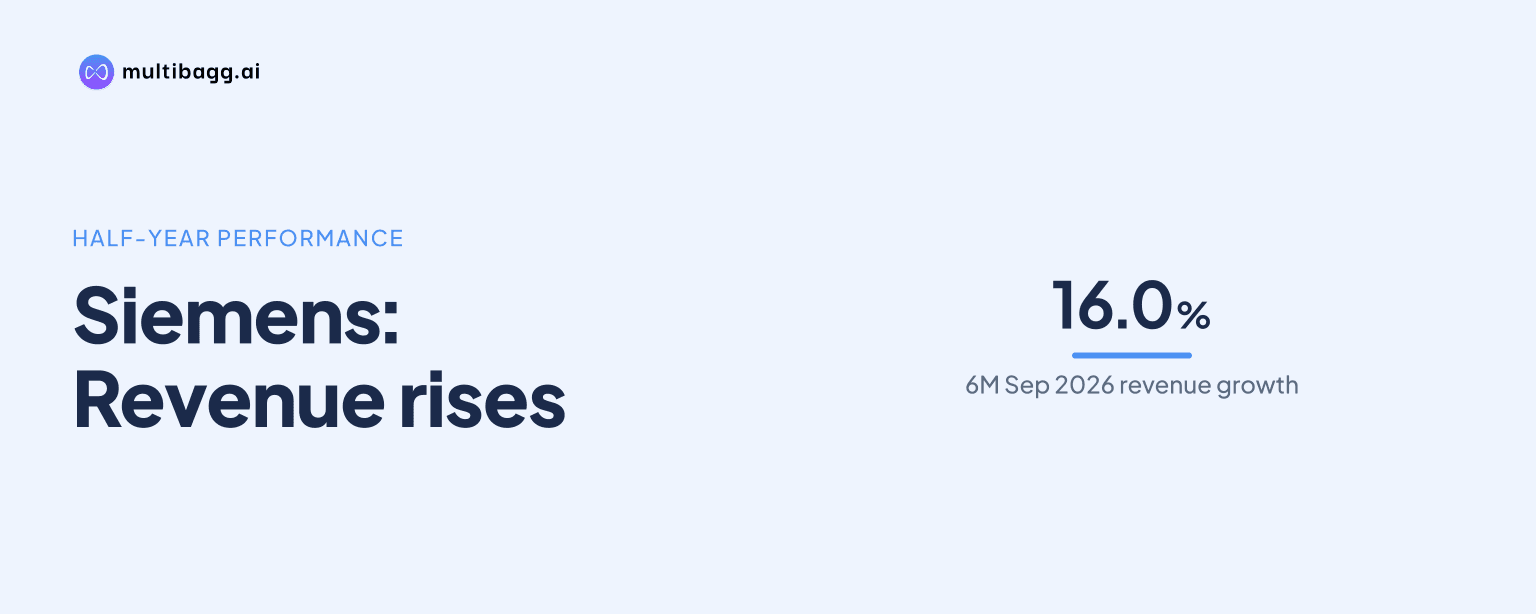
Siemens Limited reported revenue of Rs 10,450 crore for 6M Sep 2026, up 16.0% year on year, but earnings before interest, tax, depreciation and amortisation (EBITDA) declined 7.0% to Rs 1,070 crore as its EBITDA margin fell to 10.2% from 12.8%. Siemens cited commodity prices, inflation and foreign-exchange (FX) movements as factors affecting profitability.
Know Siemens inside out
Results, valuation, peers and who's buying, in one view.
What did Siemens report for the first half of FY 2027?
Siemens recorded higher orders and revenue in 6M Sep 2026, while absolute EBITDA and profit before tax declined from the prior-year period. New orders rose 26.2% to Rs 12,560 crore from Rs 9,950 crore, and revenue increased by Rs 1,440 crore to Rs 10,450 crore. However, EBITDA decreased by Rs 80 crore from Rs 1,150 crore, while profit before tax declined by Rs 90 crore to Rs 1,140 crore.
The order backlog stood at Rs 47,030 crore at September 2026, 12.0% above Rs 41,980 crore a year earlier. This backlog supported execution during the half, as indicated by the 16.0% revenue increase, but the 2.6-percentage-point reduction in EBITDA margin meant revenue growth did not translate into higher operating earnings. The margin figures were 12.8% for 6M Sep 2025 and 10.2% for 6M Sep 2026.
Why did Siemens' EBITDA margin decline despite revenue growth?
Siemens said elevated and volatile commodity prices, inflation and FX affected EBITDA even as revenue rose 16.0% in 6M Sep 2026. Its 10.2% first-half EBITDA margin was 260 basis points below the 12.8% reported a year earlier. Management's summary specifically linked the EBITDA impact to commodity prices, inflation and FX, rather than presenting the revenue gain as sufficient to offset those pressures.
Digital Industries, or DI, disclosed a direct material-cost effect from the depreciating rupee. Its 6M Sep 2026 EBITDA margin fell to 5.9% from 9.3% in 6M Sep 2025, despite revenue rising 15.8% to Rs 2,240 crore. Siemens said DI's margins were normalising amid increased material costs caused by rupee depreciation, while revenue growth came from executing its order backlog.
Smart Infrastructure, or SI, also saw a margin decline while expanding revenue. SI's 6M Sep 2026 revenue rose 17.0% to Rs 5,870 crore, but its EBITDA margin fell to 12.1% from 15.5% in the prior-year half. For the three months ended September 2026, Siemens described SI profitability as resilient despite commodity and FX movements, showing that the consolidated first-half margin pressure was present across its largest revenue business.
Got a follow-up? Ask IRIS
Which Siemens businesses drove growth and margin changes?
SI generated the largest share of Siemens revenue, accounting for 56.2% of the 6M Sep 2026 mix, compared with 55.7% a year earlier. Its first-half new orders increased 30.4% to Rs 7,040 crore and revenue rose 17.0% to Rs 5,870 crore. Siemens attributed SI revenue growth to backlog execution in Electrification & Automation and Electrical Products, while SI Electrical Products drove order growth.
DI contributed 21.4% of first-half revenue in both 6M Sep 2025 and 6M Sep 2026. Its new orders rose 6.6% to Rs 2,140 crore and its revenue increased from Rs 1,930 crore to Rs 2,240 crore. In the September 2026 quarter, DI reported book-to-bill of 1.02, meaning its Rs 1,140 crore of new orders slightly exceeded its Rs 1,110 crore revenue for the period.
Mobility, or MO, accounted for 21.2% of 6M Sep 2026 revenue, down slightly from 21.8% a year earlier, but produced the fastest quarterly order growth. Its new orders for 3M Sep 2026 surged 209.7% to Rs 2,130 crore, aided by a higher 9K HP order value. MO's quarterly revenue rose 13.5% to Rs 1,290 crore, primarily from execution of the 9K HP locomotive, while its margin was 8.1%, versus 11.8% a year earlier.
How did Siemens' second quarter compare with the first-half trend?
Siemens' 3M Sep 2026 revenue rose 17.0% to Rs 5,730 crore and EBITDA remained unchanged at Rs 630 crore, causing the quarterly margin to decline to 11.0% from 12.8%. New orders grew faster than revenue, increasing 37.8% to Rs 6,230 crore from Rs 4,520 crore. Profit before tax nevertheless increased to Rs 680 crore from Rs 660 crore in the comparable quarter.
The quarterly order position differed across the three main businesses. MO had book-to-bill of 1.65 in 3M Sep 2026, with Rs 2,130 crore of orders against Rs 1,290 crore of revenue; DI's ratio was 1.02. SI's book-to-bill was 0.91, as its Rs 2,960 crore of quarterly orders were below Rs 3,260 crore of revenue, reflecting execution exceeding fresh orders in that quarter.
Siemens' revenue composition was broadly stable in the first half despite this varying segment order performance. Domestic sales represented 87.1% of 6M Sep 2026 revenue, versus 87.0% a year earlier, while exports were 12.9%, versus 13.0%. Product and service revenue increased to 74.0% of the mix from 73.0%, whereas project revenue declined to 26.0% from 27.0%.
Conclusion
Siemens entered the second half with a Rs 47,030 crore order backlog, up 12.0% year on year, alongside a revenue mix led by SI at 56.2%. Product and service activities represented 74.0% of 6M Sep 2026 revenue, up from 73.0%, while project activities fell to 26.0%. The figures indicate that execution and order intake expanded across the business even as cost pressures affected the reported profitability outcome.
The next disclosed development to watch is execution of Siemens' announced capacity-expansion and localisation investments, which management said were on track. Investors can also track whether SI's 0.91 quarterly book-to-bill, DI's 1.02 and MO's 1.65 translate into future revenue, and whether material costs related to the depreciating rupee continue to affect DI's 5.9% first-half margin.

