










Sigma Advanced Systems names vice chairman, proposes five-year role
Key highlights
- Sigma Advanced Systems named Kartheek Raju Chintalapati vice chairman effective November 6, 2026.
- Sigma Advanced Systems proposed Chintalapati’s five-year whole-time director term from November 6, 2026, subject to shareholder approval.
- Chintalapati’s proposed role changes from non-executive director to whole-time director and promoter.
- Sigma Advanced Systems also proposed a five-year managing director term for Sunil Kumar Kalidindi on November 6, 2026.
powered by IRIS
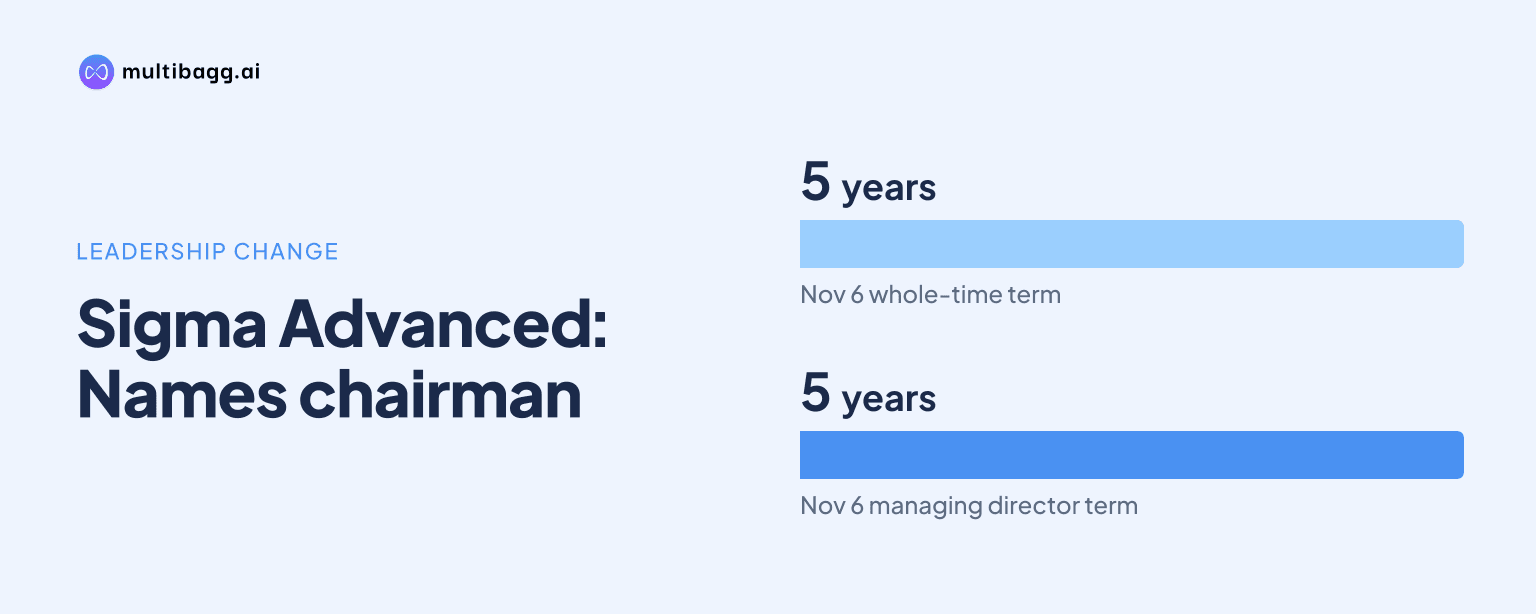
Sigma Advanced Systems Limited named Kartheek Raju Chintalapati vice chairman effective November 6, 2026, and its board proposed moving him from non-executive director to whole-time director and promoter for five years, subject to shareholder approval at the ensuing general meeting. The board approved both actions on November 6, 2026.
Know Sigma Advanced System inside out
Results, valuation, peers and who's buying, in one view.
What changed for Kartheek Raju Chintalapati at Sigma Advanced Systems?
Sigma Advanced Systems approved Kartheek Raju Chintalapati’s change from non-executive director to whole-time director and promoter on November 6, 2026, subject to shareholder approval. Separately, the board designated him vice chairman with effect from the same date.
The filing identifies the two actions as distinct decisions. The proposed whole-time directorship has a five-year term beginning November 6, 2026 and requires approval at the ensuing general meeting, while the vice-chairman designation was made effective from November 6, 2026. Sigma Advanced Systems did not disclose the date of the general meeting.
This is a shift in Chintalapati’s board status rather than the addition of a new director. Before the November 6, 2026 resolution, he was a non-executive director; the board-approved proposal would make him a whole-time director and promoter. The disclosure does not state remuneration, specific executive duties, committee memberships or a reporting structure for the proposed whole-time director role.
The company disclosed Chintalapati’s Director Identification Number as 02921819. It also said he is not related to any of Sigma Advanced Systems’ directors and confirmed, under the stock-exchange circular of June 20, 2018, that he is not debarred from holding a directorship by an order of the Securities and Exchange Board of India or any other authority.
When do Chintalapati’s vice-chairman and whole-time roles take effect?
Sigma Advanced Systems made Chintalapati vice chairman effective November 6, 2026, whereas the proposed five-year whole-time director appointment from that date remains subject to shareholder approval. Both decisions were approved at the board meeting held on November 6, 2026.
The distinction is material because the company expressly attaches a shareholder condition to the whole-time directorship. The filing says the vote will occur at the ensuing general meeting, but it does not give a meeting date, state the proposed remuneration, or describe the consequences if shareholder approval is not obtained.
The announcement does not describe the vice-chairman position as a five-year appointment. It also does not state whether the vice-chairman title changes the authority of the managing director, chairman or other directors. Sigma Advanced Systems only specifies the November 6, 2026 effective date for the vice-chairman designation.
How does this compare with Sigma Advanced Systems’ other board changes?
Sigma Advanced Systems combined Chintalapati’s elevation with changes involving Sunil Kumar Kalidindi and Lt. Gen. (Retd.) Raju Somashekar Baggavalli on November 6, 2026. Kalidindi was approved to move from whole-time director to managing director for five years, subject to shareholder approval, while Baggavalli was designated chairman from November 6, 2026.
The comparison shows that Chintalapati and Kalidindi each have proposed five-year executive appointments requiring shareholder approval. Chintalapati also received the vice-chairman title, while Baggavalli received the chairman title, both effective November 6, 2026. The filing does not set out how the chairman, vice chairman and managing director roles will divide operational or board responsibilities.
The same set of disclosures records independent director Suryanarayana Raju Nandyala’s resignation at the end of business hours on November 6, 2026. Nandyala cited increasing professional commitments and other engagements that prevented him from devoting the required time to board duties, and stated that there were no other material reasons, concerns or disagreements with the board or management requiring disclosure.
Got a follow-up? Ask IRIS
What experience does Chintalapati bring to Sigma Advanced Systems?
Sigma Advanced Systems said Chintalapati is a second-generation entrepreneur with more than 15 years of international consulting and investment experience across life sciences, power and defence. His profile links that experience to the proposed executive board role approved on November 6, 2026.
At iLabs Group, Chintalapati led diversification beyond technology and infrastructure into pharmaceuticals, energy, defence and electronics manufacturing, according to the filing. Sigma Advanced Systems described him as having experience in building teams, capital allocation and corporate strategy, but did not connect the appointment to a specific acquisition, financial target or capital-allocation programme.
For the past decade, Chintalapati has led the iLabs Family Office, where the filing says he spearheaded investment strategies in pharmaceuticals, life sciences, defence, manufacturing and the power sector. His earlier career included work as a business analyst at McKinsey & Company’s Dubai office on corporate-strategy engagements for global clients.
Chintalapati holds a Bachelor of Business Administration degree from Claremont McKenna College, with a concentration in economics, finance and accounting. The November 6, 2026 disclosure does not state his shareholding in Sigma Advanced Systems, compensation under the proposed five-year role, or the amount of time he will devote to company operations.
Why does shareholder approval matter for the proposed role?
Shareholder approval matters because Sigma Advanced Systems has made Chintalapati’s five-year whole-time directorship conditional on a vote at its ensuing general meeting. The board approval dated November 6, 2026 alone does not remove that stated condition.
The proposed whole-time director appointment would change Chintalapati’s status from non-executive director to whole-time director and promoter for a five-year period beginning November 6, 2026. The filing does not disclose the resolution text, voting threshold, meeting date or whether shareholders will consider remuneration alongside the appointment.
Kalidindi’s proposed move to managing director is also subject to shareholder approval at the same ensuing general meeting. This creates two disclosed five-year executive-designation proposals for shareholders, alongside the board-level chairman and vice-chairman designations that Sigma Advanced Systems made effective on November 6, 2026.
The filing provides no financial forecast or operating commitment associated with either five-year appointment. Its disclosed facts concern the board’s decisions, the effective date of November 6, 2026, the five-year duration for the two executive roles, and the pending shareholder approvals.
Conclusion
Sigma Advanced Systems has immediately made Chintalapati vice chairman while proposing a five-year move from non-executive director to whole-time director and promoter. The November 6, 2026 actions also place Kalidindi in line for a five-year managing director term, designate Baggavalli as chairman and follow Nandyala’s resignation as an independent director.
The next disclosed event is the ensuing general meeting, where shareholders are to decide on Chintalapati’s whole-time director appointment and Kalidindi’s managing director appointment. Sigma Advanced Systems has not disclosed the meeting date, voting results, remuneration terms or more detailed executive responsibilities for Chintalapati’s proposed five-year role.