










SJVN Buxar thermal plant reaches full 1,320 MW capacity
Key highlights
- SJVN completed Buxar’s 1,320 MW capacity after the second 660 MW unit was dedicated on 21 November 2026.
- The revised approved cost of the two-unit Buxar project is Rs 14,269.40 crore.
- Bihar has been allocated 85% of Buxar’s electricity generation under a long-term PPA.
- SJVN estimates annual Buxar generation of 9,828.72 million units at an 85% PLF.
powered by IRIS
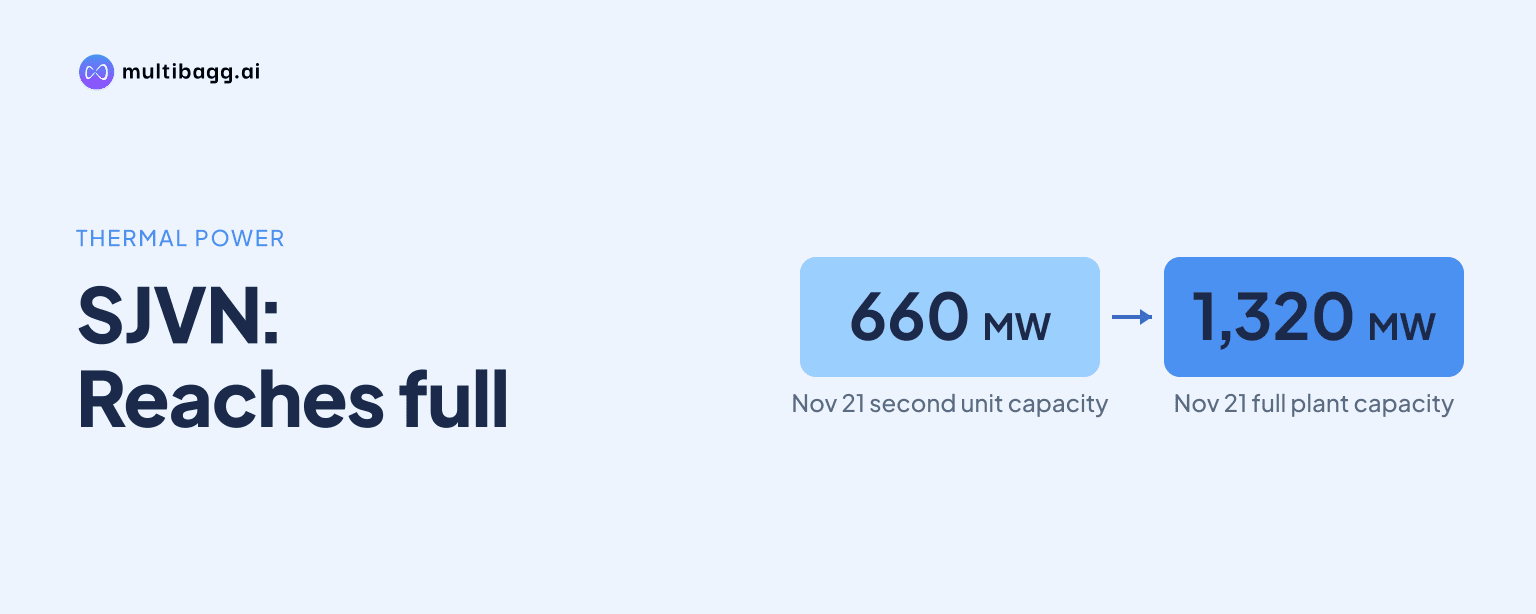
SJVN Limited has brought its Buxar Thermal Power Project to its full 1,320 megawatt (MW) capacity after Prime Minister Shri Narendra Modi dedicated the second 660 MW unit on 21 November 2026, completing a project with a revised approved cost of Rs 14,269.40 crore. Both units are commercially operational.
Know SJVN inside out
Results, valuation, peers and who's buying, in one view.
How did SJVN reach full capacity at Buxar?
SJVN reached full capacity by commissioning the second 660 MW unit alongside the first 660 MW unit at Chausa in Bihar’s Buxar district, taking the project from 660 MW to its designed 1,320 MW configuration. The Prime Minister virtually dedicated the second unit from Vaishali, Bihar, on 21 November 2026.
The project has been developed by SJVN Thermal Private Limited, SJVN’s wholly owned subsidiary. SJVN stated that the second unit involved an investment of Rs 7,221.09 crore, while the revised approved cost for the entire two-unit project stands at Rs 14,269.40 crore.
The first 660 MW unit was inaugurated on 22 August 2025, following the project’s foundation-stone laying on 9 March 2019. The addition of the second unit more than a year later doubled operating capacity at Buxar from 660 MW to 1,320 MW, rather than creating capacity beyond the approved 2 x 660 MW design.
What electricity output is expected from the Buxar project?
SJVN estimates that the 1,320 MW Buxar project can generate about 9,828.72 million units of electricity annually at an 85% plant load factor (PLF). PLF measures output relative to the electricity a plant could generate if it operated continuously at its rated capacity, so this is an estimate based on the stated operating assumption.
Over 25 years, the company estimates cumulative generation of about 245,718 million units. This forecast applies to the completed two-unit plant and differs from the period after August 2025, when only the first 660 MW unit had been inaugurated.
SJVN said the project’s generation will help meet Bihar’s electricity requirements, particularly during peak demand, and support the reliability and stability of the Eastern Regional Power Grid. The filing identifies industrial, agricultural, commercial and household users as potential beneficiaries but gives no separate demand or revenue forecast for those segments.
How much Buxar power is allocated to Bihar?
SJVN said 85% of electricity generated by the Buxar project has been allocated to Bihar under a long-term power purchase agreement (PPA). A PPA is an agreement governing the sale and purchase of electricity, and the disclosed allocation covers the bulk of generation projected at 9,828.72 million units annually.
The filing does not identify the destination or buyer for the remaining 15% of output. It also does not disclose the PPA tariff, duration, contracted revenue or the date when deliveries from the full 1,320 MW capacity began.
For fuel, SJVN has executed a fuel supply agreement with Central Coalfields Limited, a subsidiary of Coal India Limited, for long-term linkage of domestic coal. The company did not disclose coal volumes, fuel pricing, transport arrangements or a supply commencement date for the two 660 MW units.
Got a follow-up? Ask IRIS
What technology and construction inputs does Buxar use?
SJVN said Buxar uses Ultra Super Critical Technology and modern emission-control systems, which it says are designed to improve operating efficiency and reduce the environmental impact of coal-based power generation. The announcement does not quantify efficiency levels, emission reductions or plant-specific compliance limits for the 1,320 MW project.
Construction used about 254,932 metric tonnes (MT) of steel and 284,291 MT of cement, according to SJVN. Cement usage was therefore higher than steel usage by 29,359 MT, and the company said the materials were extensively sourced domestically in line with the Government of India’s Atmanirbhar Bharat and Viksit Bharat objectives.
The project engaged about 65,000 workers during different stages of construction. SJVN said the operating phase will continue to generate employment and economic activity locally, but it did not state the permanent workforce, employment spending, corporate social responsibility budget or beneficiary count for its community programmes.
Where does Buxar fit within SJVN’s capacity portfolio?
SJVN reported installed capacity of 4,931.50 MW across India and Nepal, with another 3,860.50 MW under construction. The fully operational 1,320 MW Buxar project is part of that wider expansion, although the release does not provide project-by-project details behind either capacity total.
SJVN is a Navratna central public sector enterprise under the Ministry of Power and was incorporated on 24 May 1988 as a joint venture between the Government of India and the Government of Himachal Pradesh. The Buxar plant is being developed through its wholly owned subsidiary, while the parent’s reported portfolio spans India and Nepal.
The full 1,320 MW operation also provides a contrast with the company’s remaining 3,860.50 MW under-construction pipeline. Buxar has both units commercially operational, whereas the filing gives no commissioning schedule, cost details or project names for the other capacity under construction.
Conclusion
The second 660 MW unit has completed SJVN’s Buxar Thermal Power Project at 1,320 MW, after the first unit was inaugurated in August 2025. The Rs 14,269.40 crore project carries an estimated annual output of 9,828.72 million units at an 85% PLF, with 85% of its generation allocated to Bihar through a long-term PPA.
The next points to watch are generation against the stated 85% PLF assumption, the operating performance of both commercially operational units, and execution of the long-term domestic-coal supply arrangement with Central Coalfields Limited. SJVN has also disclosed 3,860.50 MW under construction, but this announcement provides no commissioning timetable for that pipeline.