










Sky Gold reports Rs 136 crore H1 operating cash flow reversal
Key highlights
- Sky Gold generated Rs 136 crore of operating cash flow in H1 FY27 versus a Rs 100.9 crore outflow in H1 FY26.
- H1 FY27 revenue rose 68% year on year to Rs 4,403 crore, while PAT increased 112% to Rs 234 crore.
- Net working-capital days declined to 55 at September 2026 from 63 days a year earlier.
- Advance Gold represented 16% of Q2 FY27 business, while exports contributed Rs 811 crore in H1 FY27.
powered by IRIS
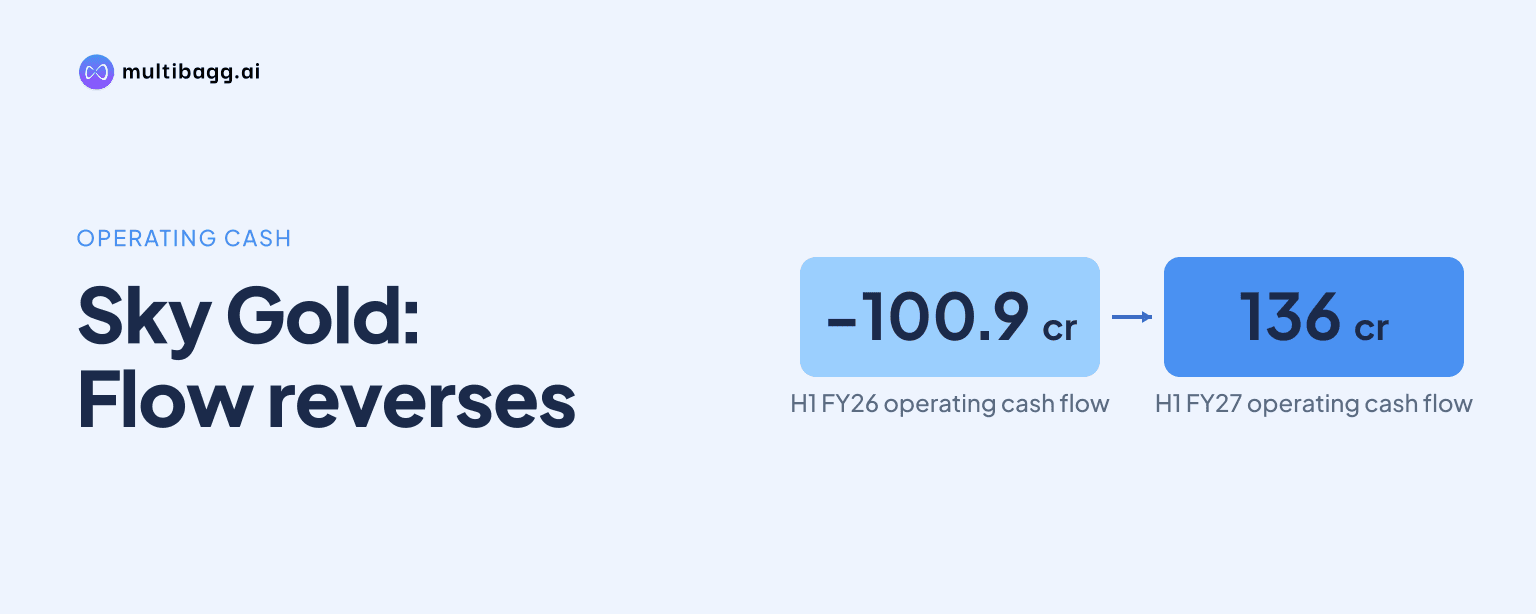
Sky Gold reported Rs 136 crore of operating cash flow in H1 FY27, reversing a Rs 100.9 crore outflow in H1 FY26. The reversal came as revenue rose 68% year on year to Rs 4,403 crore, net working-capital days declined to 55, and Advance Gold reached 16% of Q2 FY27 business.
Know Sky Gold & Diamonds inside out
Results, valuation, peers and who's buying, in one view.
How did Sky Gold reverse operating cash flow in H1 FY27?
Sky Gold reversed operating cash flow through lower working-capital intensity and changes in sales mix during H1 FY27. Operating cash flow was Rs 136 crore, equal to 58% of H1 FY27 profit after tax, or PAT, of Rs 234 crore, compared with an operating-cash outflow of Rs 100.9 crore in H1 FY26. Management said this was ahead of its earlier stated aim of converting 20% to 25% of PAT into operating cash flow.
The cash-flow change occurred alongside expansion in the business. H1 FY27 revenue was Rs 4,403 crore, up 68% year on year, while earnings before interest, tax, depreciation and amortisation, or EBITDA, reached Rs 346 crore and PAT rose 112% to Rs 234 crore. Management attributed the improvement in cash flow, margins and working capital to processes and controls developed over the preceding 18 to 24 months.
Sky Gold also reported higher profitability in Q2 FY27. Consolidated revenue was Rs 2,391 crore, up 61% year on year and 18.8% from Q1 FY27, while gross profit increased 87% to Rs 229 crore. EBITDA rose 90% to Rs 189.8 crore, and the EBITDA margin was 7.9%, providing the earnings base alongside the H1 cash-flow recovery.
What changed in Sky Gold's working-capital cycle?
Sky Gold reduced net working-capital days to 55 at September 2026 from 59 days in March 2026, 63 days in September 2025 and 71 days in March 2025. The four-day reduction from March and eight-day reduction from September 2025 coincided with the H1 FY27 shift to Rs 136 crore of operating cash generation.
Inventory was 39 days at September 2026, up from 37 days at March 2026. Management said the increase reflected investment in higher-margin studded jewellery, which requires relatively more working capital, while cash generated by the gold business was being allocated to that segment. Natural and lab-grown diamond jewellery accounted for about 2.6% of Q2 FY27 revenue.
Receivable days were 33 at September 2026, down from 39 days a year earlier but above 26 days in March 2026. Management said the March-to-September increase reflected festive dispatches, because Navratri and Diwali orders were billed in the closing weeks of the quarter and were expected to be collected in October and November. It said Advance Gold and export sales have structurally shorter payment terms than domestic sales.
How did supplier credit contribute to Sky Gold's cash flow?
Sky Gold increased payable days to 17 at September 2026 from four days in March 2026, while trade payables rose to Rs 437 crore from Rs 92 crore. Management said the increase came from supplier credit, including Rs 225 crore related to diamond and studded inputs, where 90-to-120-day credit is market practice.
Management also attributed around Rs 100 crore of September 2026 payables to roughly two days of bullion credit negotiated because of Sky Gold's scale. It said higher purchasing volumes of other raw materials had also improved supplier terms. According to management, the studded-jewellery supply chain partly finances its own working-capital requirement, reducing the need for debt to rise in the same proportion as that segment grows.
The broader financing position moved modestly during the half year. Net debt was Rs 531 crore at September 2026, compared with Rs 550 crore in March 2026, while H1 FY27 interest cost was 0.89% of sales versus 0.96% in H1 FY26. Management also reported Rs 11.70 crore of net interest income for H1 FY27.
Got a follow-up? Ask IRIS
Which sales mix improved Sky Gold's capital efficiency?
Sky Gold said Advance Gold represented 16% of Q2 FY27 business, ahead of its FY27 target of 15%, and added 110 basis points to gross margin. Under the model, customers procure and supply the gold, while Sky Gold bills for manufacturing work. Management said this leaves the company with almost no gold inventory funding or receivable requirement for customer-supplied metal.
Exports were the other stated driver of lower capital intensity. Exports contributed Rs 811 crore of revenue in H1 FY27, and management said export receivable days are much lower than domestic receivable days. It also said exports rose from more than Rs 35 crore in FY23 to about 18% of current business, with Q2 FY27 exports of Rs 435 crore and an annualised run rate of around Rs 1,600 crore.
The changing mix accompanied a higher reported gross margin. Q2 FY27 gross margin was 9.6%, up 133 basis points from Q2 FY26 and 27 basis points from Q1 FY27. Management linked the improvement to Advance Gold and studded-jewellery mix, while stating that operating costs rose to 1.6% of sales as Sky Gold added a chief executive officer, design personnel, and audit and finance capabilities.
What controls does Sky Gold say supported the improvement?
Sky Gold said it has been implementing a modern enterprise resource planning system to monitor employee productivity, gold loss, inventory positions and customer receivables. The 55-day net working-capital position at September 2026 also reflected enhanced inventory controls and a more disciplined collections process, according to management.
The company changed its audit framework in H1 FY27, appointing MSKA & Associates LLP, a BDO International firm, as statutory auditor. Management said a professional internal auditor now reports to the audit committee every quarter, while the statutory auditor reviews the internal auditor's work. It also said procurement, production, sales and treasury processes were documented and accounting policies were aligned across the parent and acquired subsidiaries.
Sky Gold said it follows a back-to-back hedging policy and does not take speculative positions in gold. Management said this mechanism meant profitability was not dependent on movements in gold prices, even during recent periods of gold-price volatility. Reported Q2 FY27 PAT was Rs 129 crore, up 93% year on year, after a Rs 7.35 crore exceptional charge related to the Star Mangalsutra fraud incident.
Conclusion
Sky Gold's H1 FY27 cash-flow reversal occurred alongside, rather than instead of, 68% revenue growth. The move from a Rs 100.9 crore outflow to a Rs 136 crore inflow coincided with lower net working-capital days, additional supplier credit, and a larger contribution from Advance Gold and exports, while investment continued in studded jewellery.
The next issue to watch is collections after September 2026 festive dispatches and whether net working-capital days remain near 55 as the studded category expands. Management disclosed a Rs 1,800 crore capital raise but said Securities and Exchange Board of India restrictions prevented it from providing a breakdown of proceeds or their use; it linked its broader approach to customer-led growth, exports and acquisitions.