










Sky Gold says Rishabh Gold profit rose nearly twelvefold
Key highlights
- Sky Gold said Rishabh Gold’s monthly mangalsutra volume increased from 20 kg to 25 kg to around 150 kg.
- Sky Gold said Rishabh Gold’s revenue rose from Rs 49 crore to Rs 175 crore and profit from Rs 1.6 crore to Rs 18.8 crore.
- Sky Gold said it acquired Rishabh Gold for less than Rs 10 crore.
- One jewellery conglomerate buys 70 kg to 80 kg of mangalsutra from the combined operation, according to Sky Gold.
powered by IRIS
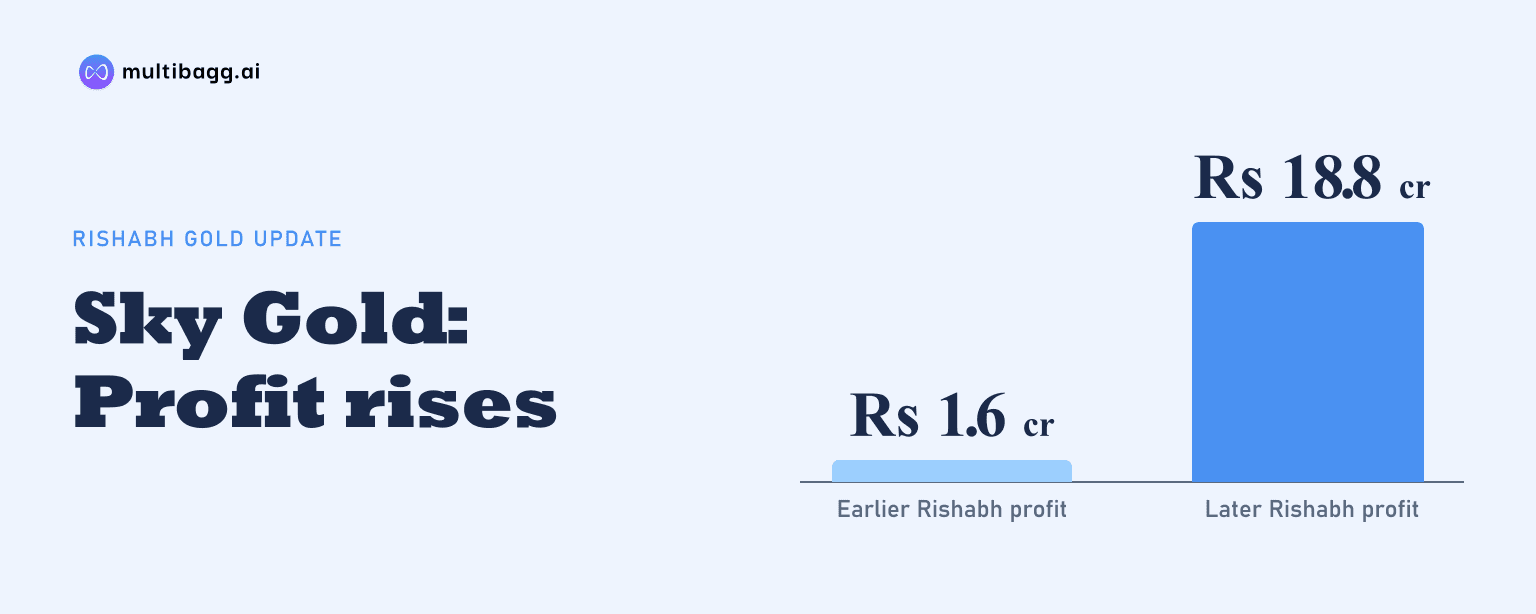
Sky Gold & Diamonds Limited said in its Q2 and H1 FY27 earnings call that acquired mangalsutra maker Shri. Rishabh Gold increased profit from Rs 1.6 crore to Rs 18.8 crore, while monthly volume rose from about 20 kg to 25 kg to around 150 kg. Management presented the figures as evidence of post-acquisition integration.
Know Sky Gold & Diamonds inside out
Results, valuation, peers and who's buying, in one view.
How much did Rishabh Gold grow after its acquisition?
Rishabh Gold’s monthly mangalsutra volume rose to around 150 kg from about 20 kg to 25 kg, according to Sky Gold management. Measured against the 25 kg end of the earlier range, volume increased sixfold; against 20 kg, it increased 7.5 times. The company did not disclose the acquisition date or the periods represented by the before-and-after volume figures.
Management said Rishabh Gold’s revenue increased from Rs 49 crore to Rs 175 crore, while profit rose from Rs 1.6 crore to Rs 18.8 crore. Revenue was therefore about 3.6 times the prior level, whereas profit was 11.75 times the prior figure. Sky Gold did not provide a standalone margin bridge, accounting basis or time period for these profit figures, so the call does not isolate the drivers of the increase.
Sky Gold said it acquired Rishabh Gold for less than Rs 10 crore. The purchase price cannot be directly compared with the reported Rs 18.8 crore profit because the transcript does not identify whether profit is annual, trailing or stated on another basis. Nevertheless, the figures are the company’s most detailed example on the call of revenue, profit and volume growth at an acquired business.
What did Sky Gold say drove Rishabh Gold’s volume growth?
Sky Gold said its casting capabilities and design library enabled Rishabh Gold to diversify its mangalsutra range. Rishabh Gold contributed a specialised handmade manufacturing team and relationships with jewellery conglomerates, while Sky Gold supplied cast elements, designs and access to a broader customer base. Management described mangalsutra as a largely handmade category that requires precision.
One trusted jewellery conglomerate now purchases 70 kg to 80 kg of mangalsutra from the combined operation, management said. That volume equals roughly 47% to 53% of the stated 150 kg monthly total. Sky Gold also said the relationship has opened doors for other jewellery categories, but it did not name the customer or quantify sales generated in those additional product lines.
The company said it had already sold mangalsutra to major corporates through Starmangalsutra before adding Rishabh Gold. Its rationale was therefore not solely to add manufacturing capacity: management said it sought Rishabh Gold’s management, expertise, designs and customer relationships. Sky Gold described the combined businesses as one of India’s trusted mangalsutra manufacturers, which was a management characterisation rather than a disclosed market-share measure.
How does Rishabh Gold fit Sky Gold’s acquisition strategy?
Sky Gold said each acquisition is intended to add a category that it can offer existing customers while giving the acquired business access to Sky Gold’s design library, technology and customer base. In Rishabh Gold’s case, the category was mangalsutra, and the acquired operation added specialised personnel and established retailer relationships.
Management said founders of acquired businesses join Sky Gold’s top management because their experience is part of what it is acquiring. It also said some historic acquisitions were guided by customers seeking a preferred acquirer among manufacturers facing working-capital, compliance and succession pressures. The call did not disclose Rishabh Gold’s transaction structure, founders’ roles or integration timetable.
Sky Gold cited Purvi Gold as another example of category-led inorganic growth. It said Purvi Gold, which operates in uncut diamonds, was acquired for Rs 9 crore against a book value of Rs 6 crore and brought management with around 20 years of relevant experience. However, Sky Gold did not give post-acquisition revenue, volume or profit metrics for Purvi Gold, making Rishabh Gold the more specific disclosed test of its integration model.
Got a follow-up? Ask IRIS
What does the Rishabh Gold result mean for Sky Gold’s mix?
Sky Gold said the Rishabh Gold acquisition supports its aim to sell gold, diamond, mangalsutra and uncut jewellery through one supplier relationship. In Q2 FY27, advance gold accounted for 16% of the business, ahead of management’s earlier FY27 target of 15%, while natural and lab-grown diamond jewellery represented about 2.6% of revenue.
Management said value-added products now account for more than half of revenue, compared with an insignificant percentage three years earlier. It also said the diamond business had doubled its contribution sequentially, without providing the two comparable amounts. These disclosures indicate that mangalsutra expansion is part of a wider product-mix strategy, rather than the sole source of the company’s growth.
Sky Gold reported consolidated Q2 FY27 revenue of Rs 2,391 crore, up 61% year on year and 18.8% from Q1, and reported profit after tax of Rs 129 crore, up 93%. In H1 FY27, revenue was Rs 4,403 crore, up 68%, and profit after tax was Rs 234 crore, up 112%. These results cover the full group and cannot be attributed specifically to Rishabh Gold.
What risks and controls did Sky Gold disclose?
Sky Gold disclosed an exceptional charge of Rs 7.35 crore in Q2 FY27 relating to a fraud incident at subsidiary Star Mangalsutra, which is separate from Rishabh Gold. Of Rs 10.70 crore involved, Rs 3.35 crore had been recovered and the remaining balance was fully provided during the quarter. The disclosure shows a control issue in a related product category, but the call made no connection between that incident and Rishabh Gold.
Management said it had put institutional internal and statutory auditor arrangements in place during H1 FY27. MSKA & Associates LLP, a BDO International firm, became the statutory auditor, while a professional internal auditor reports to the audit committee each quarter. Sky Gold also said it was implementing an enterprise resource planning system to monitor employee productivity, gold loss, inventory and receivables.
The company disclosed a recently announced Rs 1,800 crore capital raise but said Securities and Exchange Board of India restrictions prevented discussion of its specific purpose or use of proceeds. Management also said it was no longer providing forward guidance. Its disclosed H1 FY27 operating cash flow was Rs 136 crore, compared with an outflow of Rs 100.9 crore in H1 FY26, while net debt stood at Rs 531 crore at September 2026 versus Rs 550 crore in March 2026.
Conclusion
Sky Gold’s disclosed Rishabh Gold figures provide a specific example of its acquisition approach: it said a purchase for less than Rs 10 crore added specialist mangalsutra capability and customer relationships, followed by volume of around 150 kg a month, revenue of Rs 175 crore and profit of Rs 18.8 crore. The reported profit increase was much larger than the revenue increase, although the transcript does not provide periods or standalone margins to explain that difference fully.
The next disclosures to watch are the use and terms of the Rs 1,800 crore capital raise, which management said it could not discuss on the call, and any subsequent operating metrics for acquired businesses. Investors can also track whether the ERP rollout, revised audit framework and working-capital measures continue alongside expansion, after Sky Gold reported 55 net working-capital days at September 2026 versus 59 days in March 2026.