










Skyways Group Air-Cargo Revenue Rose 93.5% in H1 FY27
Key highlights
- Skyways reported H1 FY27 air-cargo revenue of Rs 1,959.8 crore, up 93.5% year on year.
- H1 FY27 air-cargo tonnage rose 25.2% to 51,115 tonnes.
- Reported H1 revenue and tonnes imply air-cargo revenue per tonne increased 54.6% to about Rs 3.83 lakh.
- Skyways reported H1 FY27 group revenue of Rs 2,528 crore, EBITDA of Rs 108.6 crore and PAT of Rs 60 crore.
powered by IRIS
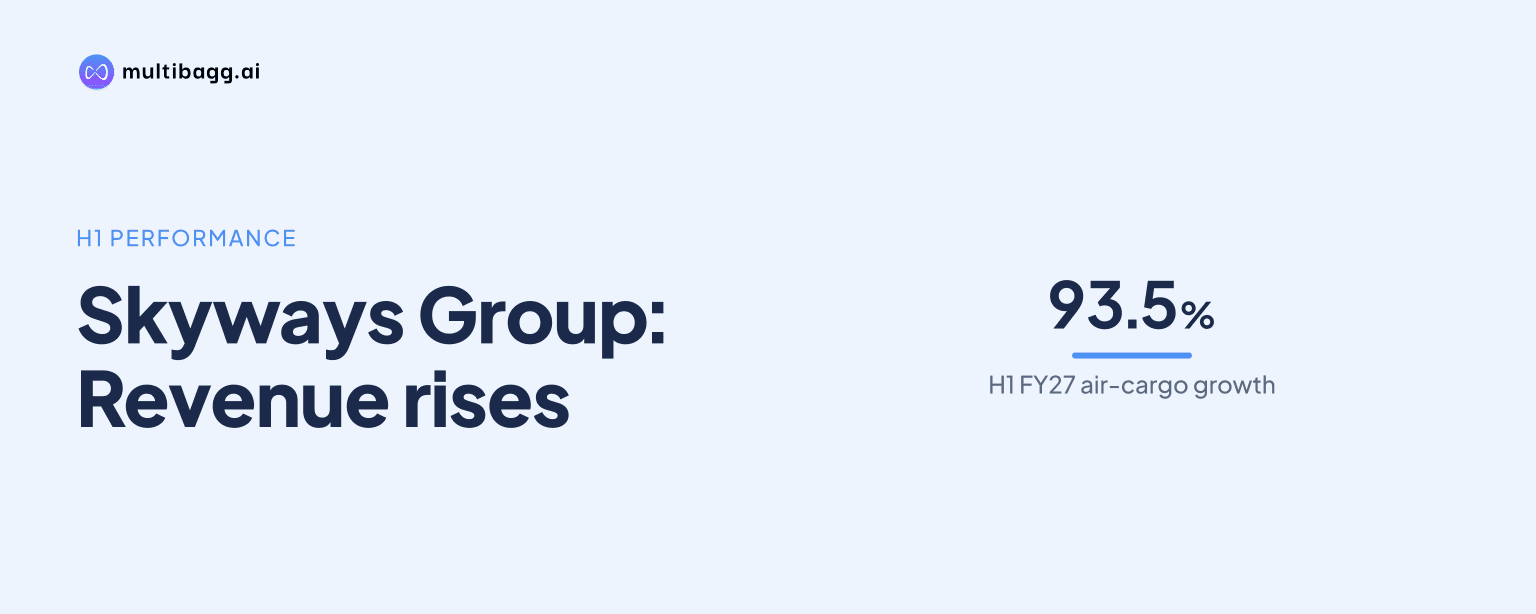
Skyways Group reported H1 FY27 air-cargo revenue of Rs 1,959.8 crore, up 93.5% year on year, while tonnage rose 25.2% to 51,115 tonnes. These reported figures imply revenue per tonne increased 54.6% to about Rs 3.83 lakh, meaning air-cargo sales grew substantially faster than physical volumes.
Know Skyways Air Services inside out
Results, valuation, peers and who's buying, in one view.
How did Skyways’ air-cargo revenue outpace tonnage in H1 FY27?
Skyways’ air-cargo revenue increased by Rs 947.1 crore in H1 FY27 to Rs 1,959.8 crore from Rs 1,012.7 crore in H1 FY26, while volume increased by 10,282 tonnes. Revenue grew 93.5% year on year (YoY), compared with 25.2% YoY growth in tonnes, according to the company’s service-engine data.
The reported figures imply H1 FY27 revenue of about Rs 3.83 lakh per tonne, compared with about Rs 2.48 lakh per tonne a year earlier. This is a calculated 54.6% increase in revenue per reported tonne. It is not a separately disclosed Skyways yield measure and does not identify the individual effects of freight rates, cargo mix, routes, customer mix or ancillary services.
Air cargo was Skyways’ largest disclosed service engine in H1 FY27. Its Rs 1,959.8 crore of revenue represented about 77.5% of the group’s Rs 2,528 crore H1 FY27 revenue, based on the reported totals. Skyways provides integrated air, ocean, surface and express logistics services, although the presentation separately quantifies revenue only for air, ocean and express.
What changed in Skyways’ second-quarter air-cargo performance?
Skyways’ Q2 FY27 air-cargo revenue rose 90.1% YoY to Rs 983.4 crore, while Q2 tonnage increased 27.1% to 27,629 tonnes. In Q2 FY26, air-cargo revenue was Rs 517.3 crore on 21,738 tonnes, again showing revenue growth substantially ahead of cargo-volume growth.
On the same calculation, Q2 FY27 revenue was about Rs 3.56 lakh per tonne, compared with about Rs 2.38 lakh in Q2 FY26. That represents an implied increase of about 49.7%. The calculated Q2 increase was below the 54.6% H1 increase, indicating that the first-quarter comparison also contributed to the half-year movement.
H1 FY27 volume of 51,115 tonnes exceeded the 40,833 tonnes moved in H1 FY26, while Q2 FY27’s 27,629 tonnes exceeded Q2 FY26’s 21,738 tonnes. The presentation therefore records growth in both revenue and physical movement. It does not provide monthly cargo data, lane-level volumes or a domestic-versus-international air-cargo split.
Got a follow-up? Ask IRIS
How did Skyways’ other service engines compare in H1 FY27?
Skyways’ ocean-cargo revenue grew 91.5% in H1 FY27 to Rs 399.7 crore, while express cargo and parcel revenue rose 48.2% to Rs 121.4 crore. Air cargo remained the largest of the three disclosed engines, with Rs 1,959.8 crore in H1 FY27 revenue and 93.5% growth from the comparable period.
Ocean container volumes rose 16.7% to 17,187 twenty-foot equivalent units (TEUs), the standard measure for container capacity, in H1 FY27. Express cargo and parcel shipments increased 17.71% to 134,967. Revenue growth exceeded the corresponding volume or shipment growth rate in all three engines, although tonnes, TEUs and shipments are not comparable operating units.
The three disclosed engines generated Rs 2,480.9 crore combined in H1 FY27, compared with group revenue of Rs 2,528 crore. At group level, revenue rose 90.3% YoY, earnings before interest, tax, depreciation and amortisation (EBITDA) rose 90.0% to Rs 108.6 crore, and profit after tax (PAT) increased 135.5% to Rs 60 crore. The presentation does not disclose EBITDA or PAT by service engine.
What supports Skyways’ air-cargo operating model, and what remains unknown?
Skyways says its integrated offering is supported by 59 airline ties, more than 25 shipping-line relationships and contracted capacities, alongside more than 26,300 logistics partners. The presentation ranks Skyways as India’s number-one air-export logistics service provider by air waybills generated for calendar years 2022 to 2025, citing WorldACD, and ranks it 42nd globally on the same measure.
Skyways also reports more than 9,500 customers, operations in 12 countries including eight overseas subsidiaries, and express coverage across 12,000 PIN codes through more than 1,200 partners. These figures describe the group’s network and carrier-access model, but they do not establish that a particular airline contract caused the calculated rise in H1 revenue per tonne.
Skyways identifies pharma, agriculture and manufacturing as sectors driving Indian air cargo, citing their requirement for fast, temperature-controlled or time-critical transport. Its presentation does not disclose H1 FY27 air-cargo revenue by customer sector, cargo type, geography, airline or contract type. It also gives no data on capacity purchased, capacity utilisation, freight-rate movements or value-added service revenue.
Conclusion
Skyways’ H1 FY27 air-cargo performance combined higher physical movement with substantially faster revenue growth. The difference between 93.5% revenue growth and 25.2% tonnage growth resulted in a calculated 54.6% increase in revenue per tonne, while air cargo accounted for most of the group’s Rs 2,528 crore half-year revenue.
The next operating measure to watch is whether Skyways continues to expand air-cargo tonnes while revenue remains ahead of volume growth. The company cites contracted capacities, 59 airline ties and its logistics network as operating supports, but it has not disclosed a target for air-cargo revenue per tonne, capacity utilisation or segment margin.