










Sonam Limited says trading supplied most H1 FY27 revenue growth
Key highlights
- Sonam Limited generated Rs 195 crore of revenue from operations in H1 FY27, up 183% year on year from Rs 69 crore.
- Manufacturing contributed Rs 20 crore of H1 FY27 revenue, while imported-goods trading accounted for the calculated balance of Rs 175 crore.
- H1 FY27 EBITDA rose to Rs 11.94 crore from Rs 5.39 crore, but EBITDA margin declined to 6.7% from 7.73%.
- Manufacturing capacity utilisation was 52% in H1 FY27, while freight represented 30% to 40% of Rs 7.5 crore of other expenses.
powered by IRIS
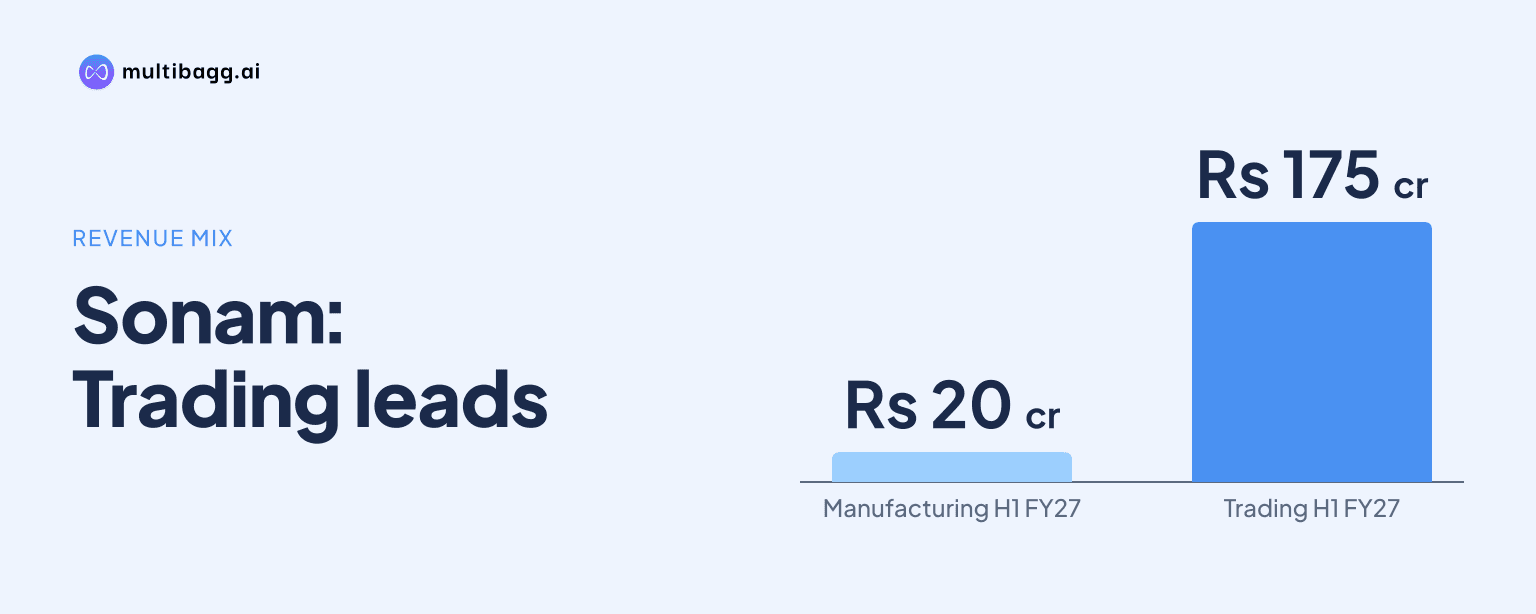
Sonam Limited said Rs 20 crore of its Rs 195 crore revenue from operations in H1 FY27 came from manufacturing, while the Rs 175 crore balance came from imported goods sold through trading. The split indicates that trading, rather than internally manufactured sales, drove most of the company’s 183% year-on-year revenue increase.
Know Sonam inside out
Results, valuation, peers and who's buying, in one view.
How much of Sonam’s H1 FY27 revenue came from manufacturing?
Sonam said manufacturing contributed Rs 20 crore of its Rs 195 crore revenue from operations in H1 FY27. Chairman and Managing Director Jayesh Shah gave the breakdown during the October 26, 2026 conference call, stating that the company imported materials used in clocks and sold those goods through trading activity.
The balance of Rs 175 crore was therefore from imported-goods trading, calculated by subtracting Rs 20 crore of manufacturing sales from total H1 FY27 revenue of Rs 195 crore. Sonam reported revenue of Rs 69 crore in H1 FY26, so its H1 FY27 total was higher by Rs 126 crore, with management’s sales split showing that trading supplied most of the larger revenue base.
Sonam separately said manufacturing revenue was Rs 60 crore in FY26, when total sales were Rs 171 crore. The Rs 20 crore manufacturing figure for H1 FY27 is not directly comparable with the Rs 60 crore full-year FY26 figure because the periods differ, but H1 FY27 total revenue had already exceeded the prior full-year turnover cited by management.
Why did Sonam’s revenue rise while its EBITDA margin declined?
Sonam’s revenue from operations increased 183% to Rs 195 crore in H1 FY27 from Rs 69 crore in H1 FY26, while earnings before interest, tax, depreciation and amortisation, or EBITDA, rose to Rs 11.94 crore from Rs 5.39 crore. EBITDA margin, however, declined to 6.7% from 7.73% as revenue expanded faster than EBITDA.
Management said raw-material prices had increased and Sonam had used special schemes and discounts to grow business. Profit after tax, or PAT, rose 213% to Rs 6.75 crore from Rs 2.22 crore, while PAT margin increased to 3.3% from 3.18%, according to Shah’s opening remarks on the H1 FY27 result.
The revenue mix also provides context for the EBITDA-margin movement. Management said imported goods carry an average operating margin of 3% to 4%, while it described manufacturing activity as having a 21% gross-profit margin. These are different measures, operating margin and gross-profit margin, so they cannot be compared directly, but the trading-heavy H1 FY27 sales mix can affect the consolidated margin profile.
What affected Sonam’s manufacturing and export activity?
Sonam said manufacturing capacity utilisation was 52% in H1 FY27, with exports lower because freight costs had risen. Shah said higher export freight affected manufacturing-level activity, while domestic sales and imported-material trading supported turnover during the period.
Management said freight accounted for 30% to 40% of Rs 7.5 crore of H1 FY27 other expenses, equal to Rs 2.25 crore to Rs 3 crore. An investor cited other expenses of Rs 2.4 crore in the first quarter and Rs 5.1 crore in the second quarter, and Shah said the freight component was lower in H1 FY26.
Sonam also said it benefited from buying and selling raw materials as crude-oil prices increased, with Shah citing good turnover and profit in that activity. The call did not quantify revenue or profit from raw-material sales, so the Rs 175 crore calculated trading balance cannot be split further by imported product or raw-material category.
Got a follow-up? Ask IRIS
What is Sonam doing to change its sales mix?
Sonam said its focus is now more on domestic sales because export freight rates have increased. Management said domestic growth reflected wider distribution and models developed for the domestic market, while the company’s wall-clock business is increasingly focused on premium products.
Sonam said it had launched many new models in the two months before the October 26, 2026 call and planned to launch another eight to 10 models in the following two to three months. Management also said it intended to launch the AMPM brand during FY27 and increase production of premium clocks, which are plans rather than reported sales outcomes.
Sonam identified premium wall clocks, clock movements and imports from China as key areas of its business. Shah said the company makes clock movements itself and sells them to factories in India, while describing the watches business as business-to-business and saying only 5% to 10% of items or raw materials are imported.
What does Sonam expect after H1 FY27?
Sonam’s management said it expected turnover over the next two quarters to be 30% to 40% higher than its earlier expectation and said margins would improve. Shah did not provide an absolute revenue target, a full-year EBITDA-margin target or a manufacturing-revenue target for FY27.
Shah also said Sonam would focus on turnover and could introduce new market schemes if EBITDA margin declined, adding that profit would grow by 40% to 50%. That was management’s expectation, not a forecast supported by a detailed financial plan, and Shah said it was difficult to specify a sustainable EBITDA margin for the full year or future periods.
Conclusion
Sonam’s H1 FY27 result combined a 183% increase in revenue to Rs 195 crore with a pronounced sales-mix change: Rs 20 crore came from manufacturing and Rs 175 crore was the calculated balance from imported-goods trading. EBITDA rose to Rs 11.94 crore, but the 6.7% margin was below 7.73% in H1 FY26 amid a trading-heavy mix, schemes and higher freight costs.
The next disclosures to watch are the planned AMPM brand launch, the proposed eight to 10 new models and changes in Sonam’s 52% manufacturing capacity utilisation. Management also expects turnover in the next two quarters to exceed its earlier expectation by 30% to 40%, while export freight costs and the manufacturing share of sales remain unresolved factors.