










Sonam shifts to premium domestic clocks as freight rises
Key highlights
- Sonam’s manufacturing capacity utilisation fell to 52% as higher export freight costs reduced overseas activity.
- Freight accounted for 30% to 40% of Sonam’s first-half other expenses, contributing to lower operating margins.
- Sonam plans to launch 8 to 10 clock models within 2 to 3 months and introduce the AMPM brand during the year.
- Management targets annual revenue of Rs 300 crore to Rs 350 crore and PAT of Rs 12 crore to Rs 14 crore.
powered by IRIS
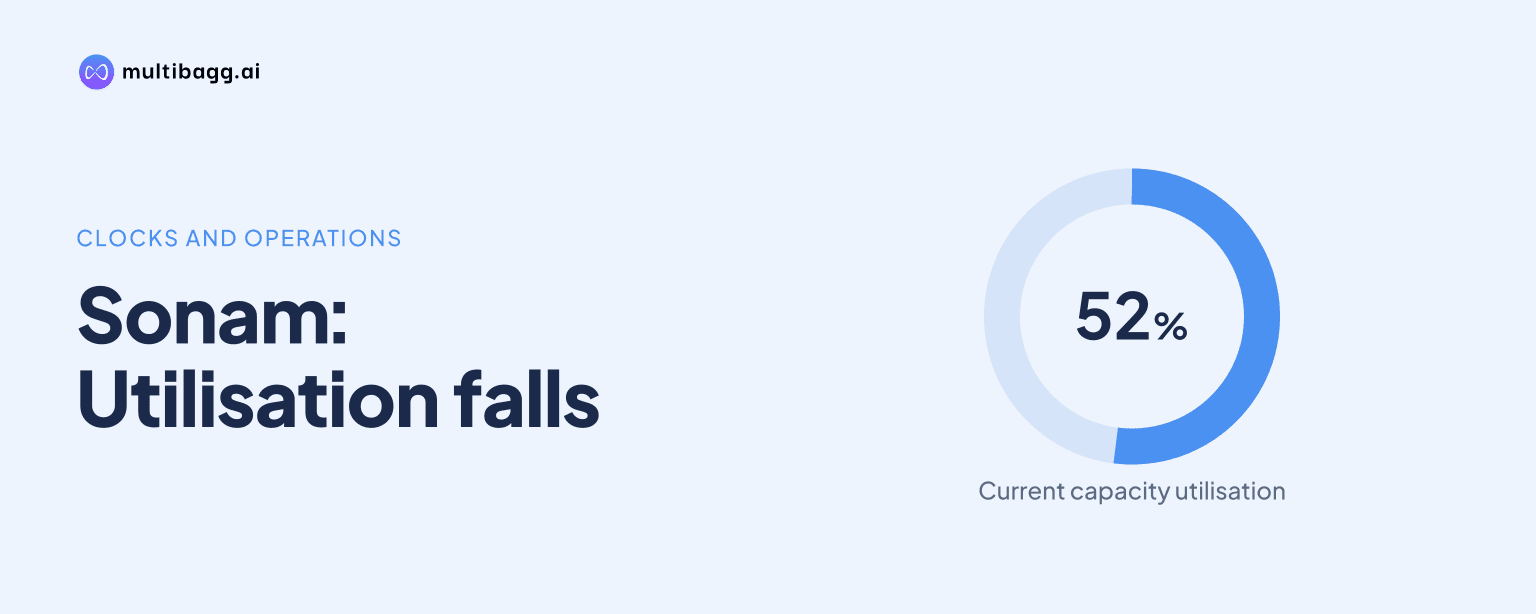
Sonam Limited is shifting its near-term emphasis towards domestic premium clocks because higher export freight costs have reduced manufacturing capacity utilisation to 52%. Sonam said domestic growth is being supported by wider distribution and new models, with eight to ten further launches planned within two to three months and a new AMPM brand due this year.
Know Sonam inside out
Results, valuation, peers and who's buying, in one view.
Why is Sonam focusing more on domestic clock sales?
Sonam is focusing more on domestic sales because export freight costs have risen sharply and affected overseas business. Management said higher freight had reduced exports and, in turn, manufacturing-level activity. It put current capacity utilisation at 52%, directly linking the unused capacity to the lower export contribution.
The freight burden also appeared in operating costs during the first half. An analyst cited other expenses of Rs 7.5 crore, comprising Rs 2.4 crore in the first quarter and Rs 5.1 crore in the second quarter. Management said freight represented 30% to 40% of first-half other expenses and confirmed that the proportion had been lower in the comparable prior period.
Domestic demand is being addressed through distribution expansion and product development rather than through a stated withdrawal from exports. When asked why domestic demand had increased, management attributed it to the broader distribution channel and the models developed for the domestic market. Sonam therefore described the domestic focus as a response to both higher export costs and better access to local buyers.
How is Sonam changing its clock product strategy?
Sonam is moving its principal wall-clock focus towards the premium range. Management contrasted clocks that previously sold for 200 rupees or 400 rupees with newly launched higher-range models. It said production costs had risen somewhat for these products, but that sales and profit per high-range clock had also increased.
The company is pursuing this positioning beyond the largest cities. Management said premium clocks were selling in tier-two and tier-three cities, where it believes consumer purchasing power has increased. This is a management assessment rather than a disclosed market measurement, but it explains why Sonam is directing its product range and distribution towards premium customers across a wider domestic geography.
The launch pipeline is central to that strategy. Sonam said it had launched many models during the preceding two months and planned to introduce another eight to ten models in the following two to three months. It also said it would launch the AMPM brand during the year, alongside increased production of premium clocks.
What do Sonam's sales mix and margin figures show?
Sonam's growth has recently been led more by domestic business, clock movements and trading activity than by exports. Management said its clock-movement business had improved, while imported goods sourced through arrangements with companies in Taiwan were delivering somewhat better profit. It also said it directly imports 50% to 70% of some materials, including materials used in its operations.
The reported sales composition changed markedly as turnover increased. An investor cited first-half revenue of about Rs 196 crore, of which management said roughly Rs 20 crore was actual manufacturing revenue; the balance included imported goods and imported materials sold through trading. For the previous full year, management put revenue at Rs 171 crore and manufacturing at Rs 60 crore. The periods are not directly comparable, but the figures show trading formed a larger share of the more recent first-half turnover.
Management said manufacturing activity had increased year on year even though its percentage of total turnover had fallen, because trading had expanded faster. It described manufacturing as Sonam's main business since 1996 and said trading had become more active over the past two to three years, particularly this year through tie-ups with suppliers. That distinction matters because management gave different margins for the two activities: 21% gross profit in manufacturing and 3% to 4% operating margin for imported goods.
Got a follow-up? Ask IRIS
How are freight and trading affecting Sonam's profitability?
Higher freight has reduced Sonam's operating margin relative to the prior period, according to management. In response to an analyst's summary, it agreed that the higher freight component in other expenses had raised the expense run rate and lowered operating margin. Management also said the previous year's net profit was higher, while stressing that raw-material trading had generated good margin and turnover after crude-oil prices increased.
Trading performance is linked to materials including acrylonitrile butadiene styrene, polycarbonate, general-purpose polystyrene and high-impact polystyrene. Management said profits in these products were currently good, partly because of supplier tie-ups, but it did not give a durable margin forecast and said future conditions could move up or down. This makes the trading-led turnover increase different from a stated permanent improvement in manufacturing economics.
Sonam said it would use turnover, schemes and new launches to support profit if earnings before interest, tax, depreciation and amortisation, or EBITDA, margin declined. Management did not provide a full-year EBITDA margin target, saying it was difficult to specify one at present. Instead, it said it hoped profit would grow by 40% to 50% through a mix of trading, manufacturing and new models.
What growth plans and targets has Sonam disclosed?
Sonam said it expected turnover over the next two quarters to be 30% to 40% above its earlier expectation, with margin also expected to rise. That is management guidance, not a reported outcome. It also said it had achieved the prior year's margin in six months, although it did not quantify that margin during this discussion.
For the financial year, management said it hoped for revenue of Rs 300 crore to Rs 350 crore and profit after tax, or PAT, of Rs 12 crore to Rs 14 crore, which it described as about double the prior year. It also referred to original equipment manufacturing, or OEM, work for Titan and Amazon, saying this could add turnover over the next two quarters. The company did not disclose the value of these orders or their margins.
Looking further ahead, management set a target of Rs 25 crore to Rs 30 crore of PAT by 2028 or 2029 and earnings per share of 5 to 6 rupees. It presented these as projections and targets, while separately cautioning that business conditions could change quarter to quarter. The premium-clock programme is also intended to lift selling values so that costs become a lower proportion of sales, according to management.
Conclusion
Sonam's strategy shift is clear: elevated export freight costs have constrained export-led manufacturing utilisation, while domestic distribution, premium clock launches, clock movements and trading are supporting growth. The company is seeking higher selling values in domestic premium clocks rather than relying on lower-priced 200-rupee to 400-rupee models, but its sales mix currently contains a larger trading contribution with a different margin profile.
The next indicators to watch are the planned eight to ten model launches within two to three months, the launch of the AMPM brand during the year, and management's expected contribution from OEM work over the next two quarters. Sonam's Rs 300 crore to Rs 350 crore revenue and Rs 12 crore to Rs 14 crore PAT expectations will also depend on freight costs, export conditions and the sustainability of trading margins.