










Shree TNB targets FY28 commercial output from new plants
Key highlights
- Shree TNB plans approximately 6,000 tonnes of annual capacity across new honeycomb and drum projects.
- The honeycomb project is planned at about 4,000 tonnes annually, while the drum project is planned at about 2,000 tonnes.
- Management estimated about 3,000 tonnes of combined capacity could be available over six months in FY27-28.
- Shree TNB said 60% to 65% of its historical revenue is generated in the second half.
powered by IRIS
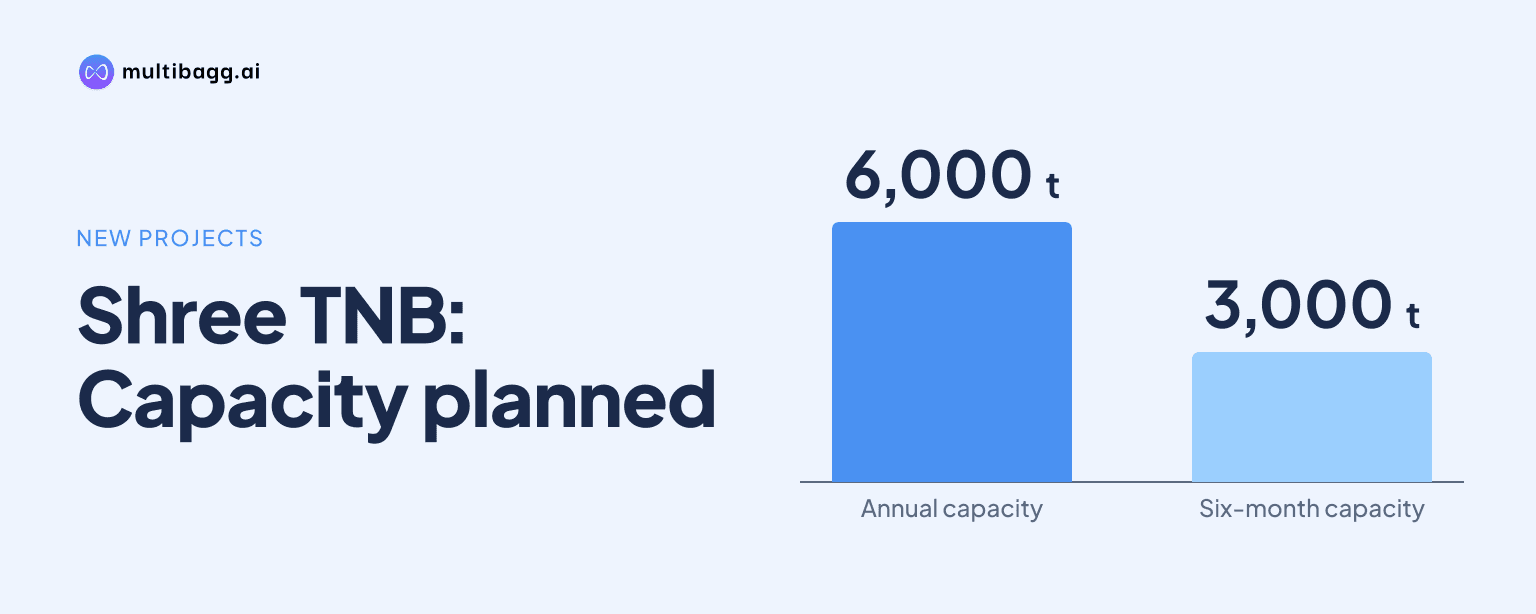
Shree TNB expects its new drum and honeycomb facilities to begin commercial production in FY27-28, or FY28, after machinery delivery, installation and two to three months of trials. Management outlined 6,000 tonnes of combined annual capacity, comprising 4,000 tonnes of honeycomb and 2,000 tonnes of drums, with about 3,000 tonnes available during a six-month initial operating period.
Know Shree TNB Polymers inside out
Results, valuation, peers and who's buying, in one view.
When will Shree TNB's new facilities start commercial production?
Shree TNB expects commercial production during FY27-28, although management cited several milestones ranging from the first quarter to September 2027. Deepak Kumar Raura said machines were ordered after the IPO proceeds arrived in the first week of October and could be delivered within five to six months. He said deliveries and installation should be completed in the first quarter of FY27-28, after which commercial production could start.
A separate timeline from Vijay Thosani was more extended. He said machinery would arrive after March, and installation plus the start of production would take six months of the next financial year, leaving six to seven months for revenue generation. In another response, Thosani said the facility would be operational by September 2027, while Raura said installation on newly acquired land would begin in March and production could start by April or May.
Management also referred to a two-to-three-month trial-production phase before commercial output. Raura said FY27-28 could be a robust year because machines would be installed, trials would be undertaken and commercial production would then continue for the year. The call did not establish one final commissioning date, so the cited first-quarter, April-May and September 2027 references appear to describe different stages of delivery, installation, trial production and commercial operations.
How much drum and honeycomb capacity will Shree TNB add?
Shree TNB plans to add approximately 6,000 tonnes of annual capacity, split between 4,000 tonnes of honeycomb products and 2,000 tonnes of polymer drums. Thosani said the plants could operate for only about six months in FY27-28, which would make roughly 2,000 tonnes of honeycomb capacity and 1,000 tonnes of drum capacity available in that period.
The 3,000-tonne figure is therefore a partial-year capacity estimate rather than a full-year sales forecast. Shree TNB did not disclose expected utilisation, revenue per tonne, customer contracts or an order book for the 6,000 tonnes of annual capacity. Management said it had initially ordered two machines for the drum business, despite describing demand across its nearby chemical-industry markets as substantial.
The two projects address different product applications. Management said polymer drums will be sold to industrial chemical customers across Vapi, Sarigam, Surat, Ankleshwar, Bharuch, Saykha, Dahej and Tarapur. Honeycomb products are intended for automotive use, and Thosani said Shree TNB is associated with the automobile industry, where the product is expected to be used.
Why will Shree TNB's new facilities take time to add revenue?
Shree TNB said revenue will begin only after machinery arrives, installation is completed, trial output is produced and products reach customers. Thosani estimated that installation and the start of production would consume six months after machines arrive, while Raura cited two to three months of trial production before commercial operations. These steps explain management's reference to only six to seven months of revenue in FY27-28.
Marketing has begun, but management said demand does not equal booked sales before physical availability. In response to whether capacity was fully committed, Raura said Shree TNB had informed dealers and deployed its marketing team, but customers generally do not place orders until products are manufactured and available in the market. Management said it shortlisted the products after a demand study and planned to launch multiple products in the first quarter.
The partial-year ramp also comes alongside the company's existing seasonality. Raura said 60% to 65% of Shree TNB's revenue has historically come in the second half, as pipe and micro-irrigation activity slows in the rainy season. He said April and May are generally the available first-half months before rains begin in June, while tendering, processing and order placement take about six months.
Got a follow-up? Ask IRIS
What supports Shree TNB's drum-project plan?
Shree TNB bases its drum-project case on demand from chemical manufacturers and a shift from metal packaging to polymer drums. Management said chemical companies generally use polymer drums because chemicals can react with aluminium or mild steel, while metal drums continue to be used to some extent in lubricants and oil applications. The planned sales focus is industrial, not household, customers.
Thosani said the planned drum machinery uses a three-layer process: virgin material on the inner and outer layers and recycled material in the middle layer. He said the middle portion's cost would be 30% lower, while the product in the drum would remain in contact with virgin material. Management did not disclose an overall drum-cost reduction, a target selling price or a margin target.
Management linked the technology to the government's Extended Producer Responsibility, or EPR, system. Thosani said recycled-material use is compulsory at 30% in the current year, 40% in the following year and 60% thereafter. He contrasted the planned machine with single-layer or single-stroke equipment, where recycled and virgin material are mixed, which management said can affect product quality.
What should readers watch as Shree TNB approaches FY28 production?
Readers should watch for confirmation of machine delivery after March, installation completion, trial-run duration and the first commercial shipments. The call contained milestones spanning the first quarter of FY27-28, possible production by April or May, and operations by September 2027. A subsequent company update would need to clarify which of these stages has been completed.
Demand conversion is the other key milestone. Management said dealers have been informed and its teams are promoting the products, but it also said customers generally wait until products are physically available before placing orders. Shree TNB did not disclose committed volumes, customer contracts, launch-period revenue targets or expected utilisation for the 4,000-tonne honeycomb and 2,000-tonne drum facilities.
For honeycomb, management said only two or three large players operate in the segment, naming Cello, Mutual Plastic and Nilkamal. For drums, management said the transport-viable zone extends from Vapi through Bharuch, Ankleshwar, Saykha, Dahej, Surat, Sarigam and Tarapur. Those statements describe the intended market opportunity, while sales results will depend on commissioning and customer orders.
Conclusion
Shree TNB's planned expansion would add 6,000 tonnes of annual drum and honeycomb capacity, but management expects only about 3,000 tonnes to be available over a six-month initial period in FY27-28. The drum project targets chemical-industry packaging, while honeycomb products target automotive applications, making the expansion dependent on separate customer markets and production ramp-up.
The next disclosed milestones are machinery arrival after March, installation on the newly acquired land, a two-to-three-month trial period and commercial production. Management's references to first-quarter completion, April-May production and September 2027 operations leave the final schedule unresolved, while its marketing efforts and dealer outreach will be tested when physical products become available.