










Shree TNB targets Rs 135-150 crore expansion revenue by FY29
Key highlights
- TNB plans to raise installed capacity by 10,000 MT, from 26,500 MT to 36,500 MT.
- Management targets Rs 135-150 crore of revenue from the added capacity, mainly in FY28-29.
- Honeycomb sheets represent 4,000 MT of the planned 10,000-MT capacity addition.
- TNB reported first-half revenue of Rs 86.08 crore and profit after tax of Rs 2.58 crore.
powered by IRIS
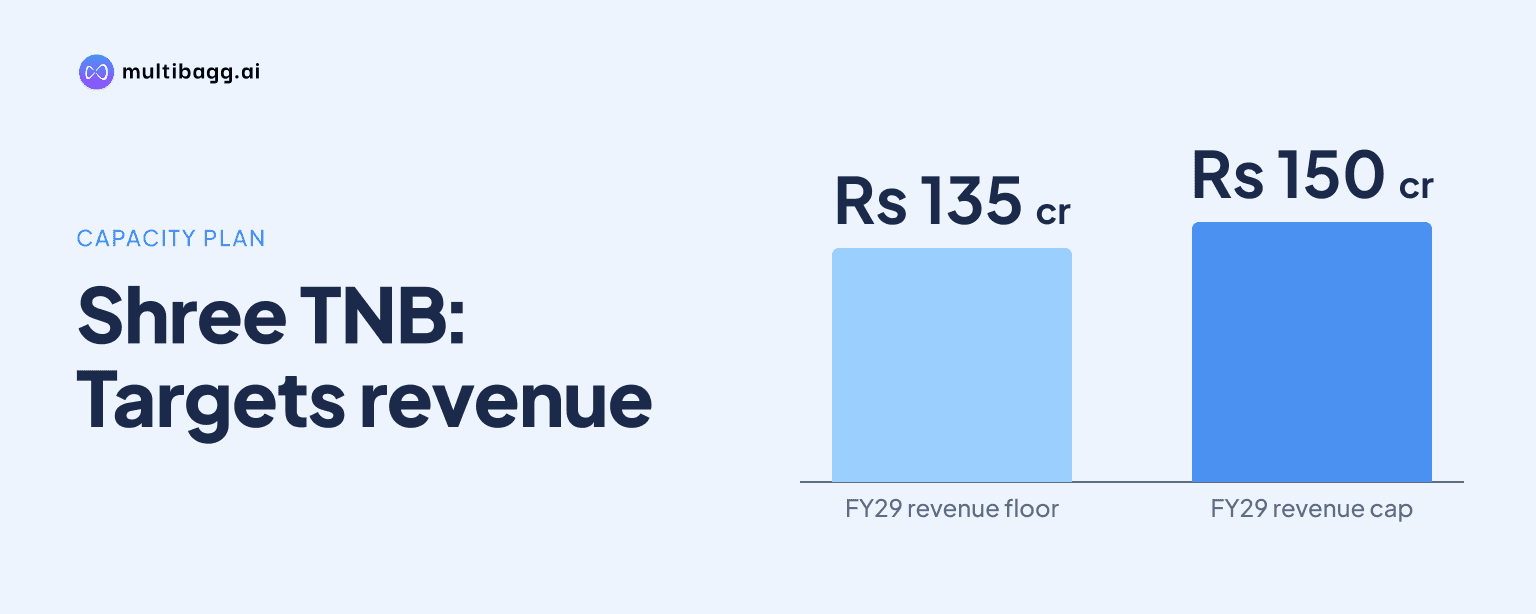
Shree TNB expects its planned 10,000 metric tonne (MT) capacity expansion to generate Rs 135-150 crore of revenue, with management expecting the main contribution in FY28-29 after installation, trials and commercial production. The programme would increase installed capacity to 36,500 MT from 26,500 MT across packaging sheets, drums and pallets.
Know Shree TNB Polymers inside out
Results, valuation, peers and who's buying, in one view.
What capacity is TNB adding?
TNB is adding approximately 10,000 MT of capacity across honeycomb sheets, polypropylene (PP) corrugated sheets, drums and plastic pallets. Management said the expansion would lift total installed capacity by 37.7%, from 26,500 MT to 36,500 MT, after the new lines are operational.
Honeycomb sheets account for the largest planned addition, at approximately 4,000 MT per annum. PP corrugated sheets are expected to add 2,000 MT, while 210-litre drums account for 1,500 MT, 60-litre drums for 500 MT and plastic pallets for 1,500 MT. These components total the 10,000-MT expansion cited by management.
TNB said Phase 1 construction has been completed through internal accruals rather than initial public offering, or IPO, proceeds. The company has 10,111 square metres of new land and has built a Phase 1 shed of about 26,000 square feet, while a further 20,000-square-foot Phase 2 shed is planned to be funded from IPO proceeds.
When will TNB's added capacity generate revenue?
TNB expects installation and either trial or commercial production to begin by March 2027, with some revenue contribution in FY27-28 and the main contribution in FY28-29. Management said machines are expected to be delivered by March, with commercial production potentially beginning around April or May after installation and trials.
The FY27-28 contribution is expected to be partial because machine installation and trial production require time. In response to an investor question, management said it would seek to generate as much revenue as possible in FY27-28, but described FY28-29 as the period when the new businesses should be in full swing.
TNB gave the same broad timing for its medium-density polyethylene, or MDPE, pipe project. The company said Phase 1 construction was complete, but production had not started because government and other approvals remained in process; it expects first-phase production from March 2027 and revenue reflection in FY27-28.
Which products support TNB's Rs 135-150 crore target?
TNB attributes the Rs 135-150 crore revenue potential to the combined 10,000-MT additions in honeycomb sheets, PP corrugated sheets, drums and plastic pallets. Management did not disclose revenue targets, selling prices or utilisation assumptions for individual product categories.
The 4,000-MT honeycomb-sheet line will serve packaging and logistics, surface protection, automotive applications and industrial signage, according to management. TNB said honeycomb is a more advanced version of products it already makes, including PP hollow sheets and flute boards, which management believes can be marketed through its existing relationships.
The 2,000-MT drum capacity includes closed-head and open-head formats, along with 210-litre and 60-litre drums. Management said customers that buy drums can overlap with its existing customers for sheets and pipes, and estimated that about 60-70% of its customers are direct customers.
TNB's chairman also described a proposed three-layer drum process using virgin polymer in the outer and inner layers and reprocessed material in the middle layer. He said the company was discussing equipment costing about Rs 2 crore that could reduce the weight of an 8.5-kilogram drum to 7.5 kilograms, though no purchase decision or implementation date was disclosed.
Got a follow-up? Ask IRIS
How does TNB's expansion compare with current operations?
The Rs 135-150 crore expansion revenue potential is larger than TNB's reported first-half revenue of Rs 86.08 crore, although it is a management estimate rather than booked or reported revenue. At the midpoint of Rs 142.50 crore, the potential annual contribution would exceed first-half revenue by Rs 56.42 crore.
TNB reported first-half earnings before interest, tax, depreciation and amortisation, or EBITDA, of Rs 7.57 crore and profit after tax of Rs 2.58 crore. Management cited a profit-after-tax margin of 3% and said the first half is generally slower because rainfall affects pipe, drip-irrigation and micro-irrigation activity for three to four months.
Management said roughly 60% of TNB's business has historically occurred in the second half. It also reported a running order book of about Rs 64.23 crore and fresh high-density polyethylene, or HDPE, pipe orders of approximately Rs 51 crore through distributors, of which a first lot worth about Rs 9 crore had cleared inspection and begun dispatch.
What must happen for TNB to reach its expansion target?
TNB's Rs 135-150 crore target depends on machine delivery, installation, trial production, regulatory approvals, working capital and customer ramp-up. Management said the company has already booked machines, placed orders and paid the margin required for those machines using IPO proceeds.
For the remaining capital needs, management said expansion capital expenditure would mainly be funded from IPO proceeds, while the company may approach banks for working capital. This separates the funding of completed Phase 1 infrastructure, which was internally funded, from the next stage of machinery and capacity deployment.
Management cited its existing manufacturing base in pipes and sheets as a route to market for the new products. TNB said it has about seven Bureau of Indian Standards, or BIS, licences, registrations and approvals in states including Maharashtra, Gujarat, Madhya Pradesh, Karnataka and Rajasthan, and a recently received licence for gas pipes.
The company also linked future profitability to higher utilisation. Management said that when its order capacity is full, it can negotiate rates, and stated that its historical profit-after-tax margin has generally been between 4% and 5%, compared with the 3% reported for the first half.
Conclusion
TNB's plan combines a 10,000-MT capacity addition with a management target of Rs 135-150 crore in revenue from honeycomb sheets, PP corrugated sheets, drums and plastic pallets. The largest single addition is 4,000 MT of honeycomb sheets, while the total programme would raise installed capacity to 36,500 MT from 26,500 MT.
The next milestones are machine delivery and installation by March 2027, completion of approvals for projects including MDPE pipes, and the transition from trials to commercial production. Management expects some revenue in FY27-28, but has identified FY28-29 as the period for the principal contribution toward its Rs 135-150 crore target.