










Sheetal passes over 80% of milk-cost gap through pricing
Key highlights
- Sheetal said more than 80% of the temporary milk-price gap is being passed to consumers.
- Sheetal uses smaller pack volumes for lower-MRP products and price revisions for products above Rs 30.
- Gross margin rose to 39.8% in Q2 FY27 from 35.1% in Q2 FY26.
- Sheetal procures up to 1.5 lakh litres of milk per day in summer versus 70,000 to 80,000 litres outside summer.
powered by IRIS
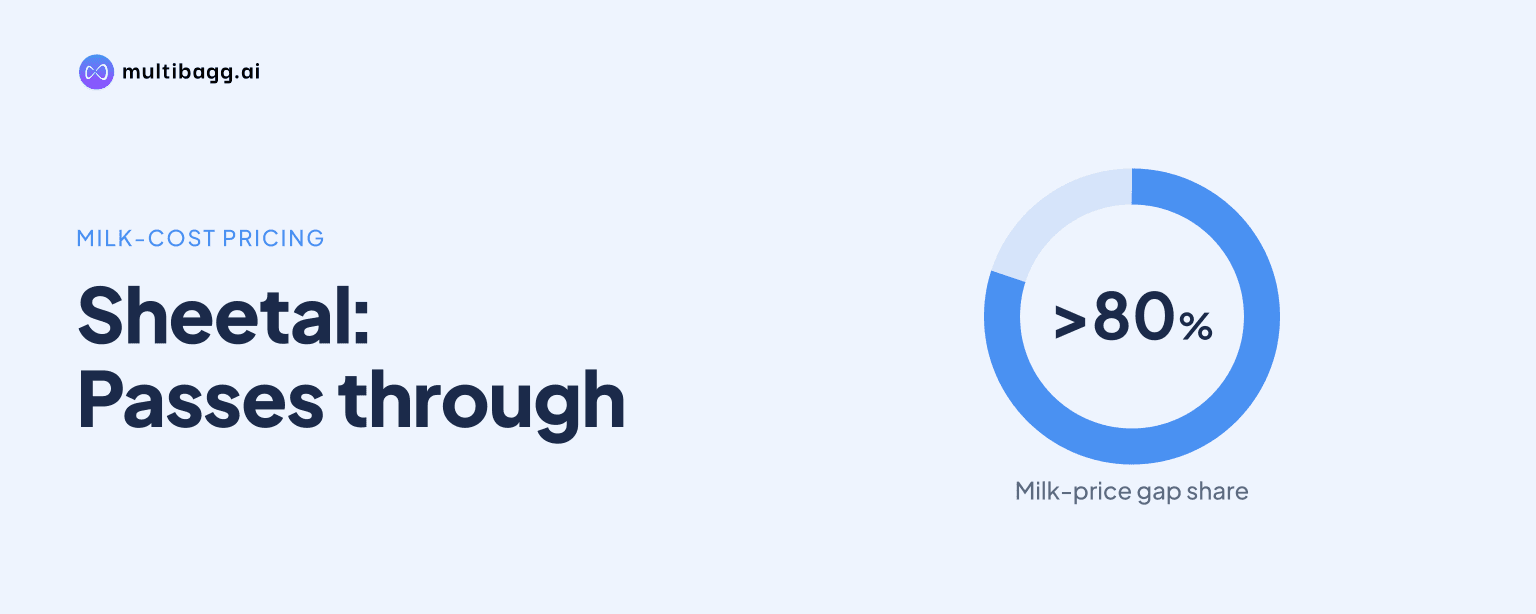
Sheetal Cool Products Limited said on its November 18, 2026 earnings call that it is passing more than 80% of a temporary milk-price gap to consumers through lower pack volumes for selected products and direct price revisions for products above Rs 30, after demand for pure-milk paneer increased.
Know Sheetal Cool Products inside out
Results, valuation, peers and who's buying, in one view.
Why are milk prices pressuring Sheetal?
Sheetal said the government’s ban on analog paneer temporarily tightened milk availability because demand for paneer made from pure milk increased across the market. Management said the resulting rise in pure-milk consumption affected Sheetal as well, adding input-cost pressure during monsoon and winter, when ice-cream consumption is lower than in summer.
The change has also supported Sheetal’s paneer sales, according to management, because the higher preference for pure-milk paneer made it easier to place its product in the market and reach consumers. Paneer, ghee and other value-added dairy products are less seasonal than ice cream, giving Sheetal categories to distribute during lower ice-cream consumption months.
Sheetal procures up to 1.5 lakh litres of milk a day in summer, compared with about 70,000 to 80,000 litres a day outside summer. Management said milk availability in the Saurashtra region has not historically been an issue, but described the current scarcity as temporary and linked it to higher pure-milk paneer consumption.
Milk remains central to Sheetal’s revenue base: management said 90% of revenue comes from milk and milk-associated products, while 10% comes from the remaining product basket. This concentration means changes in milk prices affect ice cream, paneer, ghee, shrikhand and Indian sweets rather than only the paneer category.
Sheetal said it collects milk through exclusive aggregators and bulk milk chilling points, where farmers’ milk is tested before transfer to its Amreli plant. It also said it pays a premium for procurement to support milk quality and uses quality-assurance and quality-control testing before accepting a milk batch.
How is Sheetal passing higher milk costs to shoppers?
Sheetal said it is transferring more than 80% of the milk-price gap to consumers through a combination of quantity revisions and price revisions. The method depends on the maximum retail price, or MRP, and whether a direct increase would create an odd consumer price point.
For lower-MRP packs, Sheetal said it has reduced the volume in millilitres rather than changed the displayed price. Management said this approach applies where the product cannot be sold at an odd figure, allowing the company to adjust quantity while retaining the existing visible price point.
For products priced above Rs 30, Sheetal said it is carrying the higher cost directly to consumers through price increases. The company did not specify the number of affected stock-keeping units, revised pack volumes, old prices or new prices, but said both actions together shift more than 80% of the gap.
The two-part approach indicates that Sheetal is not relying solely on internal absorption of higher milk costs. Management presented pack architecture and price increases as measures to manage a temporary input-cost increase while maintaining product availability across lower-priced and higher-priced products.
Got a follow-up? Ask IRIS
What does this mean for Sheetal’s margins in weaker quarters?
Sheetal said pricing is one of several measures intended to support gross margins, alongside procurement, manufacturing efficiency, productivity and product-mix improvement. The seasonal issue is material because management described monsoon and winter as lower-consumption periods for ice cream than summer, although it said a late winter reduced the usual consumption spike.
Gross margin improved to 39.8% in Q2 FY27 from 35.1% in Q2 FY26, an increase of 4.7 percentage points. That improvement followed pressure in FY26, when management said cost of material consumed increased 18.7% while revenue grew 13.9%, contributing to a decline in gross margin from 32.9% in FY25 to about 30% in FY26.
Management did not attribute Q2 FY27’s gross-margin improvement only to its current milk-pricing actions. It said the pace of recovery depends on input costs and market conditions, while also identifying product mix, procurement and manufacturing productivity as drivers of the reported margin movement.
Distribution expansion adds a separate margin consideration. Sheetal said 35% of its revenue comes from states outside Gujarat and 65% from Gujarat, while transportation costs rise as products move farther from production locations. Management said it intends to consider child plants in states that reach considerable revenue, supplying high-volume products locally while sending premium value-added products from its home state.
Which parts of Sheetal’s portfolio could offset seasonal pressure?
Sheetal said paneer and ghee can partly offset ice-cream seasonality because their consumption does not follow the same monsoon and winter pattern. Management’s H2 FY27 priorities are to strengthen core ice cream, deepen distribution, improve sales productivity and scale complementary categories in a disciplined manner.
The company identified volume growth, revenue outside Gujarat, channel contribution, capacity utilisation and repeat sales in newer categories as operating indicators. Sheetal has targeted deployment of about 10,000 freezers across India during the current year, with more than 50% already deployed, according to management; the equipment is intended to expand the retail outlet network and ice-cream sales availability.
Sheetal said ready-to-eat and ready-to-cook products are primarily focused on export markets, where management said margins are higher than in its domestic business. Exports accounted for about 5% of sales last year and have grown year on year since Sheetal began exporting about five years ago, although management said the business would grow steadily over the next few years.
The ready-to-eat and ready-to-cook plant was operating at about 40% capacity and is expected by management to reach 100% utilisation within two years. Sheetal expects its FY30 revenue mix to remain close to 90% dairy and milk-based products and 10% other categories, with ready-to-eat and ready-to-cook products the main contributor within the non-dairy portion.
Sheetal is also undertaking about Rs 10 crore of capital expenditure for the next summer, including additional product machinery and capacity for current production. Management said the investment also addresses demand for new ice-cream shapes and premium products with 8% or 10% milk fat, compared with an earlier 5% milk-fat product example.
Conclusion
Sheetal’s response combines two consumer-facing pricing mechanisms with a broader margin plan covering procurement, manufacturing productivity and product mix. The reported gross margin of 39.8% in Q2 FY27, up from 35.1% in Q2 FY26, shows an improved quarterly outcome, while FY26’s 18.7% rise in material costs versus 13.9% revenue growth illustrates why milk-price recovery remains important.
The next factors to watch are the temporary milk-scarcity situation, implementation of the roughly Rs 10 crore summer-capacity programme and the rollout of about 10,000 freezers during the current year. Management also expects the ready-to-eat and ready-to-cook plant to move from about 40% utilisation to 100% within two years, which would test the planned expansion of export-oriented categories.