










Sheetal pairs 17 lakh daily candies with in-house supply
Key highlights
- Sheetal reports capacity for more than 17 lakh ice-cream candies and more than 11 lakh filled cups per day.
- Sheetal lists 2 lakh litres per day of ice-cream capacity and 80,000 litres per day of milk-and-milk-products capacity.
- Sheetal makes biscuit cones, chocolate syrup and corrugated boxes in-house.
- Sheetal’s logistics network has more than 70 delivery vehicles, and clean, green energy supplies 75% of its electricity.
powered by IRIS
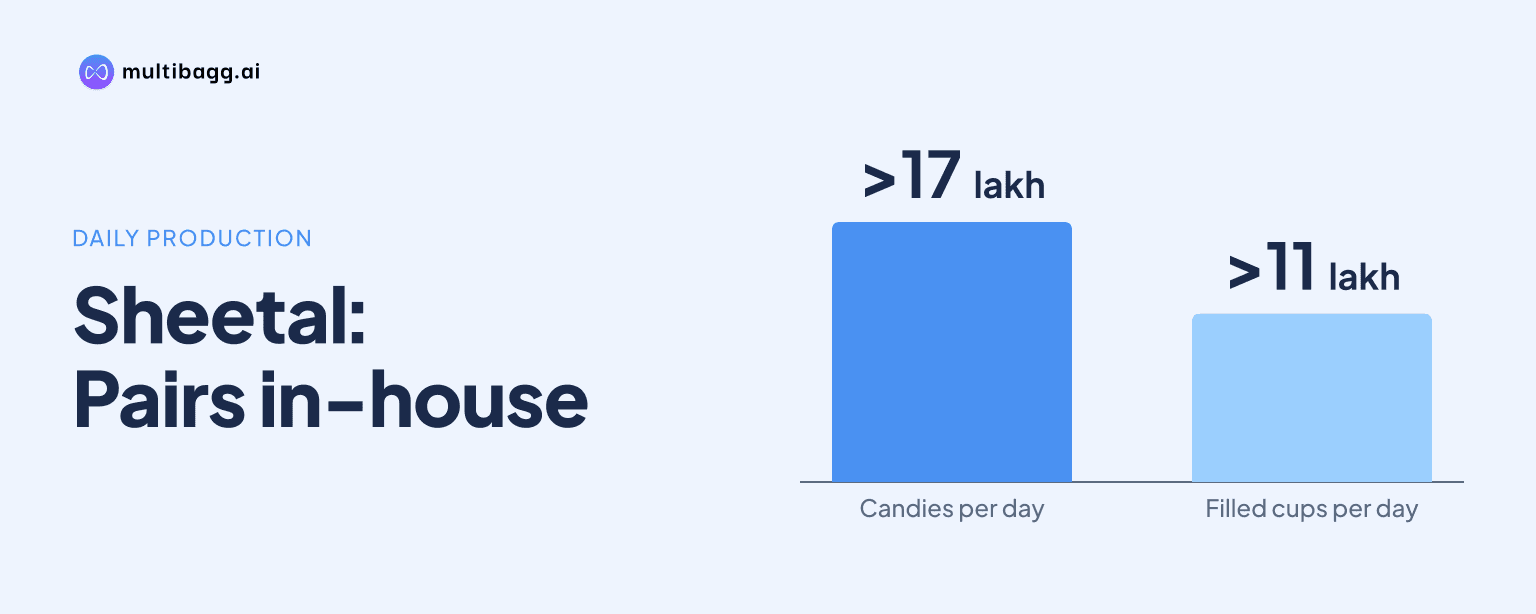
Sheetal Cool Products combines capacity for more than 17 lakh ice-cream candies a day with in-house biscuit-cone baking, chocolate-syrup blending, corrugated-box manufacturing and a fleet of more than 70 delivery vehicles. Sheetal also reports 2 lakh litres per day of ice-cream capacity and 80,000 litres per day of milk-and-milk-products capacity.
Know Sheetal Cool Products inside out
Results, valuation, peers and who's buying, in one view.
How much can Sheetal produce each day?
Sheetal reports its largest stated daily unit capacity in ice-cream candies, at more than 17 lakh pieces per day. It also lists capacity to fill more than 11 lakh ice-cream cups and make more than 7 lakh ice-cream cones each day. These measures cover different finished formats, while the company separately reports liquid capacity in litres per day, or LPD.
Sheetal also states capacity of more than 5.50 lakh namkeen pouches per day, alongside 2 lakh LPD of ice cream and 80,000 LPD of milk and milk products. The ice-cream liquid capacity is 1.20 lakh LPD higher than the dairy capacity and is 2.5 times the stated milk-and-milk-products capacity. Namkeen is measured in packed pouches rather than litres, reflecting a separate snack production line.
The presentation provides a 2018 manufacturing milestone of 2 lakh litres per day after capacity expansion. On the current capacity page, Sheetal assigns 2 lakh LPD specifically to ice cream and separately identifies 80,000 LPD for milk and milk products. The source does not disclose actual output, plant utilisation or the capacity addition that led to the 2018 level.
Which inputs and packaging does Sheetal make in-house?
Sheetal says it makes biscuit cones, chocolate syrup and corrugated boxes in-house. Its cone operation is directly connected to the stated capacity of more than 7 lakh ice-cream cones per day, while the syrup is blended internally using cocoa and other ingredients. The company describes traditional baking methods combined with modern technology for the biscuit-cone process.
The corrugated-box facility produces customised boxes for transporting products, according to the presentation. Sheetal links the facility with packaging integrity, sustainability and brand visibility, but gives no box-production capacity, internal-supply percentage or cost figure. This makes the box operation a disclosed packaging capability rather than a quantified output line.
In-house cone baking also sits within Sheetal’s ice-cream portfolio of more than 190 stock-keeping units, or SKUs. Management says internal baking supports freshness and quality, and describes chocolate syrup as a signature in-house product. The presentation does not identify how many of the 190-plus ice-cream SKUs use internally baked cones, in-house syrup or internally produced corrugated boxes.
How does Sheetal manufacture ice cream, dairy and snacks?
Sheetal’s ice-cream process begins with refrigerated milk storage, blending, pasteurisation and homogenisation, followed by cooling, ageing, flavouring, freezing and hardening. The finished product is held in cold storage before dispatch. This refrigerated sequence supports the company’s disclosed capacity of more than 17 lakh candies and more than 11 lakh filled cups per day.
The milk-and-milk-products process differs from ice cream by using milk collection, tank storage, blending, pasteurisation, heat treatment, pouch filling, crating and storage. Unlike ice cream, this process does not include ageing, continuous freezing or hardening. Sheetal associates this dairy line with 80,000 LPD, compared with 2 lakh LPD for ice cream.
For potato chips, Sheetal lists selection, de-stoning, peeling, slicing, washing, blanching, frying, flavouring and packing. Namkeen follows raw-material preparation, recipe-based mixing, flavouring, frying and packing, with automated packaging equipment using sensitive weighing heads. The namkeen line has a stated daily capacity of more than 5.50 lakh pouches.
Bakery manufacturing uses inspection, mixing, fermentation, dividing, proofing, moulding, baking, cooling and packing. Sheetal states that typical fermentation occurs at 27°C and baking at 235-240°C for 30-40 minutes. Its bakery portfolio contains more than 20 varieties, while its ready-to-cook and ready-to-eat range includes more than 10 frozen-food varieties.
Got a follow-up? Ask IRIS
What technology and logistics support Sheetal’s operations?
Sheetal says its quality-check laboratory uses gas chromatography to detect impurities. It also describes research and development focused on ice-cream flavours, ingredients, combinations and technologies for a portfolio of more than 190 ice-cream SKUs. The source does not provide laboratory test volumes, research spending or the number of new products introduced.
The company says automated plants are used to optimise production processes, reduce errors and support consistent quality and higher output. In snacks, this includes automated film-pack equipment with weighing heads for namkeen and weighing-head-equipped machines for potato chips. The presentation does not state how many automated lines serve the more than 5.50 lakh daily namkeen-pouch capacity.
Sheetal’s logistics network is supported by more than 70 delivery vehicles and includes door-to-door delivery across multiple markets. The company says the fleet serves distributors, retailers and partners, while mobile workshops provide on-site maintenance support. It does not disclose fleet ownership, vehicle refrigeration specifications, delivery mileage or the number of routes.
How does Sheetal source electricity for its infrastructure?
Sheetal states that 75% of its electricity comes from clean, green energy. Its named solar assets are a 1.20 megawatt, or MW, plant at Chital, Gujarat, and a 4.90 MW plant at Chavand, Gujarat. Together, the two solar plants have 6.10 MW of listed capacity.
The company also lists a 1.25 MW wind unit, identified as V01, at Vanku, Gujarat, and a 1.50 MW wind unit, identified as BDA45, at Bhambhadi, Gujarat. The wind assets total 2.75 MW. Combined with the 6.10 MW solar capacity, the four disclosed renewable installations total 8.85 MW.
The 75% electricity-sourcing disclosure is relevant to operations that include refrigeration, cooling tunnels, cold storage, frying, baking and automated packing. However, Sheetal does not allocate electricity consumption across its 2 lakh LPD ice-cream line, 80,000 LPD dairy line or more than 5.50 lakh daily namkeen-pouch line. The source also does not state generation output or commissioning dates for the 8.85 MW of listed assets.
Conclusion
Sheetal’s operating model combines high stated ice-cream capacity with internally produced cones, syrup and corrugated boxes, as well as a delivery fleet of more than 70 vehicles. Its 2 lakh LPD ice-cream capacity exceeds its 80,000 LPD milk-and-milk-products capacity, while the more than 17 lakh daily candy capacity shows the scale of its disclosed finished ice-cream formats.
What to watch next is whether Sheetal discloses utilisation of its 2 lakh LPD ice-cream and 80,000 LPD dairy capacity, output from its 8.85 MW listed renewable assets, or the share of cones and packaging supplied internally. The presentation identifies 75% clean-energy electricity sourcing but does not set a future capacity, energy or logistics expansion target.