










Sheetal H1 operating cash flow turns negative at Rs 32.4 crore
Key highlights
- Sheetal reported a Rs 32.4 crore operating cash outflow in H1 FY27.
- A Rs 54.7 crore operating-assets adjustment exceeded Rs 22.4 crore of pre-working-capital operating profit.
- Financing activities generated Rs 42.5 crore in H1 FY27, raising closing cash to Rs 9.3 crore.
- Short-term borrowings rose to Rs 76.1 crore at H1 FY27 from Rs 38.3 crore at FY26.
powered by IRIS
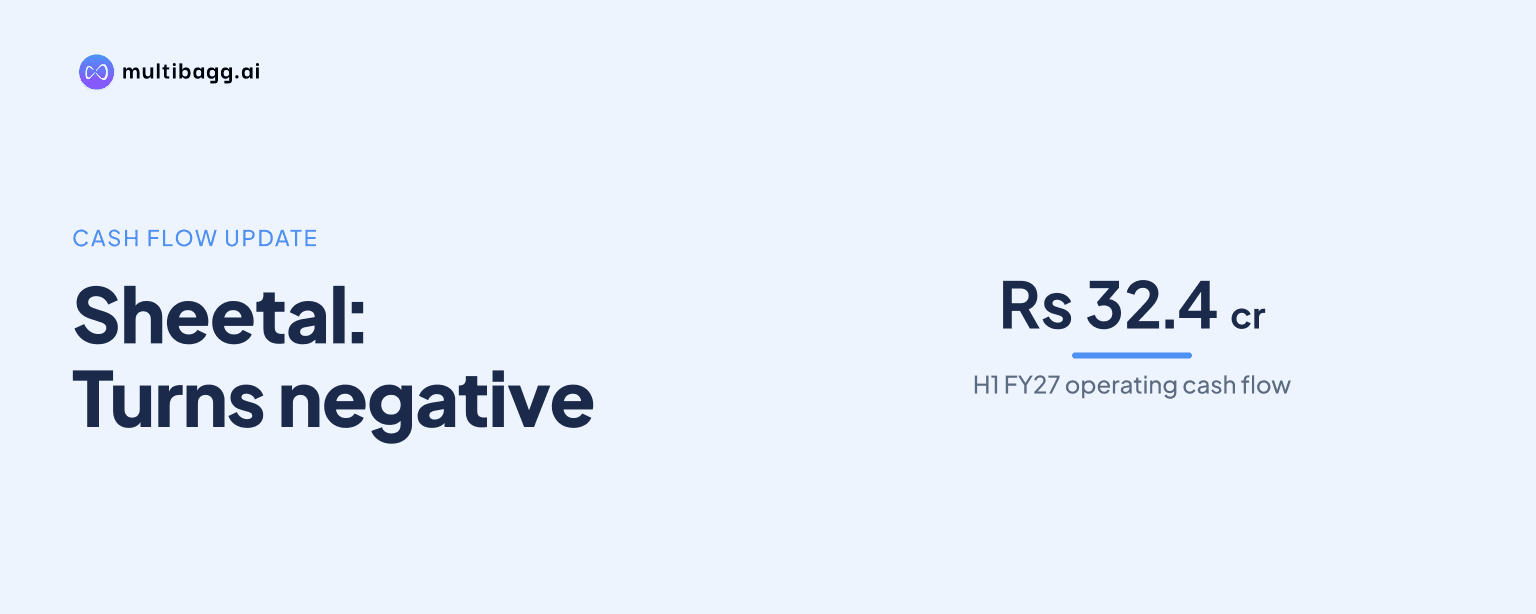
In H1 FY27, Sheetal Cool Products Limited recorded a Rs 32.4 crore cash outflow from operating activities despite Rs 10.2 crore of profit after tax, as a Rs 54.7 crore increase in operating assets exceeded Rs 22.4 crore of operating profit before working-capital changes. A Rs 42.5 crore financing inflow supported the rise in closing cash to Rs 9.3 crore.
Know Sheetal Cool Products inside out
Results, valuation, peers and who's buying, in one view.
What caused Sheetal’s negative operating cash flow in H1 FY27?
Sheetal’s operating cash outflow was caused by a Rs 54.7 crore negative adjustment for changes in operating assets in H1 FY27. Operating profit before working-capital changes was Rs 22.4 crore, but the operating-assets movement and Rs 4.9 crore of income tax resulted in cash generated from operating activities of negative Rs 32.4 crore.
The presentation does not break the Rs 54.7 crore adjustment into individual transactions. Its H1 FY27 balance sheet shows inventories rising by Rs 6.6 crore from Rs 151.8 crore at FY26 to Rs 158.4 crore, trade receivables rising by Rs 4.3 crore to Rs 40.0 crore, and other current assets increasing by Rs 3.2 crore to Rs 25.9 crore.
The H1 FY27 result differs from the full-year cash generation reported in the preceding three years. Sheetal generated Rs 34.3 crore from operations in FY26, Rs 38.1 crore in FY25 and Rs 29.9 crore in FY24, when the operating-assets adjustments were negative Rs 8.7 crore, negative Rs 1.4 crore and negative Rs 17.3 crore, respectively. Those full-year results are not directly comparable with a half-year period.
Did Sheetal’s H1 FY27 profit convert into cash?
No. Sheetal reported Rs 10.2 crore of profit after tax, or PAT, in H1 FY27 while cash generated from operating activities was negative Rs 32.4 crore. Revenue from operations increased 17.3% year on year to Rs 198.0 crore, and earnings before interest, tax, depreciation and amortisation, or EBITDA, increased 33.1% to Rs 22.4 crore.
Reported margins also rose even though operating cash was negative. PAT margin increased to 5.2% in H1 FY27 from 4.1% in H1 FY26, while EBITDA margin increased to 11.3% from 10.0%. The Rs 54.7 crore operating-assets adjustment was larger than both the Rs 22.4 crore pre-working-capital operating profit and the Rs 10.2 crore PAT.
How was Sheetal’s higher cash balance funded?
Sheetal’s Rs 8.8 crore increase in cash and cash equivalents in H1 FY27 was funded by a Rs 42.5 crore financing cash inflow. That inflow more than offset the Rs 32.4 crore operating cash outflow and Rs 1.3 crore investing cash outflow, increasing closing cash and cash equivalents to Rs 9.3 crore from Rs 0.5 crore at the beginning of the year.
Financing cash flow changed direction from the three prior full financial years presented. Sheetal reported financing outflows of Rs 25.5 crore in FY26, Rs 14.9 crore in FY25 and Rs 11.1 crore in FY24, compared with a Rs 42.5 crore inflow in H1 FY27. The presentation gives no line-item allocation of the financing inflow.
Investing cash use was Rs 1.3 crore in H1 FY27, below the Rs 18.3 crore reported for FY26. Property, plant and equipment stood at Rs 44.5 crore at H1 FY27, down from Rs 47.7 crore at FY26, while other non-current assets increased to Rs 25.2 crore from Rs 0.3 crore over the same dates.
Got a follow-up? Ask IRIS
What changed in Sheetal’s borrowings and working capital?
Sheetal’s short-term borrowings rose to Rs 76.1 crore at H1 FY27 from Rs 38.3 crore at FY26, while long-term borrowings declined to Rs 19.9 crore from Rs 38.3 crore. The two listed borrowing categories totalled Rs 96.0 crore at H1 FY27, compared with Rs 76.6 crore at FY26.
The debt-to-equity ratio was 0.6 times at H1 FY27, compared with 0.3 times at FY26 and 0.6 times at FY25. Shareholders’ funds increased to Rs 167.1 crore from Rs 156.9 crore at FY26, while trade payables declined by Rs 14.4 crore to Rs 13.7 crore and other current liabilities increased by Rs 1.2 crore to Rs 5.9 crore.
Sheetal reported a cash conversion cycle of 228 in H1 FY27, compared with 212 in FY26. Its working-capital turnover ratio declined to 3.0 times from 3.2 times, and the current ratio fell to 2.3 times from 2.7 times. These indicators accompanied the rise in inventory to Rs 158.4 crore and the negative operating cash result.
How do Sheetal’s H1 FY27 balance-sheet levels compare with earlier periods?
Sheetal’s total assets increased to Rs 309.3 crore at H1 FY27 from Rs 264.6 crore at FY26. Inventories of Rs 158.4 crore were also above Rs 147.6 crore in FY25 and Rs 129.8 crore in FY24, making inventory the largest current asset line shown in the H1 FY27 balance sheet.
Trade receivables of Rs 40.0 crore were higher than Rs 35.7 crore at FY26, but lower than Rs 45.5 crore at FY25 and Rs 50.0 crore at FY24. Cash and cash equivalents reached Rs 9.3 crore from Rs 0.5 crore at FY26, but the cash-flow statement shows that the H1 increase followed financing inflows rather than positive operating cash generation.
Conclusion
Sheetal’s H1 FY27 financial statements show a divergence between reported earnings and operating cash. Revenue rose to Rs 198.0 crore, EBITDA reached Rs 22.4 crore and PAT was Rs 10.2 crore, but a Rs 54.7 crore operating-assets adjustment led to a Rs 32.4 crore operating cash outflow. Financing activity then supplied Rs 42.5 crore and raised closing cash to Rs 9.3 crore.
The key matter to watch is the subsequent movement in the aggregate operating-assets adjustment, which the presentation does not itemise. Future disclosures can show whether inventory of Rs 158.4 crore, receivables of Rs 40.0 crore, the 228 cash conversion cycle and Rs 76.1 crore of short-term borrowings change alongside operating cash generation.