










Lords Mark gains 85% stake in Renalyx AI dialysis platform
Key highlights
- Lords Mark acquired an 85% stake in Renalyx.
- Lords Mark says Renalyx's dialysis machine uses more than 50% less water than conventional machines.
- Renalyx technology completed seven years of clinical trials, according to Lords Mark.
- India's dialysis-machine market is projected to grow at 8.83% CAGR from 2024 to 2033.
powered by IRIS
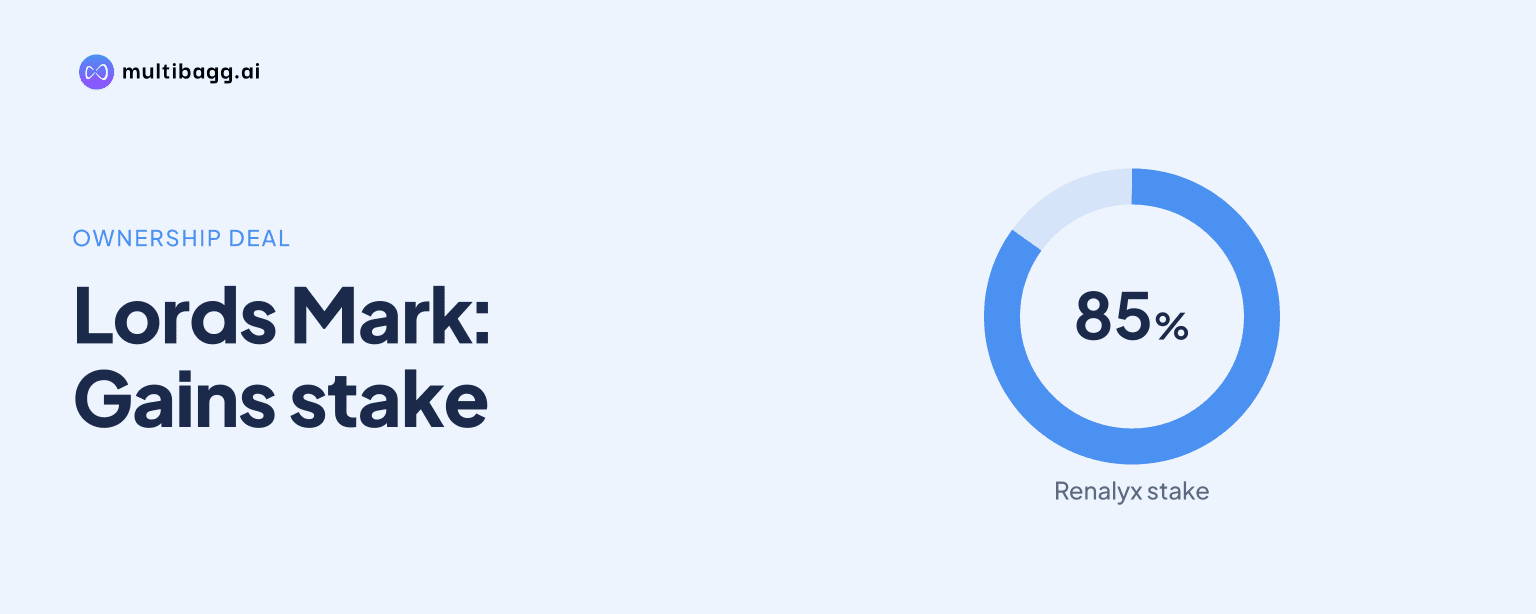
Lords Mark Industries Ltd acquired an 85% stake in Renalyx Health Systems Private Limited, adding an artificial intelligence (AI)-enabled dialysis platform that Lords Mark says uses more than 50% less water than conventional machines, follows seven years of clinical trials and connects treatment centres, devices and clinics through cloud technology.
Know Lords Mark Industries inside out
Results, valuation, peers and who's buying, in one view.
What did Lords Mark acquire from Renalyx?
Lords Mark acquired 85% of Renalyx, an Indian medical-equipment design and manufacturing company whose core product is an AI-based dialysis machine. The presentation identifies Renalyx as an 85%-owned subsidiary and places its dialysis technology within Lords Mark's healthcare portfolio of in-vitro diagnostics, genomics, e-Smart Clinics and connected monitoring products.
Renalyx's machine is described by Lords Mark as India's first indigenous AI-based dialysis machine, built to European CE certification standards and global standards. Lords Mark says the system tracks chronic kidney disease (CKD) progression, predicts risk and supports early intervention, giving the group a treatment-device platform rather than only diagnostic and screening products.
The presentation says Renalyx's technology underwent seven years of clinical trials and has approvals from regulatory authorities including CE approval. It does not disclose the acquisition price, transaction date, Renalyx revenue, manufacturing capacity, installed base, patient numbers or machine sales, leaving the acquired operation's commercial scale unspecified.
Renalyx also brings a technology team led by founder and director Dr. Shyam, according to the presentation. Lords Mark says Dr. Shyam completed a doctorate in electrical engineering at the Indian Institute of Science, Bangalore, in 1995 and has worked with CG Smith, Ericsson, Tata Consultancy Services and Philips, where he was Director of Technology.
How does Renalyx claim to reduce dialysis water use?
Lords Mark says Renalyx's dialysis machine reduces water use by more than 50% compared with conventional machines. The presentation also calls it the first machine developed in India that consumes less than 50% of the water used by other machines, but it does not provide litres used per treatment, a conventional-machine baseline or measured water-saving data.
The water-efficiency claim is paired with a patient-treatment claim. Lords Mark describes Renalyx as the world's first machine developed in India for painless dialysis, while also citing seven years of trials and CE approval; however, the presentation provides no patient sample size, pain score, clinical endpoint or comparative outcome measure for the painless-treatment description.
The stated operating mechanism extends beyond the dialysis machine. Renalyx's cloud-connected platform is intended to give unified access across dialysis centres, connected devices and clinics, while its Renal Command Center centralises occupancy, alerts and cost-efficiency information for treatment providers operating one or more locations.
Renalyx's Quality & Safety Cockpit is intended to cover treatment adequacy, infection control and water-quality compliance. Lords Mark also describes the architecture as modular and scalable for either a single-centre or multi-centre network, although the presentation does not disclose an installation schedule, number of participating centres or planned home-dialysis rollout.
Got a follow-up? Ask IRIS
How does Renalyx fit into Lords Mark's healthcare strategy?
Renalyx fits Lords Mark's stated connected-healthcare model, which moves a patient from diagnostics and AI-assisted analysis to devices, genomics, preventive care, hospitals and government programmes. In this model, Renalyx contributes a renal-treatment device and cloud monitoring layer, while its platform is designed to connect centres, clinics and remote-care processes.
The wider portfolio includes Lords Mark's e-Smart Clinic offering with Dozee, which combines teleconsultation, point-of-care diagnostics capable of more than 30 tests, and contactless vital-sign monitoring. The e-Smart Clinic is stated to operate in 70 to 100 square feet, whereas Renalyx adds specialised dialysis treatment and kidney-care management functions.
The presentation positions dialysis in a different market segment from the group's diagnostics and genomics products. It projects an 8.83% compound annual growth rate (CAGR) for India's dialysis-machine market from 2024 to 2033, compared with 4.4% CAGR for India's in-vitro diagnostics market from 2024 to 2028 and 26.8% CAGR for genome testing from 2024 to 2030.
The comparison shows that dialysis is presented as a distinct treatment-device opportunity, with projected growth above in-vitro diagnostics but below genome testing over the cited periods. Lords Mark does not provide a revenue forecast, profitability target, sales target or expected financial contribution from its 85% Renalyx holding.
What operating capabilities does Renalyx add?
Renalyx adds remote-care tools intended to support dialysis services beyond a single treatment session. Its Home Dialysis Orchestrator is designed to manage patient-enrolment logistics and remote monitoring, while the Renal Command Center provides a central view of occupancy, alerts and cost-efficiency information.
The Quality & Safety Cockpit is described as an operational tool for treatment adequacy, infection control and water-quality compliance. These are stated platform functions rather than reported outcomes, because Lords Mark gives no infection-rate data, treatment-adequacy results, operating-cost reduction or water-quality comparison in the presentation.
The platform is intended to integrate dialysis centres, Internet of Things devices and clinics through one cloud-connected system. Its modular architecture is described as suitable for both a single-centre and multi-centre network, which indicates that Renalyx is designed for different provider configurations, although customer contracts and deployment volumes are not disclosed.
Renalyx's listed partners include Bharat Electronics, eHealth Enablers, VINS, Browndove, AQUAPORIN and GEN WORKS. The presentation names these organisations but does not specify whether their roles concern manufacturing, software, research, distribution or service delivery, nor does it disclose contract values or partnership durations.
Conclusion
The 85% Renalyx acquisition gives Lords Mark an AI-enabled dialysis platform with claimed water use of more than 50% below conventional machines, seven years of clinical trials and cloud tools for centre management, safety functions and remote monitoring. It expands the group's stated healthcare ecosystem from diagnostics and screening into CKD treatment and dialysis-network operations.
The next disclosures to watch are Renalyx machine installations, centre deployments and use of the Home Dialysis Orchestrator across single-centre or multi-centre networks. Lords Mark identifies those product capabilities and cites 8.83% projected CAGR for India's dialysis-machine market from 2024 to 2033, but it has not disclosed acquisition financial terms, revenue targets, production capacity or a rollout timetable.