










Sheetal targets full RTE plant utilisation within two years
Key highlights
- Sheetal’s RTE and RTC plant is operating at about 40% utilisation and is targeted to reach 100% within two years.
- The recently inaugurated RTE and RTC plant has reached break-even with orders in hand.
- Exports represented about 5% of Sheetal sales last year, and management said export business earns better margins than domestic business.
- Sheetal reported gross margin of 39.8% in Q2 FY27, up from 35.1% in Q2 FY26.
powered by IRIS
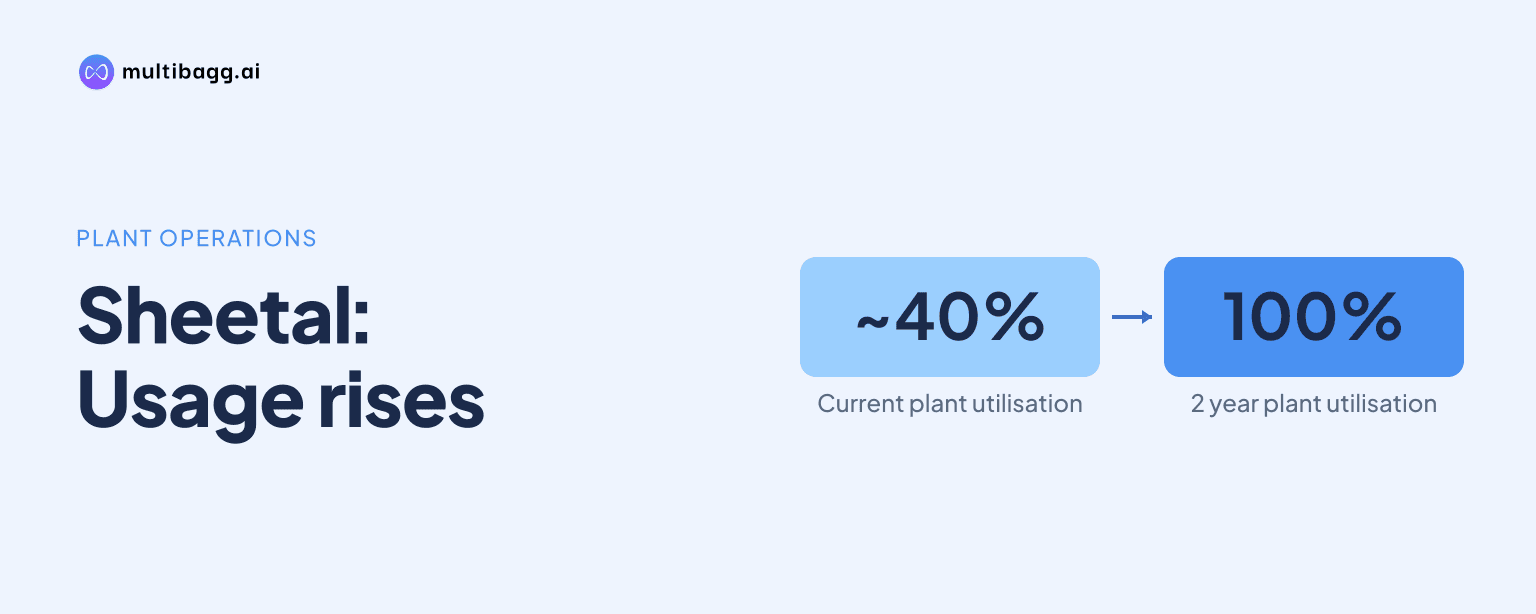
Sheetal Cool Products Limited said on November 18, 2026 that its recently inaugurated ready-to-eat and ready-to-cook plant was operating at about 40% capacity, had reached break-even with orders in hand, and is targeted to reach 100% utilisation within two years as it expands export distribution.
Know Sheetal Cool Products inside out
Results, valuation, peers and who's buying, in one view.
How quickly will Sheetal’s ready-to-eat plant reach full capacity?
Sheetal expects its ready-to-eat (RTE) and ready-to-cook (RTC) plant to reach 100% utilisation within two years, from about 40% currently. Management said the dedicated facility was inaugurated during the current financial year and has space for rapid expansion through additional machinery if production capacity needs to rise.
The RTE and RTC plant has already reached break-even because orders are in place, management said. The facility was established because export demand could no longer be fully met through the existing production site, rather than because Sheetal was entering the RTE and RTC category for the first time.
Management identified samosa as an RTE product receiving a good response in the markets where Sheetal supplies. It said milk and milk products, alongside RTE, are the two segments expected to drive key revenue growth, making export-led sales expansion central to the plant’s utilisation ramp-up.
What role will exports play in Sheetal’s plant ramp-up?
Exports are intended to be the principal outlet for Sheetal’s RTE and RTC products, and management said export business generates better margins than domestic business. Exports accounted for about 5% of sales last year, after Sheetal began exporting about five years ago, and management said this share has been growing year on year.
Sheetal described domestic and export demand as interconnected because overseas consumers are mainly Indians who have migrated abroad and already know Indian products. Management said a product’s domestic performance can support overseas demand, while a separate team and operating approach are being developed because export markets work differently from domestic distribution.
Sheetal expects its product mix to remain about 90% milk and milk-based categories, including ice cream, paneer, ghee, shrikhand and Indian sweets. The remaining 10% is expected to come from other categories, with RTE and RTC products expected to be the main contributor within that segment and primarily driven by exports.
Management did not disclose an export-sales target for the next financial year or a country-wise RTE revenue target. Its stated immediate priority is to make the products available in more countries and through more distributors, after the new plant moved beyond the order-backed break-even stage.
Got a follow-up? Ask IRIS
How will Sheetal sell more ready-to-eat products?
Sheetal plans to expand RTE and RTC sales by adding countries and distributors for products already being supplied from the new facility. The company said the category had previously been produced at its existing site, but export demand required additional dedicated capacity, indicating the plant is intended to serve an established product line.
For newer products in retail, Sheetal first focuses on shelf placement through cross-marketing, cross-promotions and trade schemes. One mechanism cited by management is offering an individual product free with the purchase of specified ice cream products, allowing retailers or consumers to sample an unfamiliar category.
Sheetal also cited in-store activity, hoardings, below-the-line marketing and social-media explainer videos as awareness tools. Management said this model helped it extend from ice cream into flavoured milk through its distributor network and is now being applied to other product categories.
Quick commerce remains at an early stage, with only a few stock-keeping units listed and discussions under way with additional partners for a wider assortment. Management said the channel could initially be loss-making, but it is being pursued alongside general trade, where Sheetal deploys freezers to support long-term product availability.
What could affect Sheetal’s capacity ramp-up and margins?
Sheetal’s RTE and RTC ramp-up depends on export distribution, while its broader margins are affected by costs of serving markets outside Gujarat. About 35% of revenue comes from states outside Gujarat and 65% from Gujarat, according to management.
Trade-partner margins are broadly similar across the country, but logistics, sales, marketing and manpower costs rise as products move farther from the production base, management said. Sheetal’s proposed response is to establish a child plant in a state once revenue there reaches a considerable level, though it did not disclose a state, revenue threshold or timetable.
Under that model, high-volume or high-value products would be supplied from the local child plant, while value-added premium products would continue to be supplied from the home state. Management said this arrangement is intended to help maintain margins while supporting expansion beyond Gujarat.
Milk procurement also remains relevant because Sheetal expects about 90% of its mix to remain in milk and milk-based products. Procurement reaches up to 1.5 lakh litres a day in summer and around 70,000 to 80,000 litres a day outside summer, while the company uses aggregators, bulk milk chilling points and testing before accepting milk.
Gross margin improved to 39.8% in Q2 FY27 from 35.1% in Q2 FY26. Management said FY26 had faced pressure as material-consumption cost rose 18.7% against revenue growth of 13.9%, and it is focusing on procurement, manufacturing productivity, product mix and pricing while noting that recovery depends on input costs and market conditions.
Conclusion
Sheetal’s stated operating objective is to lift its RTE and RTC plant from about 40% utilisation to full capacity within two years, with existing orders already supporting break-even. The plan keeps dairy as the approximately 90% core of product mix while positioning export-led RTE and RTC products as the main contributor within the remaining 10% of categories.
The next developments to watch are whether exports rise from their approximately 5% share of sales last year, whether Sheetal adds countries and distributors for samosa and other RTE products, and whether plant utilisation progresses toward 100%. Management has also targeted deployment of about 10,000 freezers across the country this year, with more than 50% already deployed, and said larger future manufacturing expansion would use a mix of debt and equity.