










Sheetal targets 10,000 freezers as rollout passes halfway
Key highlights
- Sheetal has completed more than 50% of its FY27 target to deploy about 10,000 freezers nationwide.
- States outside Gujarat contribute 35% of Sheetal revenue, while Gujarat contributes 65%.
- Sheetal Q2 FY27 revenue rose 16.8% year on year to Rs 65.30 crore and EBITDA margin reached 12.8%.
- Sheetal plans about Rs 10 crore of capital expenditure for additional machinery and new product formats before next summer.
powered by IRIS
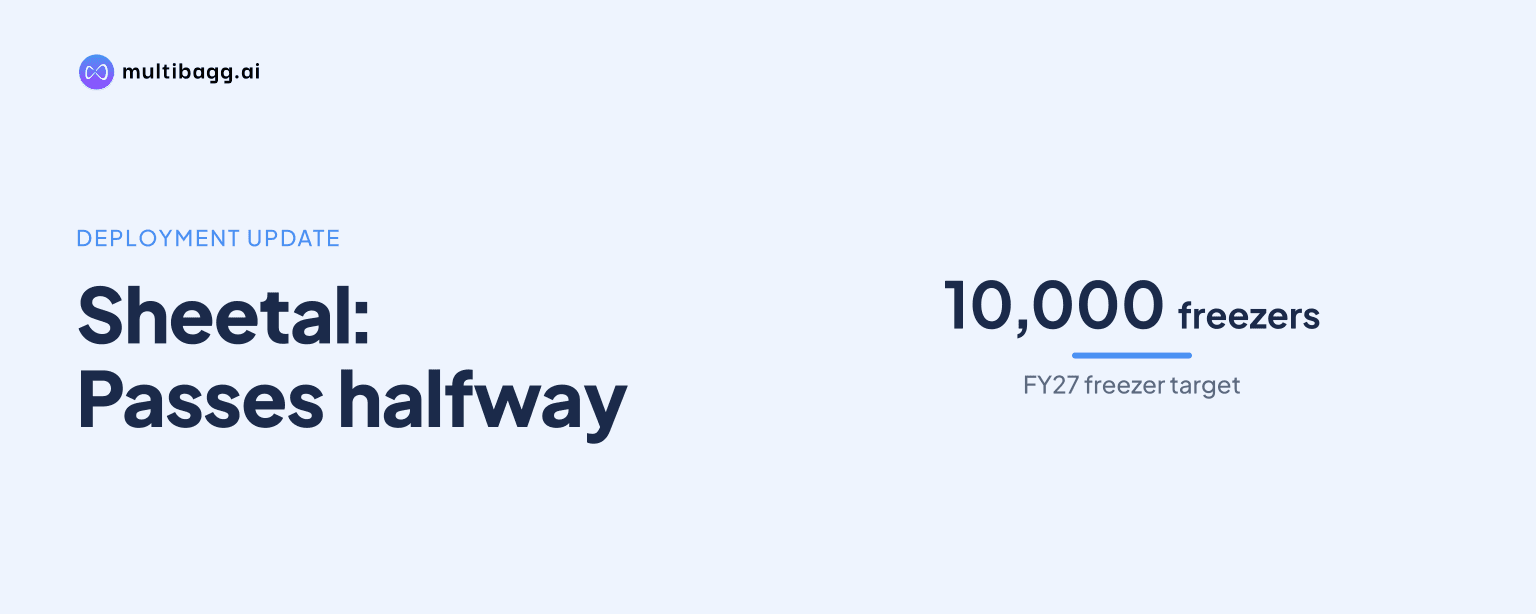
Sheetal Cool Products Limited has deployed more than half of its FY27 target of about 10,000 freezers nationwide, using freezer placement to expand its retail network beyond Gujarat, which contributed 65% of revenue as of the November 18, 2026 earnings call. Management described freezers as the key requirement for adding outlets and reviving growth.
Know Sheetal Cool Products inside out
Results, valuation, peers and who's buying, in one view.
Why is Sheetal deploying 10,000 freezers?
Sheetal is deploying about 10,000 freezers in FY27 because management said more freezers are needed to increase the number of retail outlets and generate more revenue. More than 50% of the annual deployment target had already been completed by November 18, 2026, although the company did not disclose the exact number of installed units.
The programme is focused primarily on general trade, or GT, rather than a direct company-operated retail model. Management said freezer deployment in GT provides a long-run channel for ice cream sales, while quick commerce remains at an early stage, with only a few stock-keeping units, or SKUs, listed.
Retail replenishment is faster than the turnover of Sheetal’s exclusive outlets. Management said retail stores can place repeat orders within a maximum of seven days, while the turnover of the full product assortment at an outlet can take up to 30 days. That difference reflects the broader assortment and service model at franchise outlets, which are supplied through distributors.
How much of Sheetal’s revenue comes from outside Gujarat?
Sheetal receives 35% of revenue from states outside Gujarat and 65% from Gujarat, making geographic expansion the central purpose of the freezer rollout. Management said it is pursuing two tracks in FY27: deepening distribution in existing markets and adding new locations.
The company’s operating structure starts with appointing a super stockist for a region, followed by distributors served through that hub. Management said trade margins paid to channel partners are broadly similar across India, but logistics costs rise as distance from the manufacturing base increases, alongside higher requirements for local sales, marketing and manpower support.
Sheetal said its franchise outlets are an addition to distributor economics rather than a separate distribution channel. An outlet typically purchases about Rs 35 lakh to Rs 40 lakh of products a year, according to management, and two exclusive outlets under a distributor can help that distributor cover operating costs before the wider distribution business contributes profit.
What has changed in Sheetal’s financial performance during FY27?
Sheetal reported Q2 FY27 revenue from operations of Rs 65.30 crore, up 16.8% from Rs 55.90 crore in Q2 FY26, while earnings before interest, tax, depreciation and amortisation, or EBITDA, rose to Rs 8.40 crore from Rs 6.30 crore. The company did not quantify how much of this increase came from freezer placements.
EBITDA margin increased by 1.5 percentage points to 12.8% in Q2 FY27, and profit after tax doubled to Rs 3.20 crore from Rs 1.60 crore. For H1 FY27, revenue rose 17.3% to Rs 198 crore from Rs 168.80 crore in H1 FY26, while EBITDA was Rs 22.40 crore with an 11.3% margin and profit after tax was Rs 10.20 crore.
Gross margin improved to 39.8% in Q2 FY27 from 35.1% in Q2 FY26. Management said procurement, manufacturing productivity, product mix and pricing actions remain the relevant levers, while the pace of margin recovery depends on input costs and market conditions.
The distribution expansion has a stated cost consequence. In FY26, cost of materials consumed rose 18.7%, exceeding revenue growth of 13.9%, and management cited input inflation, product mix and the cost of serving distant geographies as contributors to gross-margin pressure. Transport costs are higher when products are shipped farther from the production area.
Got a follow-up? Ask IRIS
How will Sheetal manage costs as it enters more states?
Sheetal plans to establish a local “child plant” once an individual state reaches a considerable revenue level, with no revenue threshold or timing disclosed. Under management’s proposed model, high-volume products would be supplied from the local state, while higher-value premium products would continue to be supplied from the main manufacturing base.
This sequencing means the company intends to build sales volume first and localise manufacturing later. Management said the initial logistics cost of entering distant states can pressure margins, but a plant opened after distribution reaches scale could begin with an established customer base and better local service capability.
For the next summer season, Sheetal is undertaking capital expenditure of about Rs 10 crore through internal capital management and debt. The spending covers additional production machinery, capacity for current products and equipment for newer formats, including products with three-dimensional shapes.
Premiumisation is also part of the product plan. Management said it is seeking to raise milk fat in selected products from 5% previously to 8% or 10%, aiming to improve mouthfeel. During Q2 FY27, Sheetal launched four products, including Jumbo Mango Dolly, Jumbo Chocobar, Red Velvet candy and Pista Kunafa candy.
What categories will use Sheetal’s enlarged distribution network?
Sheetal generates 90% of revenue from milk and milk-associated products, including ice cream, paneer, ghee, shrikhand and milk-based Indian sweets, while the remaining 10% comes from other categories. Management said the broad revenue mix is expected to remain similar under its FY30 revenue target of Rs 1,000 crore.
The company is using its ice cream distribution network to introduce complementary products through retailer schemes, cross-marketing and in-store activities. Management said this method helped Sheetal expand flavoured milk through its distributor base, and it is now applying the same approach to other categories that need shelf placement.
Ready-to-eat and ready-to-cook operations are another intended use of the expanded network, particularly for exports. The dedicated facility was operating at about 40% capacity and management expects it to reach 100% utilisation within two years; it said the facility was already break-even because orders were in place.
Management identified milk and milk products and ready-to-eat products as the two principal growth segments, with samosas receiving a good response in export markets. Exports represented about 5% of sales in the previous year, and management said export business provides higher margins than domestic sales, while describing its expansion as a gradual process.
Conclusion
Sheetal’s deployment of more than half of its 10,000-freezer FY27 target indicates that retail availability, especially in general trade, is management’s stated lever for increasing sales outside Gujarat. The strategy is being executed while 35% of revenue already comes from other states, and Q2 FY27 revenue grew 16.8% to Rs 65.30 crore as EBITDA margin rose to 12.8%.
The next measures to watch are completion of the remaining freezer placements in FY27, the share of revenue generated outside Gujarat and progress in reducing the logistics burden of distant markets. Management has not disclosed the state-level revenue needed for a child plant, while its ready-to-eat and ready-to-cook facility is planned to move from 40% to 100% utilisation over two years.