










SPCN Receivables Rise to Rs 43 Crore Amid Final Bill Delays
Key highlights
- SPCN’s trade receivables rose to Rs 43 crore at September 30, 2026, from Rs 38 crore in March 2026.
- SPCN said government running bills are generally settled in 40 to 45 days, with 10% withheld until final billing.
- SPCN said final-bill documentation and clearance can take 70 to 90 days, while major receivables are within 90 to 120 days.
- SPCN said operating cash flow remained negative in FY27, but was better than the prior year.
powered by IRIS
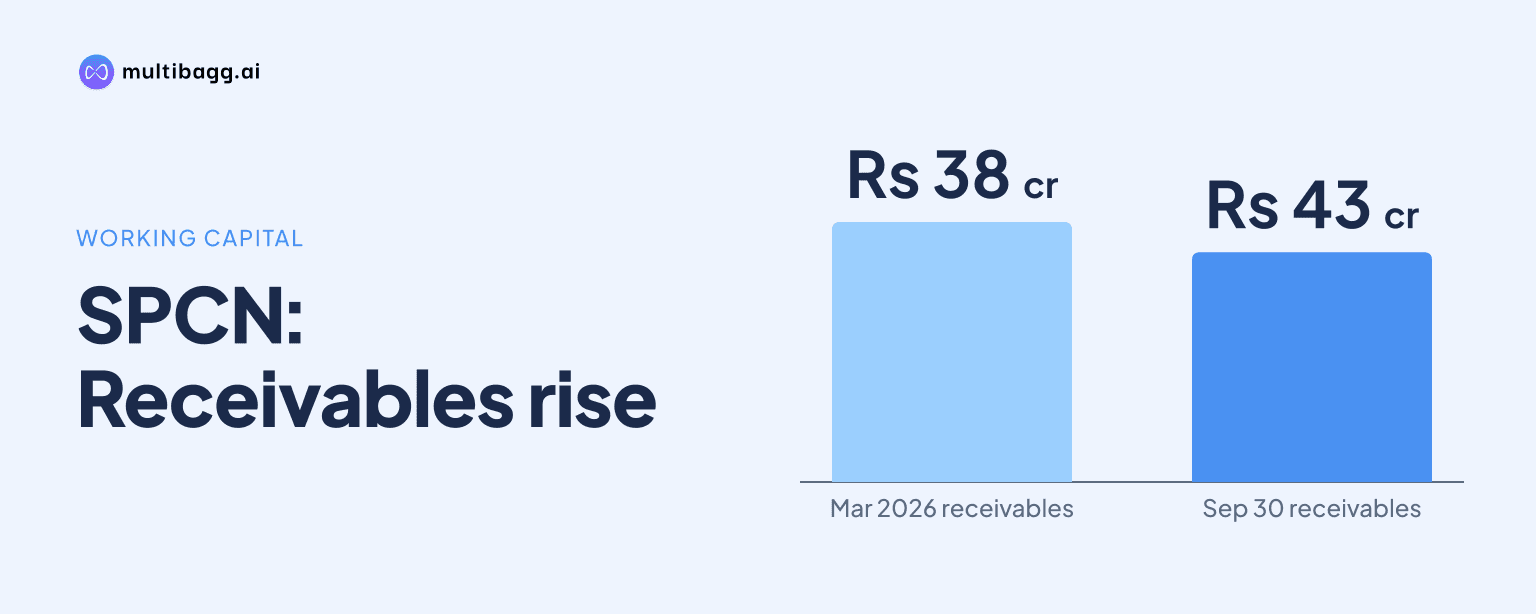
Srinibas Pradhan Construction Limited reported trade receivables of Rs 43 crore at September 30, 2026, up from Rs 38 crore in March 2026, as management said government-project final bills can take 70 to 90 days to clear after documentation. SPCN also said operating cash flow remained negative, though it had improved from the prior year.
Know Srinibas Pradhan Constructions inside out
Results, valuation, peers and who's buying, in one view.
Why did SPCN’s receivables rise to Rs 43 crore?
SPCN’s trade receivables increased by Rs 5 crore, or about 13.2%, between March 2026 and September 30, 2026. Management gave the two balance-sheet figures in response to an investor question, but did not provide revenue for the same six-month period or calculate days sales outstanding. It therefore did not quantify how much of the increase came from new execution, billing timing, retention money or overdue amounts.
SPCN said its major trade receivables were within 90 to 120 days, while acknowledging that some payments were late because construction bills can face processing delays. Management did not identify a particular government department, public-sector undertaking or client as the source of a concentrated outstanding balance. That leaves the Rs 43 crore figure as an aggregate, rather than a disclosed client-by-client credit exposure.
How long do SPCN’s government project bills take to clear?
SPCN said monthly running bills on a government project are generally settled in 40 to 45 days, but 10% is withheld from those bills until the final bill is submitted. Management illustrated the process with a Rs 5 crore project: the routine monthly bill is paid on the normal cycle, whereas the withheld portion and final settlement depend on completion documentation and clearance.
SPCN said final-bill documentation and clearance can take 70 to 90 days, which it described as the main point at which payment delays arise. This explanation is narrower than management’s separate 90-to-120-day description of major receivables: the former concerns final-bill processing, while the latter covers the age of major receivable balances. In both cases, retention means that part of the contractor’s earnings remains tied up after work has been billed.
What do higher receivables mean for SPCN’s cash flow?
SPCN said operating cash flow was negative in FY25 and FY26 and remained negative in FY27 at the time of the call, although management said the current position was better than the previous year. It did not provide the FY27 operating-cash-flow amount, a cash balance, borrowing data or a receivables ageing schedule. The call therefore confirms the direction of cash flow but not the scale of improvement management cited.
Working capital also includes inventory, which an investor said was about Rs 16 crore at March FY26. Management said the largest component was work in progress, or WIP, rather than material held for resale. It expected most of that stock to convert into sales within two to three months, while materials on hand would be replenished as they were consumed. That expected conversion is a management timeline, not a reported cash collection outcome.
Got a follow-up? Ask IRIS
Can project execution improve SPCN’s cash conversion?
SPCN’s near-term cash conversion depends on both execution and final certification because the company is focused primarily on government construction contracts. Management said an unexpected rise in input prices had reduced sales, and it expected a recovery in the second half of FY27 if rates declined as indicated by market reports. It also said the Ustali River Bridge had faced department-side drawing and road-alignment issues, with completion now expected within the financial year.
SPCN has a stated H2 FY27 target of Rs 15 crore of execution on the Bandhabahal-Barihapur Project Company project. Management also said it expected positive data in the second half from NTPC Darlipali work, without supplying an amount. These plans could add billed work, but the effect on cash generation will also depend on the 40-to-45-day running-bill cycle, the 10% retention mechanism and final-bill clearance.
Will SPCN’s mix and funding plans alter working-capital needs?
SPCN’s current plans do not remove the government-billing pattern, and management disclosed no set funding plan for larger projects. Management said the EBITDA margin increase to 22.81% from 16.76% was temporary because it took transportation work while core construction activity was slow. Transportation generated EBITDA margins of roughly 31% to 33%, according to management, which expects the consolidated margin to settle near 18% as construction sales rise.
SPCN said its initial public offering proceeds had been 100% utilised and that there was no current plan for a future equity issue, while adding that it would review funding if it secured a large project and required repayment funds. Its special-class registration permits participation in a single project worth up to Rs 50 crore, compared with a Rs 20 crore limit under its Class A licence. Larger awards could expand execution capacity, but management did not disclose a financing plan or working-capital limit for them.
Conclusion
SPCN’s receivables rose from Rs 38 crore in March 2026 to Rs 43 crore at September 30, 2026, while management described a payment structure in which monthly bills are typically cleared in 40 to 45 days but 10% retention and final documentation delay the release of part of project value. With negative operating cash flow still reported in FY27, collections and the conversion of WIP remain central to the company’s cash position.
The next disclosed milestones are management’s H2 FY27 Rs 15 crore execution target for the Bandhabahal-Barihapur Project Company project, its expectation of positive second-half data from NTPC Darlipali work, and planned completion of the Ustali River Bridge within the financial year. The expected two-to-three-month inventory conversion will also show whether WIP turns into sales and eventual collections.