










SPEL Semiconductor Limited auditor flags going-concern doubt
Key highlights
- SPEL’s factory suspension, approved on January 14, 2026, remained in force at September 30, 2026.
- SPEL reported September-quarter revenue from operations of Rs 19.89 lakh, versus Rs 1.52 crore a year earlier.
- SPEL recorded a loss before tax of Rs 80.05 lakh for the quarter ended September 30, 2026.
- SPEL disclosed a Rs 2 crore advance against the proposed sale of surplus factory land.
powered by IRIS
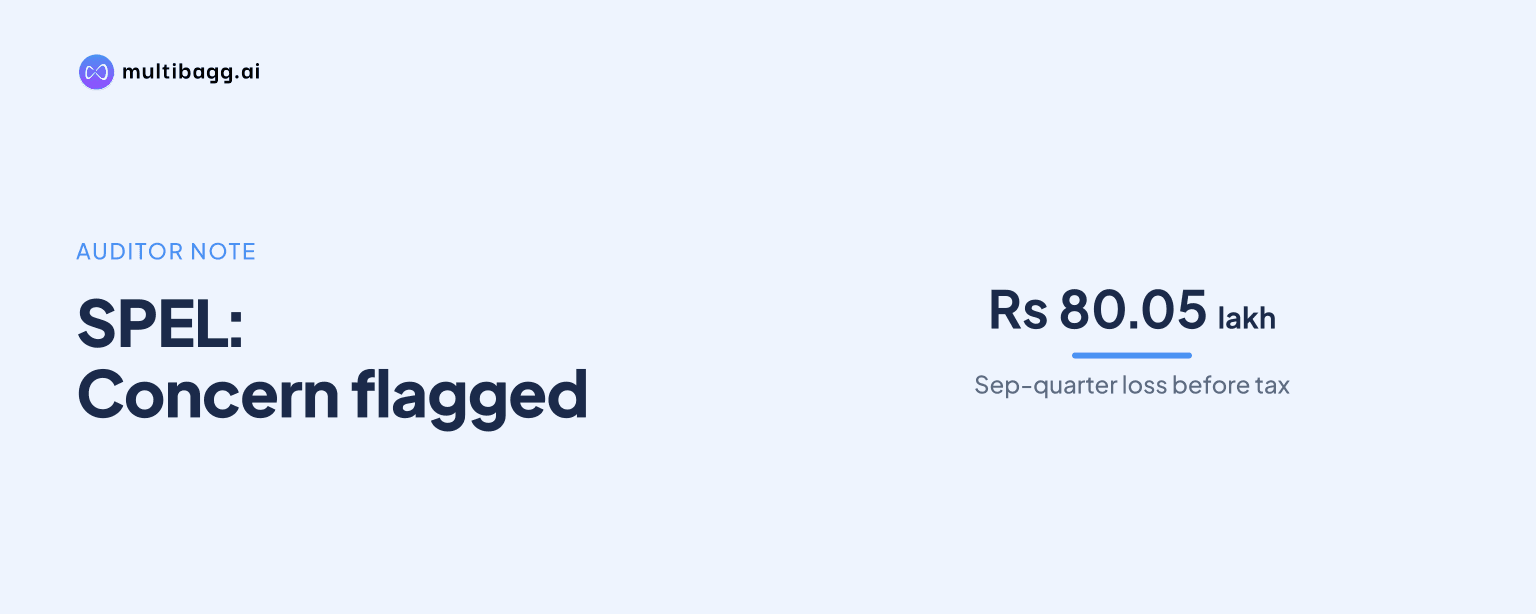
SPEL Semiconductor Limited received a qualified limited-review conclusion for the quarter ended September 30, 2026, after its auditor cited suspended factory operations, non-functional critical machinery, major employee resignations, losses and negative cash flows. SPEL reported revenue from operations of Rs 19.89 lakh, down from Rs 1.52 crore a year earlier.
Know Spel Semiconductor inside out
Results, valuation, peers and who's buying, in one view.
What did SPEL’s auditor conclude on going concern?
SPEL’s auditor issued a qualified conclusion on the unaudited standalone results for the quarter ended September 30, 2026, stating that material uncertainties may cast significant doubt on the company’s ability to continue as a going concern. The report cited losses and negative cash flows during the September 2026 period and earlier years, while the financial statements continued to be prepared on a going-concern basis pending resolution of the uncertainties.
Venkatesh & Co performed a limited review under Standard on Review Engagements 2410, which is narrower in scope than a statutory audit. Except for the possible effects of matters set out in the qualification, the auditor said nothing had come to its attention indicating that the September 2026 results failed to meet applicable accounting principles or Regulation 33 disclosure requirements. The filing dated November 13, 2026 also said the year ended March 31, 2026 had received a modified audit opinion.
Why are SPEL’s factory operations still suspended?
SPEL’s factory operations remained suspended at September 30, 2026, following Board approval for the suspension on January 14, 2026. The auditor said major plant and machinery had broken down and critical machinery was non-functional, creating operational uncertainty alongside the absence of production activity during the quarter.
The auditor also reported that major employees had resigned, causing a significant reduction in employee strength that persisted at the September 30 reporting date. Employee-benefit expense was Rs 31.64 lakh in the September 2026 quarter, against Rs 70.18 lakh in the quarter ended September 30, 2025. The auditor identified the reduced workforce and unavailable machinery as conditions that may affect SPEL’s ability to continue as a going concern.
What do SPEL’s September-quarter results show?
SPEL recorded a loss before tax of Rs 80.05 lakh in the quarter ended September 30, 2026, compared with a loss of Rs 1.34 crore in the preceding June 2026 quarter and Rs 12.47 crore a year earlier. The September 2025 loss included exceptional items of Rs 11.35 crore, while no exceptional item was reported in the latest quarter. Before exceptional items, the loss narrowed from Rs 1.12 crore a year earlier to Rs 80.05 lakh.
Revenue from operations was Rs 19.89 lakh in the September 2026 quarter, up from Rs 7.99 lakh in June 2026 but down from Rs 1.52 crore in September 2025. SPEL said the latest quarter’s revenue primarily comprised residual export and other sales because its factory was suspended. Other income of Rs 88.32 lakh took total income to Rs 1.08 crore, against total expenses of Rs 1.88 crore.
For the half year ended September 30, 2026, revenue from operations was Rs 27.88 lakh, versus Rs 3.46 crore in the corresponding half year of 2025. The half-year loss before tax was Rs 2.14 crore, compared with Rs 18.05 crore a year earlier, when exceptional items were Rs 14.51 crore. SPEL said results during the suspension were not comparable with normal operating periods because ordinary production was not taking place.
Got a follow-up? Ask IRIS
Which SPEL balances require confirmation and reconciliation?
SPEL had trade receivables of Rs 14.83 lakh and trade payables of Rs 3.61 crore at September 30, 2026 that were subject to confirmation and reconciliation, according to the auditor. The receivables balance was net of customer advances of Rs 15.19 lakh and debtors of Rs 30.02 lakh. Without independent balance confirmations and reconciliation, the auditor could not determine whether adjustments, including consequential effects on the September-quarter statement, were required.
Total equity was Rs 90.32 lakh at September 30, 2026, down from Rs 3.04 crore at March 31, 2026. Other equity was a negative Rs 45.21 crore, compared with a negative Rs 43.07 crore at the March 2026 year-end. Total current liabilities were Rs 76.14 crore, including Rs 3.27 crore due to creditors other than micro and small enterprises, while non-current borrowings stood at Rs 10.50 crore.
How does SPEL plan to restart production?
SPEL said it was pursuing a factory restart through capital infusion, including the sale of surplus land at its factory premises, mobilisation of funds from financial institutions and investors, and restoration of plant and machinery. The company disclosed an advance of Rs 2 crore against the proposed surplus-land sale. It did not disclose a date for completion of the sale, funding arrangements, machinery restoration or resumption of production.
Assets held for sale were Rs 37.80 crore at September 30, 2026, compared with Rs 35.92 crore at March 31, 2026. From the September 2026 quarter, SPEL identified two business segments: manufacture and sale of integrated circuits, and leasing of surplus land with lease-rental income. Lease-rental income remains included in other income, which was Rs 1.29 crore for the half year ended September 30, 2026.
Conclusion
SPEL’s qualified review combines financial and operating uncertainties: a Rs 2.14 crore half-year loss before tax, negative cash flows, suspended factory operations, machinery breakdowns and a reduced workforce. Although the September-quarter loss was below the reported loss a year earlier, revenue from operations fell to Rs 19.89 lakh and mainly reflected residual sales rather than normal production.
The next disclosed developments are the proposed surplus-land sale, which has a Rs 2 crore advance, efforts to raise funds from financial institutions and investors, and work to restore plant and machinery. SPEL’s future disclosures will also show whether operations restart and whether the Rs 14.83 lakh receivable and Rs 3.61 crore payable balances are confirmed and reconciled.