










SPEL seeks land sale funding to restart suspended factory
Key highlights
- SPEL’s factory operations remained suspended from January 14, 2026 through September 30, 2026.
- SPEL reported a Rs 2.14 crore loss before exceptional items for H1 ended September 30, 2026.
- SPEL disclosed a Rs 2 crore advance against the proposed sale of surplus factory land.
- SPEL used Rs 53.08 lakh in operating activities during H1 ended September 30, 2026.
powered by IRIS
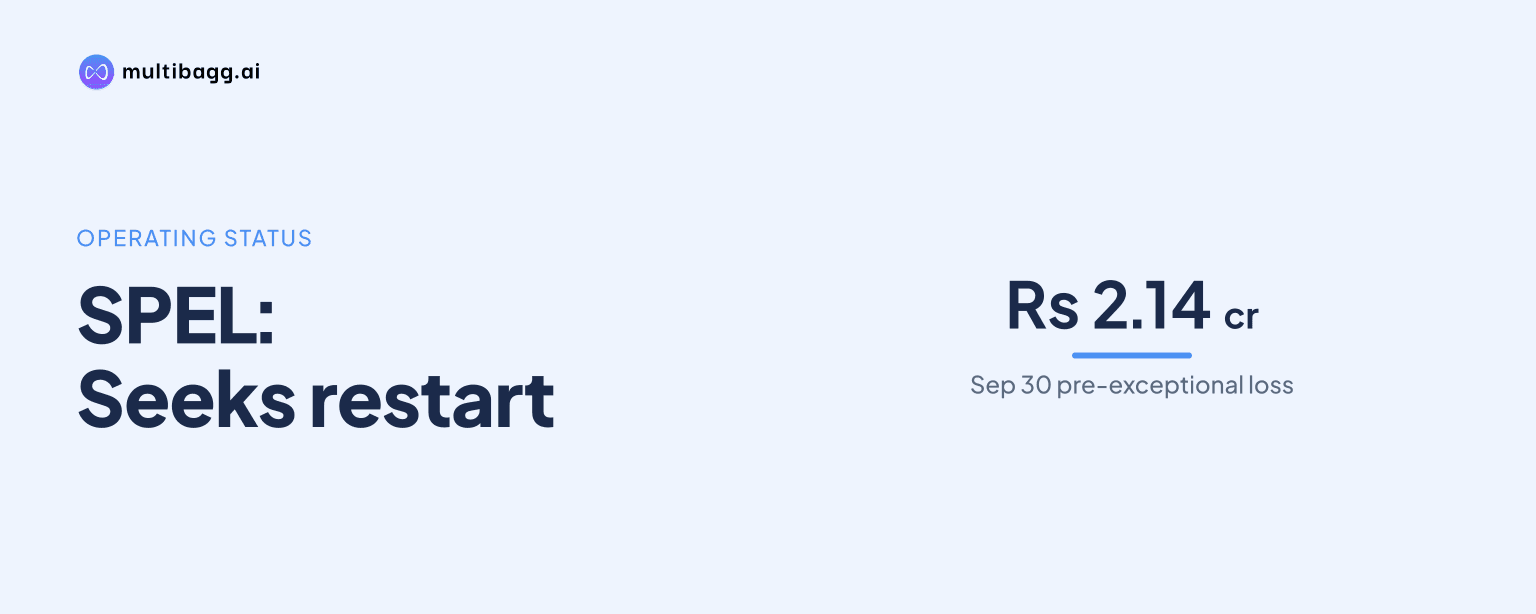
SPEL Semiconductor Limited is pursuing a surplus-land sale, funding from financial institutions and investors to restart factory operations suspended since January 14, 2026, after reporting a Rs 2.14 crore loss before exceptional items for the half year ended September 30, 2026. The company disclosed a Rs 2 crore advance against the proposed land sale.
Know Spel Semiconductor inside out
Results, valuation, peers and who's buying, in one view.
How does SPEL plan to restart its suspended factory?
SPEL said it is actively pursuing the restart through capital infusion from the sale of surplus land at its factory premises, funds mobilised through financial institutions and investors, and other measures. Factory operations remained suspended at September 30, 2026, following the Board of Directors’ approval on January 14, 2026.
SPEL disclosed that it had received a Rs 2 crore advance against the sale of surplus land. Its cash-flow statement for H1 ended September 30, 2026 separately records Rs 1 crore of advance received against the sale of capital assets, identified as land. The filing does not provide a sale value, buyer identity, completion date, funding requirement or terms for any institutional or investor financing.
The production suspension also changed SPEL’s segment presentation from the September 2026 quarter. The company identified two business segments: manufacture and sale of integrated circuits, and leasing of surplus land and generation of lease-rental income. Lease rental income continues to be reported within other income in the statement of profit and loss.
What revenue did SPEL report during the factory suspension?
SPEL reported Rs 27.88 lakh of revenue from operations in H1 ended September 30, 2026, down from Rs 346.30 lakh in H1 ended September 30, 2025. The company said the latest half-year and quarterly revenue primarily represented residual export and other sales, and stated that the results were not comparable with normal operating periods.
Revenue from operations in the quarter ended September 30, 2026 was Rs 19.89 lakh, compared with Rs 7.99 lakh in the June 2026 quarter and Rs 152.91 lakh in the September 2025 quarter. Total income for the latest quarter was Rs 108.19 lakh, consisting of Rs 19.89 lakh revenue from operations and Rs 88.32 lakh other income.
Other income rose to Rs 128.60 lakh in H1 ended September 30, 2026 from Rs 90.01 lakh a year earlier, while total income fell to Rs 156.47 lakh from Rs 436.31 lakh. The cash-flow reconciliation identifies Rs 80.57 lakh of rental income and Rs 44.21 lakh of interest income in the latest half year, compared with Rs 73.96 lakh and Rs 13.76 lakh respectively in the prior-year period.
How did SPEL’s losses and expenses change in H1?
SPEL’s loss before exceptional items narrowed to Rs 214.11 lakh in H1 ended September 30, 2026 from Rs 354.05 lakh in H1 ended September 30, 2025. There were no exceptional items in the latest half year, whereas the prior-year half included Rs 1,451.25 lakh of exceptional items, resulting in a reported loss for that period of Rs 1,805.30 lakh.
Total expenses fell to Rs 370.59 lakh from Rs 790.36 lakh. Employee-benefit expense declined to Rs 60.87 lakh from Rs 143.44 lakh, finance costs fell to Rs 120.65 lakh from Rs 267.30 lakh, and power and fuel expense declined to Rs 27.14 lakh from Rs 119.21 lakh. Depreciation and amortisation expense was broadly unchanged at Rs 56.64 lakh, against Rs 57.88 lakh a year earlier.
For the September 2026 quarter, SPEL reported a loss before exceptional items of Rs 80.05 lakh, compared with Rs 134.06 lakh in the preceding June 2026 quarter. Total expenses increased slightly quarter on quarter to Rs 188.25 lakh from Rs 182.34 lakh, while total income rose to Rs 108.19 lakh from Rs 48.28 lakh.
Got a follow-up? Ask IRIS
What does SPEL’s cash flow show about its funding position?
SPEL used Rs 53.08 lakh in operating activities during H1 ended September 30, 2026, compared with net operating cash generation of Rs 600.57 lakh in the prior-year half. Before working-capital changes, the latest operating loss was Rs 161.60 lakh, compared with Rs 2,398.29 lakh in H1 ended September 30, 2025.
Investing activities generated Rs 172.23 lakh in the latest half year, compared with Rs 87.72 lakh a year earlier. The latest investing cash flow included Rs 76.03 lakh of rental income received and Rs 100 lakh of land-sale advance, partly offset by Rs 3.79 lakh spent on property, plant and equipment and capital work-in-progress.
Financing activities used Rs 119.22 lakh in H1 ended September 30, 2026, against an outflow of Rs 688.24 lakh in the previous-year period. The latest outflow comprised net borrowing repayment of Rs 45.20 lakh and finance costs paid of Rs 74.02 lakh. Cash and cash equivalents were Rs 7,000 at September 30, 2026, down from Rs 14,000 at the start of the half year.
What balance-sheet and audit issues does SPEL face?
SPEL’s total equity was Rs 90.32 lakh at September 30, 2026, down from Rs 304.43 lakh at March 31, 2026. Equity share capital was unchanged at Rs 4,611.74 lakh, while other equity widened to a deficit of Rs 4,521.42 lakh from a deficit of Rs 4,307.31 lakh, following the Rs 214.11 lakh half-year loss.
Assets held for sale increased to Rs 3,780 lakh at September 30, 2026 from Rs 3,591.81 lakh at March 31, 2026. Property, plant and equipment decreased to Rs 2,295.57 lakh from Rs 2,532.86 lakh. Total assets were Rs 11,429.55 lakh, marginally below Rs 11,526.46 lakh six months earlier.
The independent auditor issued a qualified conclusion on the September 2026 standalone results. The report cited losses, negative cash flows, resignation of major employees, significant reduction in employee strength, suspended production and non-functional critical machinery as conditions creating material uncertainty over SPEL’s ability to continue as a going concern. It also said trade receivables of Rs 14.83 lakh and trade payables of Rs 361.09 lakh were subject to confirmation and reconciliation.
Conclusion
SPEL’s disclosed restart strategy rests on converting surplus factory land into capital and securing funding from financial institutions and investors while manufacturing remains suspended. Revenue from operations fell to Rs 27.88 lakh in H1 ended September 30, 2026, and the company used Rs 53.08 lakh in operating activities despite a narrower loss before exceptional items.
The next disclosed milestones are the proposed surplus-land sale and the mobilisation of external funds for the restart. SPEL has not set out a date for completing the land transaction, raising the planned capital, repairing critical machinery or resuming factory production.