










SpiceJet Faces Questions After ₹5,500 Crore Fundraising
Key highlights
- SpiceJet has raised more than ₹5,500 crore in recent years, according to the material.
- SpiceJet has shareholder approval to raise up to ₹3,000 crore through further fundraising.
- The airline reported unpaid TDS and employee provident-fund dues of ₹350 crore.
- The Centre said SpiceJet received ₹150 crore under the ECLGS in September.
powered by IRIS
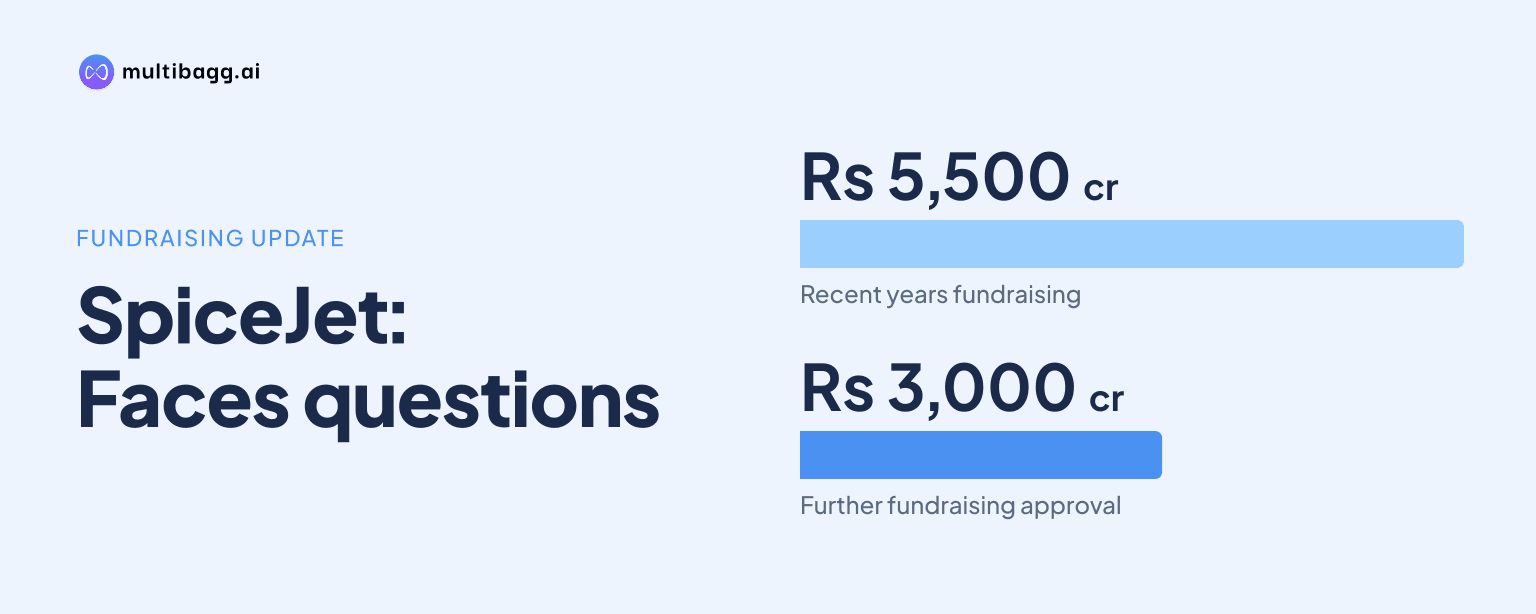
SpiceJet faces questions over more than ₹5,500 crore raised in recent years as the airline continues to report financial and operational pressure, including reported unpaid tax and employee provident-fund dues of ₹350 crore. The carrier is pursuing additional capital, with shareholder approval for fundraising of up to ₹3,000 crore.
Know SpiceJet inside out
Results, valuation, peers and who's buying, in one view.
Why is SpiceJet facing scrutiny over its fundraising?
SpiceJet is facing scrutiny because repeated fundraising efforts have not ended concerns around its liabilities, operating capacity and payments to creditors. The material provided says the airline has raised more than ₹5,500 crore in recent years, while its financial crisis has continued and questions have been raised about the use of funds, management accountability and regulatory oversight.
The issue is significant for an airline because daily operations require regular payments for aircraft leases, maintenance, fuel, airport services, staff and statutory obligations. When cash availability is constrained, aircraft availability and route operations can come under pressure. The material describes SpiceJet as facing mounting losses, unpaid dues and an operational decline, although it does not provide a detailed, audited break-up of the earlier ₹5,500 crore fundraising or its deployment.
The reported disclosure of ₹350 crore in unpaid tax deducted at source and employee provident-fund dues has added to the focus on the airline's financial position. The airline is attempting to raise new money to stabilise operations and address outstanding liabilities, including statutory dues and creditor payments.
What fundraising plans has SpiceJet announced?
SpiceJet has received shareholder approval to raise up to ₹3,000 crore and has also considered other debt and equity routes. Under the stated fundraising plan, the airline may issue up to about 32 crore equity shares and 13 crore convertible warrants at an issue price of ₹50 per security.
The company has said its qualified institutional placement received strong investor interest, including participation by Madhu Kela's family office. The material states that the fundraising response exceeded the airline's target, though it does not give a final amount raised through that exercise.
Separately, SpiceJet's board was scheduled to consider fundraising through equity shares, preference shares, debt securities or other permissible instruments. The stock-exchange filing cited in the material did not specify the intended amount, use of proceeds, prospective investors, pricing or timing. Any transaction would remain subject to shareholder and regulatory approvals where required.
How do the ECLGS funds and creditor discussions fit in?
SpiceJet received ₹150 crore under the Emergency Credit Line Guarantee Scheme, according to a statement by the Centre in September. The same statement said that the regulator was monitoring the airline's operations and financial position. The ECLGS support is relevant because it indicates access to a government-backed credit facility during a period of continuing financial stress.
The airline has also pursued restructuring with aircraft lessors. One announced plan involved converting Carlyle Aviation Management debt of $137.68 million into equity, adjusted to $97.51 million upon settlement. The board also approved a preferential issue of equity shares worth $29.5 million to Carlyle Aviation Partners as part of the proposed restructuring arrangement.
These initiatives show that SpiceJet's capital strategy extends beyond a conventional equity raise. Debt settlements, equity conversion and fresh capital can reduce immediate payment pressure, but the material does not establish whether the transactions have fully resolved the airline's liabilities. It also notes a proposed investment term sheet of ₹5,000 crore, while making clear that its completion was uncertain.
Got a follow-up? Ask IRIS
What has been the operational impact on SpiceJet?
SpiceJet's financial pressure has coincided with reduced operating capacity, and the government has pushed the airline to increase its operations. The airline has outlined an expansion plan from about 25 to 28 aircraft to more than 100 aircraft within two years, based on the statement included in the material.
That target is large relative to the current operating fleet level cited by the airline. Achieving it would require adequate funding and the ability to manage aircraft acquisition or leasing, maintenance, staffing and other operating obligations. The available information does not confirm a timetable for adding aircraft or identify the specific funding allocation for the proposed expansion.
For passengers, capacity constraints can affect route availability and flight schedules. For vendors, lessors and employees, the reported dues and restructuring discussions are important because they concern payment obligations. For shareholders, the use of equity and warrants may raise fresh capital, but it can also increase the number of outstanding securities depending on the final structure and conversion of warrants.
Why does the situation matter to investors and the aviation industry?
SpiceJet's position matters because aviation is a capital-intensive business with narrow room for disruption in cash flows. The airline's efforts to raise capital, settle lessor obligations and restore fleet strength will therefore be closely linked to its ability to sustain operations. The material reports a 5.5% rise in SpiceJet shares after the Carlyle debt-to-equity announcement and a 6% rise after board approval for a ₹2,500 crore qualified institutional placement, indicating that investors responded to specific financing announcements.
However, share-price reactions do not by themselves establish that a turnaround has been completed. Investors would need clarity on the amount actually raised, terms of any debt restructuring, settlement of statutory and vendor dues, and the number of aircraft returned to service. The source material does not provide a complete use-of-proceeds disclosure for the more than ₹5,500 crore raised earlier, so conclusions on fund deployment cannot be drawn from the available details.
The case also highlights the importance of financial disclosure and regulatory monitoring in aviation. The Centre's statement that the regulator was keeping watch on operations and finances places the carrier's funding actions within a wider safety and operational oversight context.
Conclusion
SpiceJet has pursued several funding and restructuring measures, including more than ₹5,500 crore raised in recent years, a shareholder-approved plan for up to ₹3,000 crore, ECLGS support of ₹150 crore and lessor settlement discussions. Yet the reported ₹350 crore of unpaid TDS and PF dues, continuing creditor obligations and lower operating capacity explain why the airline's finances remain under close attention.
The next material developments are the completion and terms of any new equity or debt issuance, the status of the proposed investment and lessor arrangements, and progress toward the airline's stated plan to expand from about 25 to 28 aircraft to more than 100 aircraft in two years. Disclosures on fund utilisation and settlement of outstanding liabilities will be central to assessing the plan.