










Sreeleathers forecasts ₹67-70 crore December-quarter revenue
Key highlights
- Sreeleathers forecasts Q3 FY27 revenue of ₹67 crore to ₹70 crore, versus ₹60.90 crore in Q3 FY26.
- Company-owned and company-operated store revenue grew 24.5% year on year in Q2 FY27, against 11.3% company-wide revenue growth.
- Festival-fortnight footfall at company-owned and company-operated stores increased 20.3% from the prior-year quarter.
- H1 FY27 profit after tax rose 46.1% to ₹16.86 crore on revenue of ₹142.79 crore.
powered by IRIS
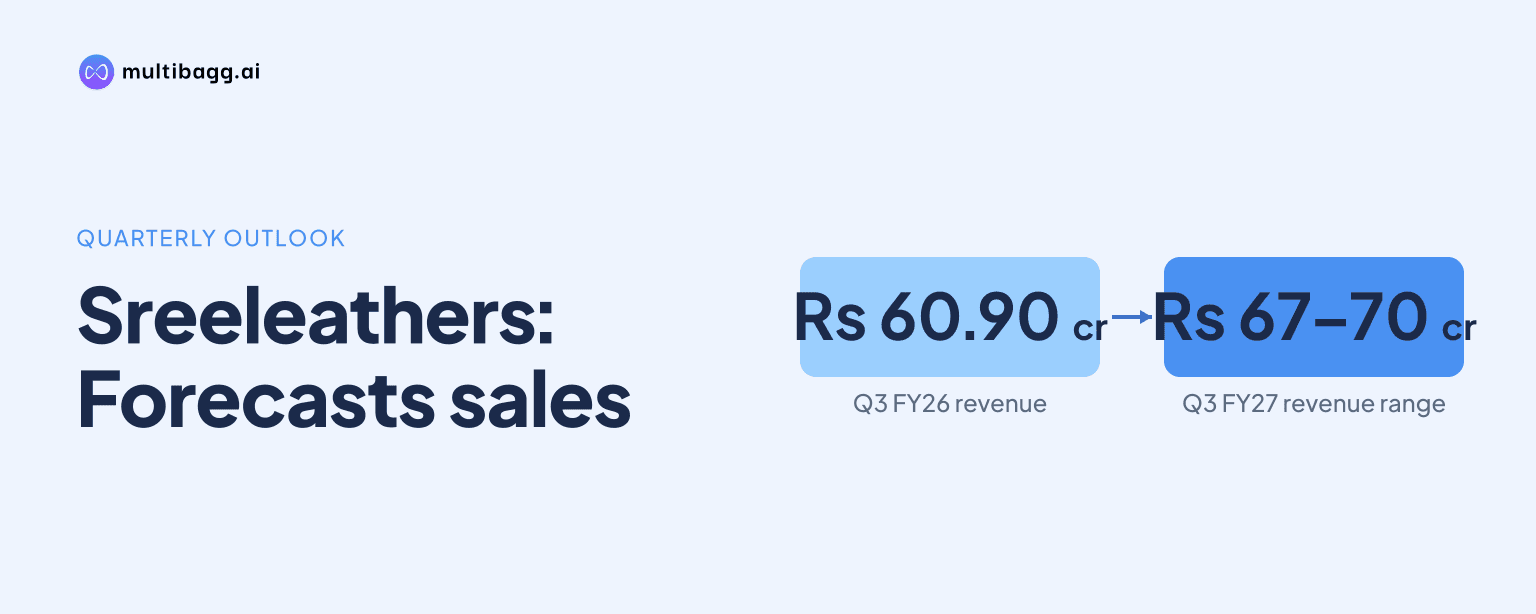
Sreeleathers Limited expects Q3 FY27 revenue from operations of ₹67 crore to ₹70 crore, up 10% to 15% from ₹60.90 crore a year earlier, after company-owned and company-operated store revenue rose 24.5% in Q2 FY27. Management expects revenue below the ₹83.16 crore September-quarter level because pre-Puja shopping was booked earlier.
Know Sreeleathers inside out
Results, valuation, peers and who's buying, in one view.
What is Sreeleathers forecasting for the December quarter?
Sreeleathers forecasts Q3 FY27 revenue from operations of about ₹67 crore to ₹70 crore, compared with ₹60.90 crore in Q3 FY26. Management describes the outlook as 10% to 15% year-on-year growth, with its comparison table indicating approximately 12.5% growth. This is a management estimate rather than reported performance.
The forecast is below Q2 FY27 revenue of ₹83.16 crore, which management describes as the pre-Puja peak. September-quarter revenue was 11.3% above ₹74.71 crore in Q2 FY26 and 39.5% above ₹59.63 crore in Q1 FY27. The comparison shows that a larger share of festive purchases was recorded before Durga Puja in FY27.
Why does Sreeleathers expect revenue below the September quarter?
Sreeleathers expects Q3 FY27 revenue to be lower than Q2 FY27 because much Durga Puja shopping occurred in the weeks before the festival and was booked in the September quarter. Durga Puja fell in the December quarter in FY27 but in the September quarter in the prior year, while management says the main customer buying period arrived before the festival.
Some Q2 FY27 wholesale sales will also be invoiced in Q3 FY27 after warehouse dispatch capacity fell behind late-quarter orders. Sreeleathers said certain categories ran short, supply was restored within days, and affected orders were dispatched in the December quarter. Management is working with trade partners to spread ordering more evenly and is considering warehousing expansion, without disclosing a capacity target, cost or date.
Diwali and Christmas also fall in Q3 FY27, and management says both events trade well. Sreeleathers entered the quarter with 34 authorised stores across eight states and inventory of ₹11.51 crore, compared with ₹8.05 crore at 31 March 2026. The company said the higher inventory was stocked for the festival season.
How did Sreeleathers company-operated stores perform?
Sreeleathers’ company-owned and company-operated stores grew revenue 24.5% year on year in Q2 FY27, ahead of the company-wide revenue increase of 11.3%. The 13.2-percentage-point gap is management’s key channel-level evidence for its festive-trading confidence. Management also said footfall at these stores exceeded the prior year despite the different Durga Puja timing.
Festival-fortnight footfall at company-owned and company-operated stores rose 20.3% from the same quarter a year earlier. Sreeleathers identifies the channel and footfall measures as management analysis, not separately reported segments, and says they are single-period comparisons rather than annualised figures. The presentation does not disclose visitor counts, channel revenue amounts or store-level sales.
Franchised-store sales are booked roughly 10 days ahead of the retail counter, according to management. That timing means franchise-related festival sales can enter reported revenue earlier than company-operated-store sales. It helps explain how Q2 FY27 revenue reached ₹83.16 crore while some post-festival and delayed wholesale sales are expected in Q3 FY27.
Got a follow-up? Ask IRIS
What do Sreeleathers’ half-year results show?
Sreeleathers reported H1 FY27 revenue of ₹142.79 crore, up 14.4% from ₹124.81 crore in H1 FY26, while profit after tax increased 46.1% to ₹16.86 crore from ₹11.54 crore. Earnings per share rose to ₹7.28 from ₹4.98. The half-year result includes the September-quarter pre-Puja buying period.
Q2 FY27 profit after tax rose 14.8% to ₹9.88 crore on revenue of ₹83.16 crore. Operating EBITDA, defined by Sreeleathers as profit before tax plus finance costs and depreciation less other income, increased 13.6% to ₹13.27 crore. Its operating EBITDA margin rose 33 basis points to 16.0%, while gross margin declined 138 basis points to 22.1% from 23.5%.
Dealer incentive expense fell to ₹1.13 crore from ₹1.68 crore, other expenses declined to ₹1.80 crore from ₹1.90 crore, and employee costs decreased to ₹2.21 crore from ₹2.31 crore. These movements occurred alongside the higher operating EBITDA margin. Sreeleathers also reported no borrowings as of 30 September 2026.
What could make Sreeleathers miss its December-quarter estimate?
Sreeleathers says its ₹67 crore to ₹70 crore estimate uses rolling growth rates, company-operated-store footfall compared with the prior year, and a mapping of FY27 festival dates against FY26. Management says actual results could differ materially because the outlook depends on consumer demand, festival timing, wholesale ordering, supply, warehouse capacity and general economic conditions.
Warehouse execution remains an identified uncertainty after late Q2 FY27 orders exceeded dispatch capacity and temporarily left some categories short. The company expects delayed orders to support Q3 FY27 invoicing, but it provides no measure of their value. Management says it will update the outlook only through its ordinary disclosures.
Conclusion
Sreeleathers expects year-on-year December-quarter revenue growth, with a ₹67 crore to ₹70 crore Q3 FY27 range against ₹60.90 crore in Q3 FY26, while anticipating a decline from the ₹83.16 crore pre-Puja Q2 FY27 peak. The 24.5% revenue growth at company-owned and company-operated stores, compared with 11.3% company-wide growth, is the principal demand indicator management cites.
The next result will show whether delayed wholesale dispatches, Diwali and Christmas trading, and the 34-store authorised network deliver the forecast range. Management’s consideration of warehousing expansion also warrants attention because Q2 FY27 order bunching exposed a dispatch-capacity constraint, yet no implementation schedule or capacity target has been disclosed.