










Sreeleathers Q2 profit rises 14.8% as sales shift to December
Key highlights
- Sreeleathers reported Q2 FY27 revenue of Rs 83.16 crore, up 11.3% year on year and 39.5% from Q1 FY27.
- Q2 FY27 profit after tax rose 14.8% to Rs 9.88 crore, while earnings per share reached Rs 4.27.
- Operating EBITDA margin increased 33 basis points to 16.0%, although gross margin declined 138 basis points to 22.1%.
- Company-owned and company-operated store revenue grew 24.5% year on year in Q2 FY27.
powered by IRIS
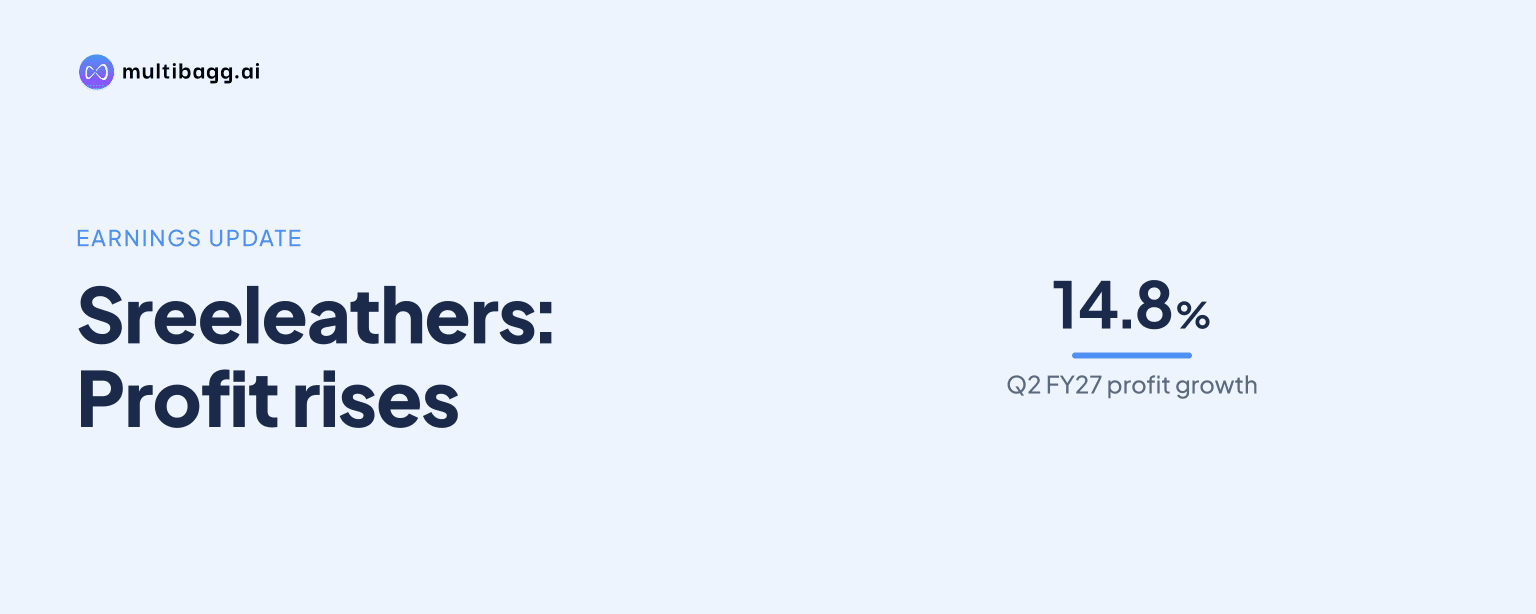
Sreeleathers Limited reported profit after tax of Rs 9.88 crore for Q2 FY27, up 14.8% year on year, after revenue reached Rs 83.16 crore despite warehouse dispatch constraints that delayed some wholesale invoicing into the December quarter. Operating EBITDA margin increased 33 basis points to 16.0%, although gross margin declined to 22.1%.
Know Sreeleathers inside out
Results, valuation, peers and who's buying, in one view.
How did Sreeleathers perform in Q2 FY27?
Sreeleathers delivered revenue from operations of Rs 83.16 crore in the quarter ended 30 September 2026, up 11.3% from Rs 74.71 crore in Q2 FY26. Total income rose 11.5% to Rs 83.57 crore from Rs 74.96 crore, while profit before tax increased 15.2% to Rs 13.25 crore from Rs 11.50 crore. Profit after tax rose to Rs 9.88 crore from Rs 8.61 crore, and earnings per share increased to Rs 4.27 from Rs 3.72.
The September-quarter revenue was also 39.5% above Rs 59.63 crore in Q1 FY27. Management had indicated in August that it expected about 45% quarter-on-quarter revenue growth, implying revenue of around Rs 86 crore. The reported result was below that estimate because wholesale orders accumulated late in the quarter and warehouse dispatch capacity did not keep pace, according to management.
Why did Sreeleathers shift wholesale sales into December?
Sreeleathers said wholesale orders bunched in the final days of Q2 FY27, when warehouse dispatch capacity could not process all orders in time. Some categories also ran short during the period. Supply was restored at category level within a few days, but the affected orders were dispatched and invoiced in the December quarter rather than in the quarter ended 30 September 2026.
The delay occurred around Durga Puja, which fell in the December quarter in FY27, although much of the festival shopping occurred in the weeks before it and was booked in the September quarter. Management said the festival traded well and that a more even ordering pattern through the quarter would improve warehouse-resource planning. Its stated longer-term response is to consider warehouse expansion to address capacity constraints.
How did Sreeleathers' margins change in Q2 FY27?
Sreeleathers' gross profit increased 4.8% to Rs 18.40 crore from Rs 17.56 crore, but gross margin declined to 22.1% from 23.5% a year earlier. The 138-basis-point decline also placed gross margin below the 25.5% reported in Q1 FY27. One basis point is one-hundredth of a percentage point.
Dealers' incentive, which the presentation records below gross profit, declined to Rs 1.13 crore in Q2 FY27 from Rs 1.68 crore in Q2 FY26. Net of this incentive, management calculated margin at 20.8%, compared with 21.3% a year earlier, a decline of about 49 basis points. This comparison shows that the reported gross-margin movement differs from the margin measure after dealer incentives.
Got a follow-up? Ask IRIS
What supported Sreeleathers' operating profit growth?
Sreeleathers increased operating EBITDA, or earnings before interest, tax, depreciation and amortisation, by 13.6% to Rs 13.27 crore from Rs 11.68 crore. Operating EBITDA margin reached 16.0%, compared with 15.6% in Q2 FY26 and 14.9% in Q1 FY27. The 33-basis-point year-on-year improvement came despite the 138-basis-point decline in gross margin.
Below gross profit, dealers' incentive decreased by Rs 0.55 crore, other expenses fell by Rs 0.10 crore to Rs 1.80 crore, and employee costs declined by Rs 0.10 crore to Rs 2.21 crore. The effective tax rate was 25.5%, compared with 25.2% a year earlier. Profit before tax rose 15.2%, while profit after tax increased 14.8% to Rs 9.88 crore.
What did Sreeleathers' stores and half-year results show?
Sreeleathers said revenue at company-owned and company-operated stores grew 24.5% year on year in Q2 FY27, ahead of the 11.3% growth in company-wide revenue. Footfall at these stores was also ahead of the prior year, despite Durga Puja falling in the September quarter a year earlier and in the December quarter in FY27. The presentation does not disclose the rupee revenue of this store group.
For H1 FY27, revenue rose 14.4% to Rs 142.79 crore from Rs 124.81 crore in H1 FY26, while profit after tax increased 46.1% to Rs 16.86 crore from Rs 11.54 crore. Half-year earnings per share were Rs 7.28, compared with Rs 4.98. Sreeleathers also reported trailing-12-month revenue of Rs 266.38 crore, profit after tax of Rs 34.07 crore and earnings per share of Rs 14.71 at 30 September 2026.
What is Sreeleathers' outlook for the December quarter?
Sreeleathers management estimates Q3 FY27 revenue of Rs 67 crore to Rs 70 crore, which would be 10% to 15% above Rs 60.90 crore in Q3 FY26. The estimate would nevertheless be below Q2 FY27 revenue of Rs 83.16 crore because much of the Puja shopping occurred before the festival and was recorded in the September quarter.
Management said the December quarter includes the festival itself, post-festival trading and the wholesale orders deferred from September, as well as Diwali and Christmas. The network entered Q2 FY27 with 34 authorised stores across eight states, while inventory stood at Rs 11.51 crore at 30 September 2026, compared with Rs 8.05 crore at 31 March. The company reported no borrowings as of 30 September 2026.
Conclusion
Sreeleathers combined 11.3% revenue growth with 14.8% growth in profit after tax in Q2 FY27, while operating EBITDA margin rose to 16.0%. The quarter came close to management's approximate Rs 86 crore revenue expectation, but late wholesale ordering and warehouse constraints shifted some invoicing into the next quarter. Lower dealer incentives, employee costs and other expenses supported operating profitability despite lower gross margin.
The next result to watch is whether December-quarter revenue falls within management's Rs 67 crore to Rs 70 crore estimate and captures the deferred wholesale dispatches. Management has also identified more even trade-partner ordering and potential warehouse expansion as responses to the Q2 FY27 bottleneck, while noting that demand, festival timing, supply and warehouse capacity could affect actual Q3 FY27 performance.