










String Metaverse seeks Rs 1,000 crore debt for acquisitions
Key highlights
- String Metaverse approved a proposed Rs 1,000 crore private-placement NCD programme on November 6, 2026.
- The company proposes to raise authorised share capital from Rs 200 crore to Rs 5,000 crore.
- The authorised equity-share limit would increase from 200 crore shares to 5,000 crore shares of Rs 1 each.
- The announced acquisition framework covers India and overseas opportunities, but names no target or transaction value.
powered by IRIS
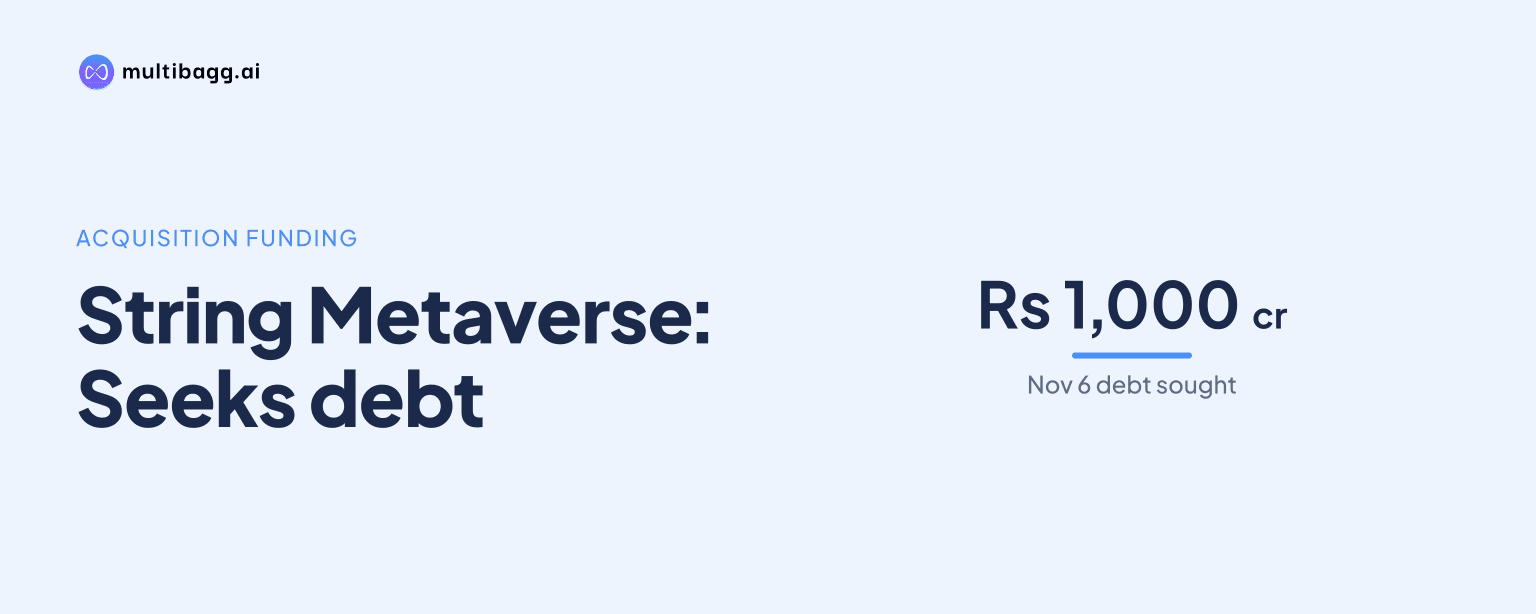
String Metaverse Limited’s board on November 6, 2026, approved a proposed Rs 1,000 crore private-placement debt programme for acquisitions and recommended raising authorised share capital from Rs 200 crore to Rs 5,000 crore, subject principally to member and regulatory approvals.
Know String Metaverse inside out
Results, valuation, peers and who's buying, in one view.
What did String Metaverse approve on November 6, 2026?
String Metaverse approved a strategic acquisition, investment and business-expansion framework on November 6, 2026, intended to pursue inorganic growth in India and overseas. The board said the framework covers acquisitions, investments, mergers, joint ventures and other expansion opportunities, including purchases of equity shares, securities, business undertakings, ownership interests and strategic or controlling stakes.
The framework identifies emerging and high-growth areas including artificial intelligence, data centres, digital infrastructure, financial technology, global technology, information technology, Web 3.0 and blockchain technology. String Metaverse said its stated objectives include diversification, expanded operations and greater technological capabilities, but it did not identify an acquisition target, transaction value or a timetable for a specific deal in its November 6 announcement.
How much debt can String Metaverse raise for acquisitions?
String Metaverse may issue up to Rs 1,000 crore of non-convertible debentures, or NCDs, and other eligible non-convertible debt securities through private placement in one or more series or tranches. The board’s approval sets an aggregate principal ceiling rather than confirming an immediate issue, and each tranche can be structured separately by the board or its authorised committee.
The proposed proceeds are primarily intended for strategic acquisitions, investments, business expansion and inorganic opportunities in India and overseas. The permitted uses also include acquiring equity shares, securities, business undertakings and ownership interests, transaction expenses and other permissible corporate purposes. The announcement does not specify how much of the Rs 1,000 crore ceiling would be assigned to any one sector or transaction.
NCD terms remain undecided at the November 6 stage. String Metaverse said the securities may be secured or unsecured, listed or unlisted, and redeemable, while the coupon rate, tenure, maturity, interest-payment schedule, redemption provisions and any security arrangements will be decided for each tranche. As no securities have been issued or allotted, the company reported that there was no applicable payment delay or default information.
Separately, String Metaverse reported consolidated profit after tax of Rs 39.8639 crore for the quarter ended September 30, 2026, compared with Rs 21.6365 crore for the quarter ended September 30, 2025. Finance costs were Rs 12.64 lakh in the latest quarter, compared with Rs 0.31 lakh a year earlier; these reported results precede any issuance under the proposed Rs 1,000 crore programme.
How does String Metaverse’s authorised-capital proposal change its capacity?
String Metaverse proposes to increase its authorised share capital 25 times, from Rs 200 crore to Rs 5,000 crore, by creating 4,800 crore additional equity shares with a face value of Rs 1 each. Authorised capital is the maximum share capital a company is permitted to issue under its constitutional documents; the board has not announced an equity issue, price or recipient under this proposal.
The comparison is between the existing capital clause and the board-recommended revised clause, rather than between reporting periods. The proposed increase would raise the authorised equity-share limit from 200 crore shares to 5,000 crore shares, while amending Clause V, the capital clause, of String Metaverse’s Memorandum of Association. It remains subject to member approval and any other required statutory or regulatory permissions, and does not itself create new paid-up shares.
Got a follow-up? Ask IRIS
Which sectors can String Metaverse pursue under the new objects?
String Metaverse also approved changes to its objects clause, subject to member approval, that would add businesses beyond the broad technology categories listed in the acquisition framework. The new objects include data centres, hyperscale data centres, cloud-computing infrastructure, colocation facilities, data storage, disaster-recovery centres and allied technology projects in India or elsewhere.
The proposed objects extend to power generation, energy storage, transmission and distribution networks, substations, conventional and renewable electricity, wind farms and hybrid energy projects. They also include defence equipment, drones, aerospace systems, defence electronics, communication and surveillance systems, specialised engineering products and related infrastructure. Any acquisitions, investments or operations in those areas remain subject to licences, security clearances, government permissions and other regulatory approvals where applicable.
The sector list therefore combines digital infrastructure with physical infrastructure and regulated industries. For example, the data-centre objects cover construction, ownership, leasing, operation and maintenance, while the energy objects cover generation, storage, transmission, distribution and trading. The defence objects specifically contemplate participation in government and private-sector projects, contracts and collaborations, but String Metaverse disclosed no signed contract or proposed asset purchase in any of these sectors.
What approvals and execution steps are still pending?
String Metaverse’s board approved a postal-ballot notice to seek member approval through remote e-voting for the proposals recommended on November 6, 2026. The company appointed Desina Balarama Krishna of Balaramakrishna & Associates, Hyderabad, as scrutiniser for the postal ballot. The filing does not state the remote e-voting dates, the record date or the date when voting results will be declared.
Member approval is specifically required for the authorised-capital increase and changes to the Memorandum of Association, while the debt issue is also subject to approvals wherever required and to applicable corporate, statutory and regulatory requirements. The planned NCD programme must comply with the Companies Act, 2013, the Securities and Exchange Board of India, or SEBI, listing regulations and SEBI’s non-convertible-securities regulations.
Even after approvals, the Rs 1,000 crore programme does not prescribe a mandatory drawdown. The board or authorised committee must determine each tranche’s size within the aggregate ceiling, whether it will be listed, its maturity and coupon, whether assets will secure it, and the redemption mechanics. Those decisions will establish the actual debt raised and the financial terms attached to it.
Conclusion
String Metaverse has established a proposed funding and corporate-object framework for a broader acquisition strategy, combining a maximum Rs 1,000 crore non-convertible debt programme with a 25-fold increase in authorised capital to Rs 5,000 crore. The November 6, 2026 decisions create financing and legal capacity, but they do not announce a target, completed acquisition or issued debt instrument.
The next disclosed event to watch is the postal-ballot process for member approval of the capital and objects-clause changes. After that, material execution milestones would be any tranche-level NCD terms, including coupon and tenure, and any separately disclosed acquisition, investment, joint venture or regulatory approval under String Metaverse’s framework.