










Subex targets economic integrity for autonomous AI decisions
Key highlights
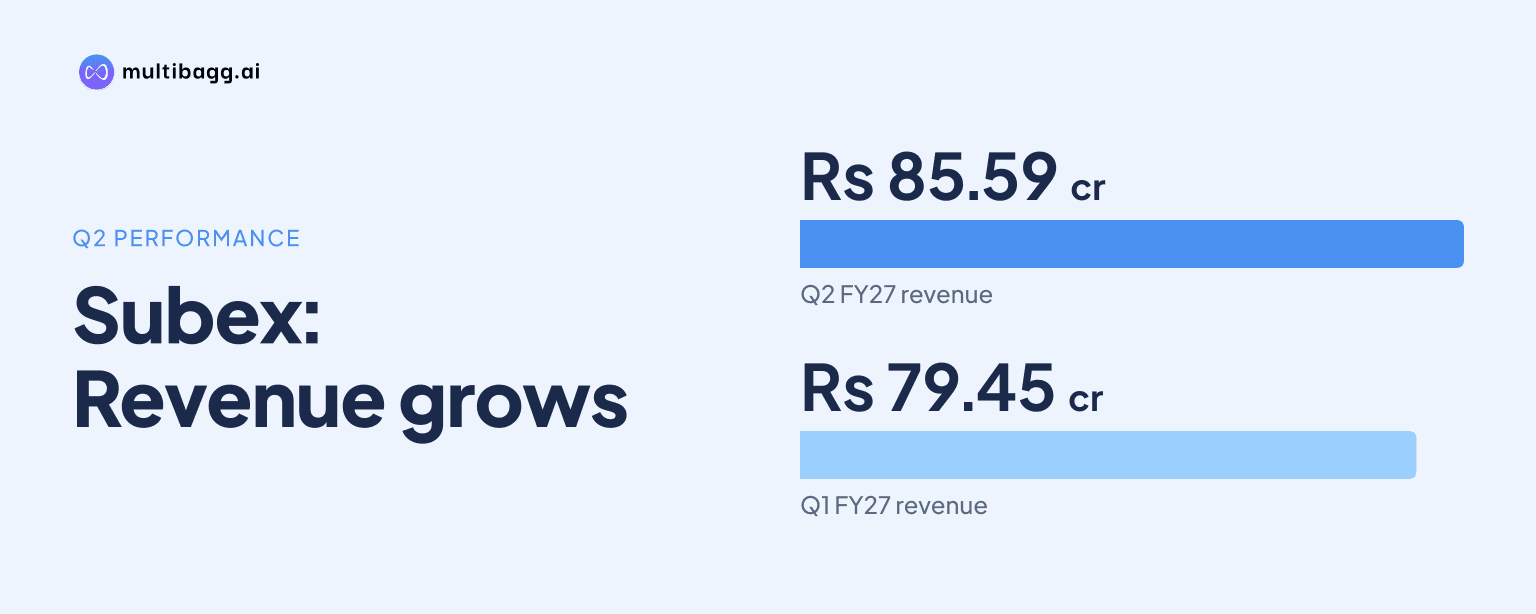
- Subex reported Q2 FY27 revenue of Rs 85.59 crore, up 7.7% from Rs 79.45 crore in Q1 FY27.
- Subex said Q2 FY27 revenue grew 24% year on year and marked its fifth consecutive quarter of sequential growth.
- Subex reported Q2 FY27 normalised EBITDA of Rs 17.77 crore and cash and cash equivalents of Rs 198 crore.
- Management described economic integrity as a platform-neutral control layer for autonomous AI decisions with financial consequences.
powered by IRIS
Subex Limited is targeting an economic-integrity layer to assess whether autonomous AI decisions are authorised, economically valid and accountable, as Q2 FY27 revenue rose 7.7% sequentially to Rs 85.59 crore. Management described the initiative on November 4, 2026 as a strategic direction rather than an established market position or a disclosed commercial offering.
Know Subex inside out
Results, valuation, peers and who's buying, in one view.
What is Subex’s economic-integrity strategy for AI?
Subex’s strategy is to move closer to decisions that determine financial outcomes instead of only analysing losses after they occur. For the quarter ended September 30, 2026, Managing Director and Chief Executive Officer Nisha Dutt said AI agents will increasingly make decisions, initiate transactions, interact with systems and execute activities with varying degrees of autonomy.
Subex wants to assess whether an action was appropriate, authorised, economically sound and within its intended boundary. Management cited an incorrect settlement, a fraudulent transaction authorisation, revenue misallocation and a difficult-to-reverse chain of actions as potential consequences of an AI agent taking a wrong action. The proposed control is therefore centred on the integrity of the decision itself.
The company linked this opportunity to more than three decades of telecom work across networks in over 100 countries. Its existing experience concerns how value is created, measured, reconciled and protected, including relationships, dependencies, behaviours and exceptions that management said help determine whether a transaction is economically legitimate.
Why does Subex see autonomous AI as a telecom control issue?
Subex sees autonomous AI as a telecom control issue because machines, bots and agents may initiate activity at a scale and speed beyond controls designed mainly for human traffic. Management contrasted this with traditional customer actions such as making calls, sending messages, consuming data or initiating payments.
The company compared the proposed model with a maker-checker mechanism, except that both the maker and checker could be intelligent systems. An autonomous agent may initiate an action, while another decision mechanism assesses its authorisation and boundaries. Management said the unresolved questions include who authorised an action, whether it stayed within its intended boundary and who is accountable when it fails.
Subex does not intend to own every AI platform, data infrastructure or automation product used by an operator. Instead, management described its intended role as platform-neutral: capabilities that work across customer environments to govern critical decisions and protect economic outcomes without depending on which AI platform becomes dominant.
How does Subex’s AI direction fit its core business?
Subex says business assurance, fraud management and managed services remain central to near-term growth and profitability. Alongside those operations, the company plans to advance AI-led capabilities for more intelligent detection and investigation, as well as increasingly autonomous workflows with appropriate human oversight.
Management said it will focus first on customer environments where it can demonstrate measurable economic value, then build outward. Dutt said Subex is not pursuing AI simply because adjacent markets appear attractive; its investment pace will depend on whether the company’s domain intelligence creates a genuine advantage and can support a sustainable business.
The proposed opportunity may also extend beyond conventional mobile network operators. Management identified satellite and non-terrestrial networks, mobile money, digital financial services and enterprise platforms as increasingly interconnected and automated areas that could bring new revenue-leakage, fraud and settlement complexity. It did not disclose contracts, revenue or deployment targets for these adjacent markets.
Got a follow-up? Ask IRIS
Can AI replace Subex’s managed-services revenue?
Subex does not expect AI alone to eliminate its managed-services revenue over the next two years. In response to an investor question, Dutt said managed services relate to Subex products, including maintenance, upgrades and upsells, rather than work on competing vendors’ products.
Management said operators commonly use multiple systems, including their own systems, in the same telecom environment. Dutt said this is already the case and does not mean Subex’s managed-services work is shrinking. She added that a vendor operating across hundreds of telecom operators can observe cross-operator patterns, such as fraud emerging in one geography and moving to another.
Subex is also considering whether AI agents can make its own managed-services delivery more efficient. Management did not provide a quantified efficiency target, cost-saving estimate or timeline. Its position was that automation may change how the service is delivered, rather than remove the need for managed services around its products.
What Q2 FY27 results support Subex’s strategic investment?
Subex reported Q2 FY27 revenue of Rs 85.59 crore, compared with Rs 79.45 crore in Q1 FY27, an increase of Rs 6.14 crore. Management said revenue grew 24% year on year and that Q2 marked the company’s fifth consecutive quarter of sequential growth.
Management said normalised EBITDA increased despite annual wage increases in Q2 FY27. It reported an EBITDA margin of 20.8% and said PAT was 16.7%, while also stressing that it wants growth that does not come at the cost of the bottom line. Cash and cash equivalents increased to Rs 198 crore at quarter-end from Rs 184 crore in the preceding quarter.
Subex also said its minority investments in PrivaSapien and OnGrid had appreciated by about 5 times and 2 times, respectively, from their original investment values based on the latest available valuations. These were cited as strategic-investment value creation and were not presented as revenue from the economic-integrity initiative.
What targets has Subex set for this strategy?
Subex has not provided a quantitative revenue target, commercialisation date or formal guidance for the economic-integrity strategy. Management said its first responsibility remains strengthening and scaling the core business, while using customer deployments and measurable outcomes to determine the pace and direction of investment.
When asked for numerical guidance, Dutt said management’s aspiration was high-single-digit to double-digit growth while maintaining durable margins. She also said margins may not remain exactly the same in every quarter. This was directional commentary, not a formal forecast, and management did not quantify future AI-led revenue or customer adoption.
Conclusion
Subex is seeking to apply its telecom assurance, fraud-management and transaction experience to controls for AI decisions that can have financial consequences. The strategy is not an attempt to replace operators’ AI platforms; management instead described a platform-neutral layer focused on authorisation, economic legitimacy, boundaries and accountability. Q2 FY27 revenue of Rs 85.59 crore and cash of Rs 198 crore provide the financial context for that planned expansion.
The next issue to watch is whether Subex can demonstrate measurable economic value in customer environments, as management said this will determine how it builds outward. Investors can also track whether core business assurance, fraud management and managed services continue to grow, whether AI agents improve managed-services delivery, and whether the company later discloses deployments, contracts or quantified targets for the new direction.