










Sumit Woods reports Rs 35.58 crore operating cash outflow
Key highlights
- Sumit Woods used Rs 35.58 crore in operating activities in the half year ended September 30, 2026.
- Inventory increased by Rs 40.17 crore to Rs 212.96 crore at September 30, 2026.
- Net borrowing proceeds were Rs 43.19 crore, lifting total borrowings to Rs 129.68 crore.
- Half-year net profit rose to Rs 6.24 crore from Rs 3.96 crore a year earlier.
powered by IRIS
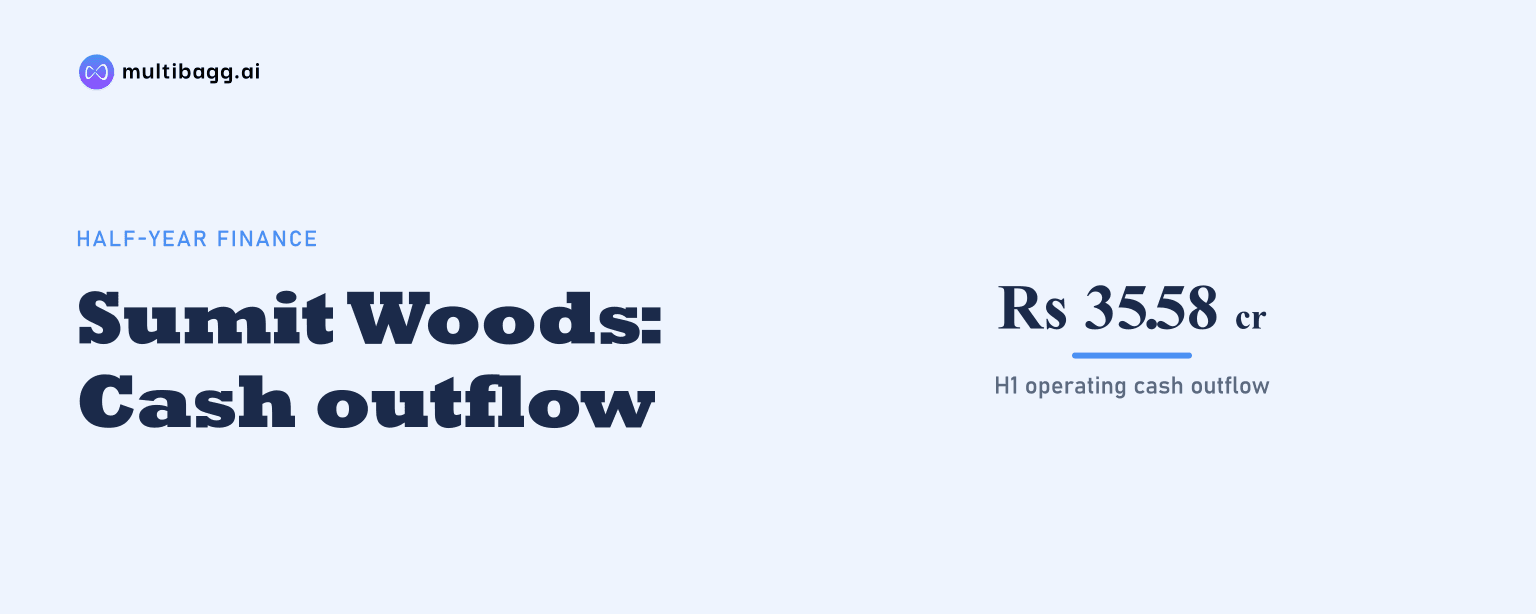
Sumit Woods Limited reported a Rs 35.58 crore operating cash outflow for the half year ended September 30, 2026, as a Rs 40.17 crore increase in inventories and a Rs 6.63 crore rise in trade receivables outweighed Rs 10.57 crore of operating profit before working-capital changes.
Know Sumit Woods inside out
Results, valuation, peers and who's buying, in one view.
Why did Sumit Woods report negative operating cash flow?
Sumit Woods reported negative operating cash flow because project-related working-capital uses exceeded cash generation before working-capital changes. Cash generated from operations was negative Rs 34.58 crore in the half year ended September 30, 2026, and income-tax payments of Rs 1 crore took net cash used in operating activities to Rs 35.58 crore.
The principal movement was inventories, which consumed Rs 40.17 crore of cash during the half year. Trade receivables used a further Rs 6.63 crore, while other assets used Rs 2.01 crore. These outflows were partly offset by a Rs 4.78 crore increase in trade payables and Rs 1.12 crore from other current liabilities and provisions. The cash-flow statement therefore identifies working capital, rather than the reported profit figure alone, as the immediate reason for the outflow.
The comparison available in the filing is with the full year ended March 31, 2026, when Sumit Woods used Rs 44.84 crore in operations. That full-year outflow included Rs 19.13 crore used for inventories, Rs 17.07 crore for other assets and Rs 23.46 crore for other current liabilities and provisions. In the current half year, inventory became the largest disclosed working-capital use, more than doubling the full-year inventory cash use despite covering only six months.
How much did Sumit Woods' inventory and receivables increase?
Sumit Woods' inventory balance rose by Rs 40.17 crore to Rs 212.96 crore at September 30, 2026, from Rs 172.78 crore at March 31, 2026. Trade receivables increased by Rs 6.63 crore to Rs 12.47 crore from Rs 5.84 crore over the same period.
Inventory was Sumit Woods' largest current asset at September 30, representing most of total current assets of Rs 272.14 crore. Other financial assets stood at Rs 30.92 crore, compared with Rs 27.52 crore at March 31. Cash and cash equivalents increased to Rs 11.07 crore from Rs 2.96 crore, while other current assets fell to Rs 4.71 crore from Rs 7.16 crore.
Sumit Woods recognises revenue over time under Indian Accounting Standard 115, Revenue from Contracts with Customers, using the percentage-of-completion method. Under this mechanism, construction cost incurred for each project determines the degree of completion of the performance obligation. Sumit Woods also states that, after an occupancy certificate is issued, it records 100% of revenue for sold apartments whose agreements are registered subsequently.
The filing says Sumit Woods operates primarily in real estate and has one geographical segment, so it does not provide separate reportable-segment disclosure. It also says the sector has inherent seasonality, which can cause quarterly figures to fluctuate. Revenue from operations for the half year nevertheless increased to Rs 81.09 crore from Rs 52.35 crore a year earlier, while construction and development expenses rose to Rs 101.62 crore from Rs 21.72 crore.
Got a follow-up? Ask IRIS
How did Sumit Woods fund the working-capital requirement?
Sumit Woods funded the period's cash requirement mainly through net borrowing proceeds of Rs 43.19 crore. Financing activities generated Rs 38.10 crore after Sumit Woods paid Rs 4.13 crore of finance costs and Rs 95.72 lakh of dividends during the half year ended September 30, 2026.
Total borrowings on the balance sheet rose to Rs 129.68 crore at September 30 from Rs 86.49 crore at March 31, an increase of Rs 43.19 crore. The composition shifted toward non-current debt: non-current borrowings rose Rs 45.09 crore to Rs 110.30 crore, whereas current borrowings declined Rs 1.90 crore to Rs 19.38 crore.
Investing activities supplied Rs 5.59 crore in the half year. The largest listed investing inflow was Rs 11.12 crore under deposits for new projects, while payments for property, plant and equipment were Rs 4.28 crore and investment in subsidiaries, associates, firms and joint ventures used Rs 1.28 crore. Combined with financing inflows, these movements produced a Rs 8.12 crore net increase in cash and cash equivalents.
Did profit growth translate into cash generation for Sumit Woods?
Sumit Woods' reported profit increased, but it did not translate into positive operating cash flow during the half year because of working-capital movements. Profit before tax rose to Rs 8.39 crore for the half year ended September 30, 2026, from Rs 5.24 crore in the corresponding half year ended September 30, 2025, and net profit rose to Rs 6.24 crore from Rs 3.96 crore.
Before working-capital changes, Sumit Woods generated Rs 10.57 crore of operating profit. This figure incorporated Rs 73.33 lakh of depreciation, Rs 2.31 crore of finance costs, Rs 1.31 crore for unwinding expenses on security deposits under Indian Accounting Standards, and Rs 3.20 crore of interest income. The subsequent Rs 48.81 crore combined cash use from inventory, receivables and other assets was greater than the pre-working-capital operating profit.
For the September quarter, revenue from operations was Rs 36.62 crore, down from Rs 44.48 crore in the June quarter, but above Rs 10.92 crore in the September 2025 quarter. Quarterly profit before tax was Rs 2.66 crore, compared with Rs 5.72 crore in the preceding quarter and Rs 55.77 lakh a year earlier. Sumit Woods notes that September-quarter figures are balancing figures between the half-year results and the June-quarter results.
Sumit Woods also recorded a Rs 49.78 lakh impairment expense in the half year after management concluded on May 21, 2026 that certain intangible work in progress would not be completed and was not expected to generate future economic benefits. Sumit Woods says this amount represented capitalised project costs and did not relate to normal operating expenses.
Conclusion
Sumit Woods combined higher reported revenue and profit with a Rs 35.58 crore operating cash outflow in the half year ended September 30, 2026. The filing shows that the gap was driven chiefly by a Rs 40.17 crore inventory build-up and a Rs 6.63 crore increase in receivables, while net borrowing proceeds of Rs 43.19 crore funded the resulting cash requirement and increased total borrowings to Rs 129.68 crore.
The next reported results will show whether the higher inventory and receivables are converted into operating cash as projects progress under the percentage-of-completion method. Readers can also track the mix of borrowings, particularly non-current debt of Rs 110.30 crore at September 30, 2026, and any further spending or recoveries relating to new-project deposits and real-estate development activity.