










Sunita Tools Limited receives licence for 81 mm-to-155 mm shells
Key highlights
- Sunita Tools announced its DPIIT industrial licence for empty artillery shell bodies on 20 November 2026.
- The Sunita Tools licence covers empty artillery shell bodies from 81 mm to 155 mm.
- Sunita Tools stated initial annual production capability of 3,00,000 units.
- Sunita Tools reported approximately Rs 550 crore of orders in hand in the division.
powered by IRIS
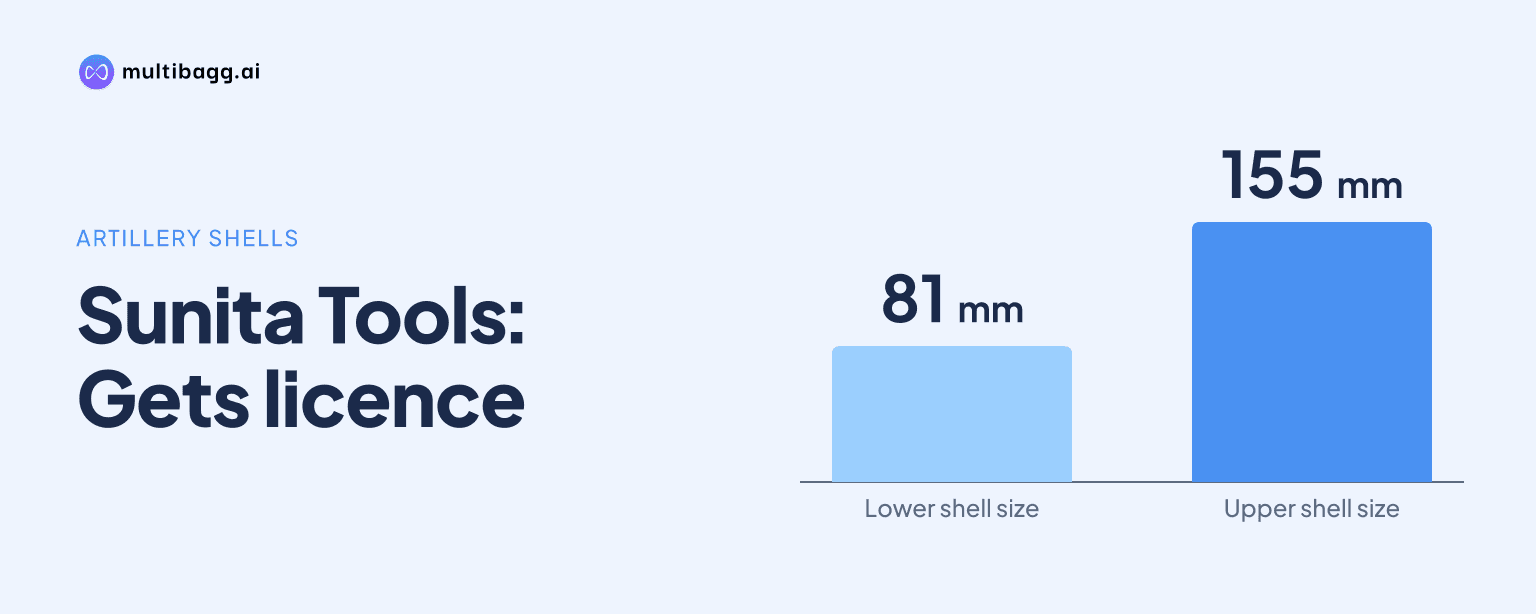
Sunita Tools Limited received a DPIIT industrial licence on 20 November 2026 to manufacture empty artillery shell bodies from 81 mm to 155 mm, clearing the licensing requirement it cited for a division with approximately Rs 550 crore of orders in hand and initial annual capacity of 3,00,000 units.
Know Sunita Tools inside out
Results, valuation, peers and who's buying, in one view.
What licence did Sunita Tools receive?
Sunita Tools received an industrial licence from DPIIT under the Arms Act, 1959, for defence manufacturing of empty artillery shell bodies. The company disclosed the approval in a press release dated 20 November 2026 and filed it with BSE Limited under Regulation 30 of the Securities and Exchange Board of India listing regulations. The approval applies to empty shell bodies, rather than completed or filled artillery ammunition.
Sunita Tools described the licence as covering all major empty artillery-shell sizes in the 81 mm-to-155 mm calibre range. The company has previously operated in engineering and mould-base manufacturing for more than 40 years, with ground plates, mould bases and precision machining among its stated products. The licence adds a regulated defence-manufacturing category to that product base.
Which artillery-shell sizes can Sunita Tools manufacture?
Sunita Tools is licensed to manufacture empty artillery shell bodies across calibres from 81 mm to 155 mm. These two figures define the range stated in the 20 November 2026 release, but the company did not provide a production schedule, customer allocation or annual volume for each calibre within the range.
The filing places empty artillery shells alongside Sunita Tools' existing products for automotive, pharmaceutical, electronics, consumer-goods, aerospace and defence customers. Unlike its disclosed ground plates and mould bases, the new 81 mm-to-155 mm shell-body activity requires the industrial licence granted under the Arms Act, 1959. The announcement does not provide historical sales, production or financial contribution for this shell category.
What production capacity and order pipeline did Sunita Tools disclose?
Sunita Tools stated that its initial production capability for the newly licensed activity is 3,00,000 units annually. It also said it has plans to raise output by installing a second production line at its factories, referred to as Line-2. The release does not disclose the investment required, the additional unit capacity, or a commissioning date for that line.
Sunita Tools said manufacturing was on track to begin in November 2026 for an order from a defence public-sector unit, followed by other orders already in hand. It put orders in hand for the division at approximately Rs 550 crore. That figure is an approximate order value, not reported revenue, invoicing, collections or profit, and the filing gives no customer-by-customer quantities or delivery terms.
Got a follow-up? Ask IRIS
How does the licence change Sunita Tools' operating position?
Sunita Tools said it can now entertain and take orders from customers whose orders it could not previously confirm because it lacked the licence. For the 81 mm-to-155 mm empty-shell category, the disclosed operational change is the removal of that stated regulatory constraint. The company did not say that every enquiry, letter of intent or request for quotation will convert into a firm order.
The company also referred to letters of intent and requests for quotation that could now be considered after the licence was received. Management said an order described as NATO-related could proceed when the customer is ready with logistics, but it did not provide a value, quantity, delivery date or named customer for that order. The distinction is material because the approximately Rs 550 crore figure covers orders in hand, while the other potential opportunities are not quantified in the release.
What quality standards and market plans has Sunita Tools outlined?
Sunita Tools said its manufacturing processes will follow defence-sector quality-control and operational-safety requirements for empty artillery shell bodies. It said output is intended to meet the specialised operational requirements of the Indian Armed Forces and international defence-parts standards, citing NATO and Elbit. The 20 November 2026 announcement does not include certification numbers, test outcomes, customer acceptance records or third-party audit findings.
Management linked the 81 mm-to-155 mm manufacturing plan to domestic and international artillery demand and to the Atmanirbhar Bharat initiative. Those statements set out management's market plans rather than reported export revenue or confirmed overseas sales. The company also cautioned that forward-looking statements may be affected by government actions, political or economic developments, technological risks and other uncertainties.
Conclusion
The licence gives Sunita Tools regulatory approval to manufacture empty shell bodies across the stated 81 mm-to-155 mm range, extending its more than 40-year engineering and mould-base business into a specified defence category. The disclosure pairs this approval with 3,00,000 units of initial annual capacity and approximately Rs 550 crore of orders in hand, but does not report shell production, revenue or margins.
The next disclosed event is the planned November 2026 manufacturing start for the defence public-sector-unit order. Sunita Tools has also outlined Line-2 to increase output and cited a NATO-related order subject to customer logistics readiness, so subsequent disclosures on commissioning, capacity addition and order execution are the matters to watch.