










Susan plans 16,000 km cable capacity expansion by March 2027
Key highlights
- Susan plans to raise LT and HT cable capacity from 11,000 km to 16,000 km per annum by March 2027.
- Susan’s installed 6 kV to 33 kV CCV line is expected to become operational in about 10 days.
- Susan plans to increase winding-wire capacity from 4,200 tonnes to 5,500 tonnes.
- Susan says existing land can support future cable capacity of up to 22,000 km per annum.
powered by IRIS
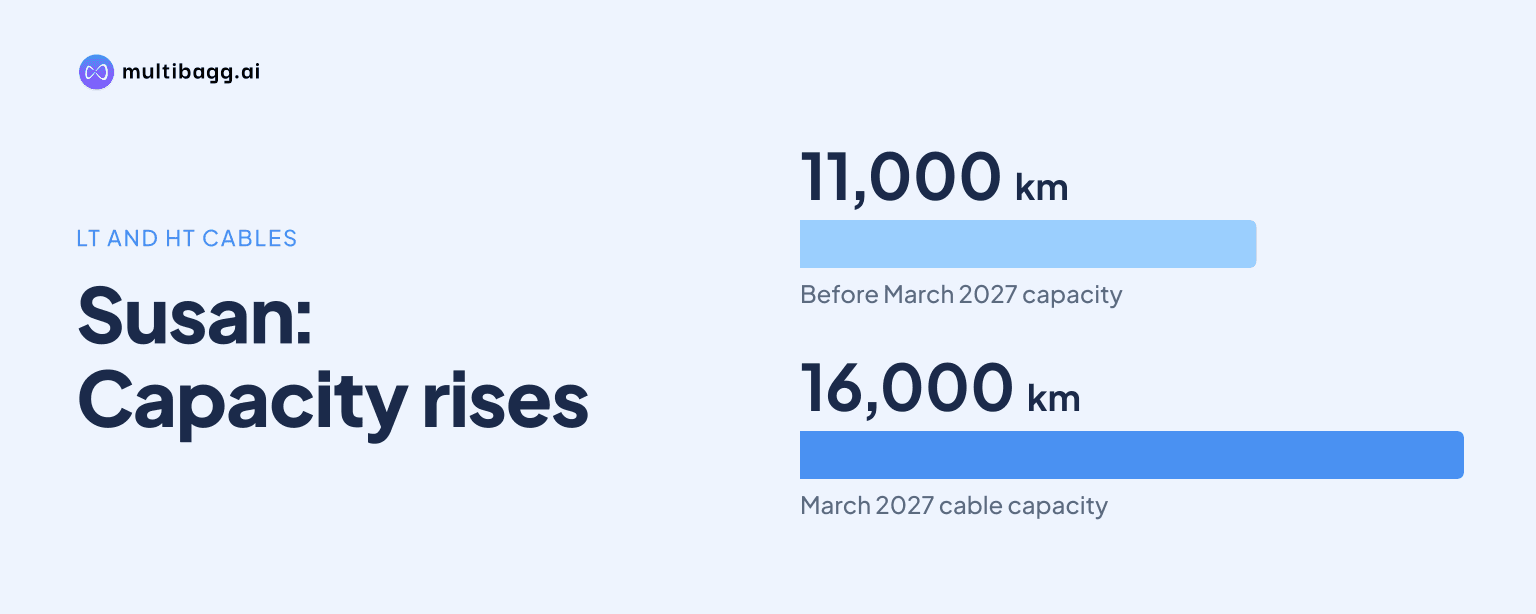
Susan Wire & Cables plans to raise annual LT and HT cable capacity from 11,000 km to 16,000 km by March 2027, adding 5,000 km while targeting commercial production. The plan also includes an installed 6 kV to 33 kV Continuous Catenary Vulcanization line, which Susan says is mandatory for most HT cable projects.
Know Susan Electricals India inside out
Results, valuation, peers and who's buying, in one view.
How much cable capacity is Susan adding?
Susan plans to add 5,000 km per annum of Low Tension, or LT, and High Tension, or HT, cable capacity, taking the total to 16,000 km per annum from 11,000 km. The capacity-expansion plan states 80% utilisation for the cable business and gives March 2027 as the commercial-production target.
The present 11,000-km cable base equals the installed capacity of Susan’s two cable units in Sahibabad, Ghaziabad. Unit II produces LT cables and has capacity of 6,000 km at 80% utilisation, while Unit III produces LT and HT cables and has capacity of 5,000 km at 80% utilisation. The planned 16,000-km level is 5,000 km above this combined installed base.
Susan identifies LT and HT cables, together with a 6 kV to 33 kV CCV line, as the proposed line under the expansion programme. The presentation does not disclose capital expenditure, project cost, product-wise capacity allocation or a commissioning sequence beyond the March 2027 commercial-production target.
What does the CCV line mean for Susan’s HT cable projects?
Susan says its installed Continuous Catenary Vulcanization, or CCV, line is expected to become operational in about 10 days and is mandatory for most HT cable projects. The line is specified for 6 kV to 33 kV cables, matching the company’s HT cable division, which was launched up to 33 kV in 2024-25.
Susan says CCV technology helps meet technical requirements for HT cable supplies to state utilities and government departments, subject to applicable approvals and qualifications. The line can therefore widen the projects in which Susan can participate, but the presentation does not state that installation alone secures approvals, tenders or customer orders.
The company presents the CCV line as part of a move towards HT cables and Medium Voltage Covered Conductor, or MVCC, rather than as a separately quantified volume addition. Susan launched MVCC in 2025 and says it started supplying new government utilities, while the current expansion plan focuses on a combined 5,000-km cable-capacity addition.
How is Susan expanding winding-wire capacity?
Susan plans to increase winding-wire capacity to 5,500 tonnes from 4,200 tonnes, a 1,300-tonne increase. The presentation also shows that current capacity of 4,200 tonnes followed a previous capacity level of 3,307 tonnes, and reports 75% utilisation at the winding-wires and strips unit.
The current 4,200-tonne facility is Unit I on SSGT Road in Ghaziabad, Uttar Pradesh. Susan was founded in 2007 and began by manufacturing copper and aluminium winding wires and strips used in manufacturing and repairing distribution and power transformers.
The capacity page separately highlights a 900-tonne increase and a 1,300-tonne increase beside the three winding-wire stages. Its figures show a 1,300-tonne rise from 4,200 tonnes to 5,500 tonnes; it does not give a separate commercial-production date for winding wires apart from the March 2027 target for the proposed LT, HT and CCV line.
Got a follow-up? Ask IRIS
What land and facilities support Susan’s expansion?
Susan says possession of additional land with an approximate value of Rs 22 crore is at an advanced stage. The company says the land is intended to support higher manufacturing capability, new product lines and future growth initiatives.
Separately, Susan says its existing land can support future cable capacity of up to 22,000 km per annum. That is 6,000 km above the immediate 16,000-km capacity target, although the presentation does not specify when a 22,000-km level could be reached or how much would be assigned among LT, HT and MVCC products.
The three disclosed facilities are all in Ghaziabad: the 4,200-tonne winding-wire unit on SSGT Road, the 6,000-km LT cable unit in Sahibabad, and the 5,000-km LT and HT cable unit in Sahibabad. Susan reports 80% utilisation at each cable facility, compared with 75% at the winding-wire facility.
Which products and markets is Susan targeting after expansion?
Susan’s roadmap prioritises manufacturing and geographical sales of HT cables and MVCC, strengthening HT cable capacity, expanding LT cable sales and ramping up aluminium conductors. It also says the company will explore electrification opportunities in railway and defence, without disclosing expected revenue, tender values or project deadlines.
The company lists operations in nine states: Uttar Pradesh, Telangana, Rajasthan, Madhya Pradesh, Jharkhand, Bihar, Haryana, Punjab and Gujarat. It identifies Kerala, Tamil Nadu, Uttarakhand, Karnataka, Maharashtra, Andhra Pradesh and Chhattisgarh as expansion markets, with no separate timeline beyond the March 2027 production target.
For project qualification, Susan lists ISO 14001:2015, ISO 45001:2018 and ISO 9001:2015 certifications, alongside type-test approvals from the Central Power Research Institute, Electrical Research and Development Association and National Test House. These disclosed certifications and approvals are relevant to the company’s stated aim of serving HT cable requirements for utilities and government departments, subject to applicable qualifications.
Conclusion
Susan’s plan combines a 5,000-km annual increase in LT and HT cable capacity, from 11,000 km to 16,000 km, with a rise in winding-wire capacity from 4,200 tonnes to 5,500 tonnes. The installed 6 kV to 33 kV CCV line is the stated manufacturing mechanism for participating in most HT cable projects, subject to approvals and qualifications.
The next disclosed milestone is commercial production targeted for March 2027, while the CCV line is expected to become operational in about 10 days. Investors can watch for progress on possession of the approximate Rs 22 crore additional land, as well as disclosures on product-wise capacity, qualifications and conversion of HT cable and MVCC opportunities into orders.