










Tamilnadu Telecommunications Limited auditors reject going concern
Key highlights
- TTL received an adverse limited-review conclusion for the half year ended September 30, 2026.
- TTL disclosed accumulated losses of Rs 2.5812483 crore and negative net worth of Rs 2.0148443 crore at September 30, 2026.
- TTL’s factory has been shut since August 2017, and auditors said it had no new orders supporting a restart.
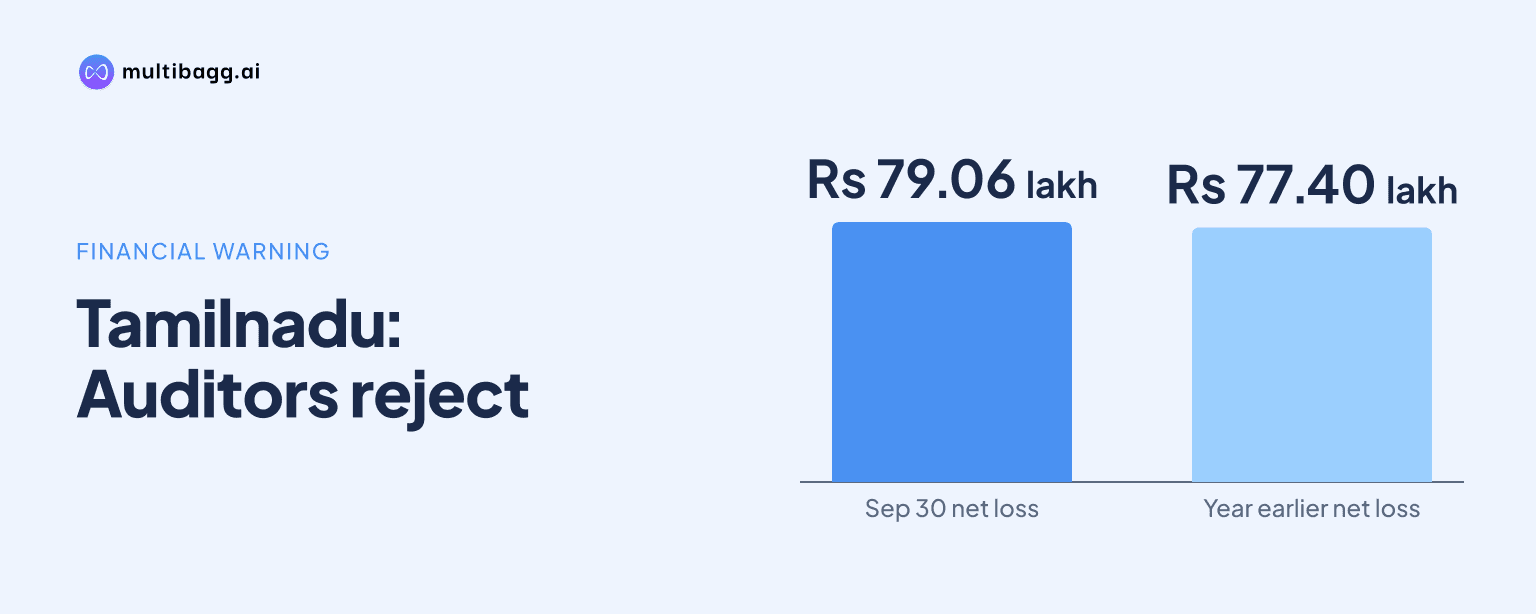
- TTL reported a half-year net loss of Rs 79.0566 lakh, compared with Rs 77.3978 lakh a year earlier.
powered by IRIS
Tamilnadu Telecommunications Limited received an adverse limited-review conclusion for the half year ended September 30, 2026, after auditors found its going-concern accounting basis inappropriate because the factory has been shut since 2017, the company had no new orders, and company disclosures reported accumulated losses of Rs 2.5812483 crore.
Know Tamil Nadu Telecommunications inside out
Results, valuation, peers and who's buying, in one view.
Why did TTL receive an adverse conclusion?
TTL received an adverse conclusion because Sundaram & Srinivasan concluded that management’s use of the going-concern basis was inappropriate for the financial statements at September 30, 2026. The auditors cited the inactive factory, no new orders, the cost of major machinery overhauls and a lack of supplier support for major manufacturing raw materials.
The review accompanied TTL’s unaudited standalone results for the quarter and half year ended September 30, 2026, which its board approved on November 13, 2026. The auditors said the interim financial information did not give a true and fair view of the company’s affairs at September 30 or its operating results and cash flows for the six-month period.
TTL’s factory has not operated since 2017, while the company’s notes specify that operations have been suspended since August 2017. The auditors said this prolonged shutdown, combined with no new orders to support a restart, created material uncertainty over TTL’s ability to continue as a going concern.
What losses and net worth did TTL disclose?
TTL disclosed accumulated losses of Rs 2.5812483 crore and negative net worth of Rs 2.0148443 crore as of September 30, 2026. The company said its accumulated losses had exceeded net worth during 2011-12, and it remained in a rehabilitation period under a scheme approved by the erstwhile Board for Industrial and Financial Reconstruction in 2010-11.
The audit report, however, describes accumulated losses as Rs 258.12 crore and negative net worth as Rs 201.48 crore. Those figures conflict with TTL’s own September 30, 2026 notes and statement of assets and liabilities, which are presented in Indian rupees in hundreds and support the lower amounts disclosed by the company.
TTL reported a net loss of Rs 79.0566 lakh for the half year ended September 30, 2026, compared with Rs 77.3978 lakh in the corresponding half year of 2025. Total income was Rs 0.025 lakh in the 2026 half year, compared with Rs 0.0376 lakh a year earlier, while total expenses increased to Rs 79.0816 lakh from Rs 77.4354 lakh.
How did TTL perform in the September 2026 quarter?
TTL reported a net loss of Rs 44.923 lakh for the quarter ended September 30, 2026, compared with a loss of Rs 42.9823 lakh in the September 2025 quarter. The loss was also higher than Rs 34.1336 lakh reported in the immediately preceding quarter ended June 30, 2026.
Employee-benefit expense was Rs 13.0573 lakh in the September 2026 quarter, up from Rs 4.069 lakh in the year-earlier quarter and Rs 3.5011 lakh in the June 2026 quarter. Finance cost was Rs 28.8483 lakh, marginally above Rs 28.6759 lakh in the September 2025 quarter.
TTL’s total assets were Rs 1.671315 crore at September 30, 2026, compared with Rs 1.670526 crore at March 31, 2026. Its paid-up equity share capital was Rs 45.6762 lakh at both dates, while total equity stood at negative Rs 2.0148443 crore at September 30, compared with negative Rs 1.9357878 crore at March 31.
Got a follow-up? Ask IRIS
What balance-sheet issues did the auditors identify?
TTL had not recognised specified financial balances at fair value under Indian Accounting Standard 109, or Ind AS 109, and the auditors said the impact on the unaudited results could not be ascertained. The review report lists net amounts due to Fujikura Limited of Rs 2.21 crore and trade receivables of Rs 4.70 crore.
TTL’s notes present different figures for the same balances, stating that Rs 2.21099 lakh was due to Fujikura Ltd and trade receivables were Rs 4.70414 lakh. The filing therefore contains an internal discrepancy, and neither the auditors nor TTL quantified the resulting effect on the September 30, 2026 financial statements.
TTL said it measured financial liabilities aggregating to Rs 1.8789492 crore at carrying value rather than discounting them to fair value. Management said the obligations, including amounts payable on demand to holding company Telecommunications Consultants India Limited, were current or short term and any fair-value restatement would be immaterial.
The auditors also highlighted that balances in debtors, creditors, advances and deposits, except those relating to Telecommunications Consultants India Limited, remained subject to confirmation as of September 30, 2026. TTL had also not carried out an actuarial valuation of gratuity and leave-encashment benefits under Indian Accounting Standard 19, or Ind AS 19.
What actions has TTL disclosed to revive operations?
TTL said it is exploring alternative revenue avenues, diversification in the cable industry and fresh investment partners to revive its Maraimalai Nagar factory and enter new business areas. Management also said it was hopeful of improving its order book, referring to optical fibre cable demand and anticipated support from Telecommunications Consultants India Limited and government sources.
The company issued a request for proposal on March 16, 2023 for a lease-cum-revenue-sharing arrangement for the Maraimalai Nagar manufacturing facility. TTL received one quote and accepted the bid, but Tamil Nadu Industrial Development Corporation directed it on October 10, 2023 not to proceed with the lease agreement, and the prospective lessee did not take over the factory.
TTL said the lease was cancelled and that it was continuing to examine other options. The auditors noted in their report dated November 13, 2026 that there had been no fresh development in the revival matters over the years, despite the company’s stated plans.
TTL used Rs 20.3597 lakh of cash in operating activities during the half year ended September 30, 2026. Borrowings during the same period were Rs 20.6919 lakh, and cash and cash equivalents increased to Rs 0.4098 lakh at period-end from Rs 0.0577 lakh at the beginning of the period.
Conclusion
The September 2026 filing shows that TTL’s auditors reached an adverse conclusion rather than simply drawing attention to a going-concern risk. Their conclusion was based on the factory’s shutdown since 2017, lack of executable orders, required overhaul costs, raw-material supply constraints and the company’s negative net worth at September 30, 2026.
The next disclosure to watch is whether TTL converts its exploration of diversification, revenue alternatives or investment partners into a defined arrangement. The 2023 factory lease plan was cancelled after the October 10, 2023 direction from Tamil Nadu Industrial Development Corporation, leaving a new operating or funding plan, fresh orders and a possible factory restart unresolved.